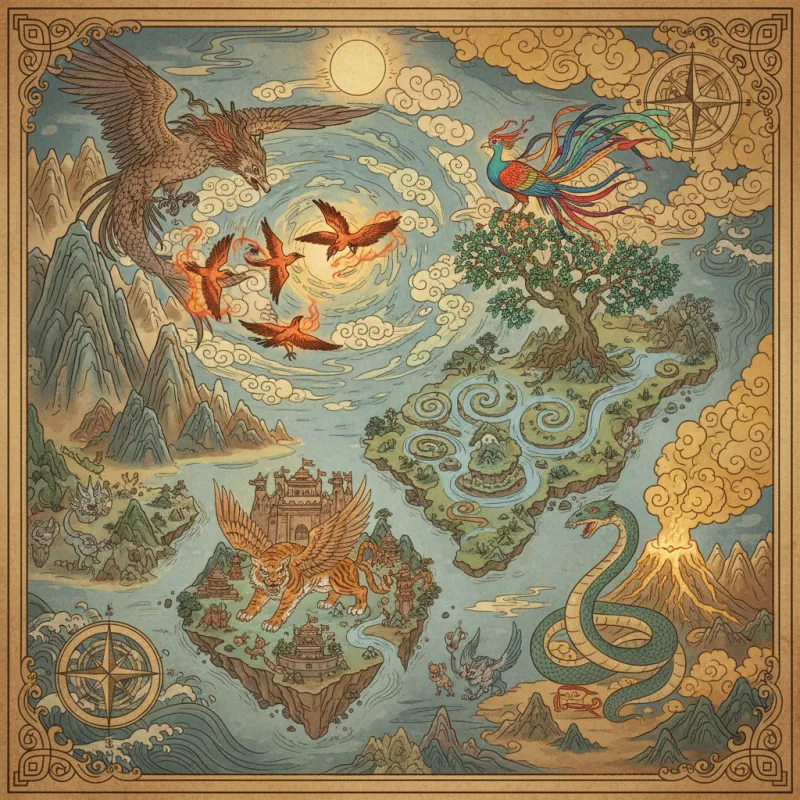
Picture this: you're standing at the edge of a mountain range that shouldn't exist, watching a bird with nine heads screech across a crimson sky, each beak singing a different prophecy. This isn't fever dream territory—it's Tuesday afternoon in the Shanhaijing 山海经 (Shānhǎijīng, Classic of Mountains and Seas). Compiled somewhere between the 4th century BCE and the early Han dynasty, this text doesn't just catalog mythical creatures. It maps an entire cosmology where birds aren't background decoration—they're omens, warnings, and occasionally, your worst nightmare with feathers.
When Birds Meant Business: The Shanhaijing's Avian Hierarchy
The Shanhaijing presents roughly 60 distinct bird species, and I use "species" loosely because we're talking about creatures that make the phoenix look pedestrian. These aren't the charming songbirds of Tang poetry. The text approaches birds with the clinical precision of a field guide written by someone who's seen things—terrible, wonderful things—and lived to document them.
Take the Jingwei 精卫 (Jīngwèi), probably the most famous bird in the entire compilation. According to the text, this creature was once Nüwa, the daughter of the Flame Emperor Yandi 炎帝 (Yándì), who drowned in the Eastern Sea. Transformed into a bird with a white beak and red claws, she spends eternity carrying twigs and pebbles to fill the ocean that killed her. It's futile, obsessive, and deeply human—which is precisely why the Jingwei became a cultural shorthand for determined perseverance against impossible odds. The phrase "Jingwei filling the sea" 精卫填海 (jīngwèi tián hǎi) still means exactly that in modern Chinese.
But here's what the sanitized retellings miss: the Shanhaijing doesn't present this as inspirational. The original text is matter-of-fact, almost cold. The bird exists. It does this thing. Moving on. That tonal restraint makes the mythology hit harder—these aren't morality tales dressed up with narrative flourish. They're observations from a world where the line between natural and supernatural was more permeable than we can comfortably imagine.
Geographic Impossibilities and the Birds That Inhabit Them
The Shanhaijing organizes its content geographically, dividing the known (and unknown) world into mountain ranges and seas. Each region hosts its own avian population, and the distribution patterns reveal something fascinating: the further you get from the Central Plains—the cultural heartland of ancient China—the weirder the birds become.
In the relatively tame Nanshan Jing 南山经 (Nánshān Jīng, Classic of the Southern Mountains), you'll find the Bifang 毕方 (Bìfāng), a one-legged crane-like bird with a blue body and red markings. Its appearance signals fire, which makes sense for a creature that's essentially a walking arson warning. The text notes it appears before major conflagrations, functioning as both omen and perhaps cause—the Shanhaijing rarely clarifies causation.
But venture into the Beishan Jing 北山经 (Běishān Jīng, Classic of the Northern Mountains), and you encounter the Qinyuan 钦原 (Qīnyuán), a bird that looks like a bee, roughly the size of a mandarin duck, and whose sting kills trees and people with equal efficiency. The text places it near Mount Tai, which is interesting because Mount Tai was (and is) one of China's most sacred mountains. The Shanhaijing doesn't shy away from putting nightmare fuel in holy places.
This geographic distribution isn't random. The text reflects the Warring States period's expanding geographic knowledge and the anxiety that came with it. As Chinese states pushed into new territories, they encountered unfamiliar ecosystems, peoples, and ideas. The Shanhaijing processes this expansion by populating frontier regions with increasingly exotic creatures. Birds become markers of distance—both physical and cultural—from the known world.
The Practical Magic of Mythical Birds
Here's what modern readers often miss: the Shanhaijing is fundamentally a practical text. It tells you what birds do, what they mean, and occasionally, what you should do about them. This isn't abstract mythology—it's applied cosmology.
The Zhenniao 鴆鸟 (Zhènniǎo), for instance, is a poisonous bird whose feathers, when dipped in wine, create a lethal toxin. The text doesn't moralize about this. It simply notes the fact, the way a modern field guide might mention that certain mushrooms are toxic. During the Han dynasty, zhenniao poison became synonymous with assassination by poisoned wine, appearing in historical records and court intrigue. The bird from the Shanhaijing became a murder weapon in the real world.
Similarly, the Shang Yang 商羊 (Shāngyáng), a one-legged bird that dances before rainstorms, served as a meteorological indicator. When you see this bird performing its distinctive hop-dance, you prepare for flooding. The Shanhaijing doesn't explain why the bird dances or how it knows rain is coming—it just documents the correlation. Ancient readers would have treated this information the same way we treat weather forecasts: useful data for planning.
This practical dimension connects to the broader function of mythical creatures in Chinese thought. Unlike Western mythology, which often uses monsters to represent moral lessons or psychological states, Chinese mythical creatures frequently serve as environmental indicators or geographic markers. The divine birds of Chinese mythology weren't just symbols—they were part of a complex system for understanding and navigating the world.
The Nine-Headed Birds and Other Nightmares
Let's talk about the Jiufeng 九凤 (Jiǔfèng), the nine-headed bird that appears in the Dahuang Beijing 大荒北经 (Dàhuāng Běijīng, Classic of the Great Northern Wilderness). Each head has a human face. It appears in the northern wilderness, a region the text describes with barely contained dread. The Shanhaijing offers no explanation for why this creature exists or what it wants, which somehow makes it more unsettling than if it came with a detailed backstory.
The nine-headed motif appears repeatedly in the Shanhaijing—there's also a nine-headed snake and a nine-tailed fox. The number nine (jiu 九) carries significance in Chinese numerology as the highest single-digit number, representing completeness and extremity. A nine-headed bird isn't just weird—it's maximally weird, pushed to the absolute limit of what a bird can be while still being recognizable as avian.
Compare this to the Chongming Niao 重明鸟 (Chóngmíng Niǎo), the "double-brightness bird" with two pupils in each eye. It appears once every few years, and its arrival brings peace and prosperity. The text describes it as resembling a rooster, which grounds the fantastic in the familiar—a common technique in the Shanhaijing. You start with something recognizable (rooster) and add the impossible (four pupils total), creating creatures that feel almost plausible.
This range—from the relatively benign Chongming Niao to the nightmare fuel of Jiufeng—reveals the Shanhaijing's sophisticated understanding of the uncanny. The text knows that true strangeness comes from distortion of the familiar, not complete invention. Every mythical bird retains enough recognizable avian characteristics to register as "bird" while violating enough expectations to become "other."
Birds as Boundary Markers Between Worlds
The Shanhaijing uses birds to mark transitions between different types of space—not just geographic regions, but ontological zones where different rules apply. The Fenghuang 凤凰 (Fènghuáng), often translated as "phoenix" but more accurately rendered as a composite of male feng and female huang, appears in the Nanshan Jing on Mount Danxue. Its appearance signals a period of peace and prosperity, but more fundamentally, it marks a place where the celestial and terrestrial realms intersect.
The text describes the Fenghuang with meticulous detail: the head of a rooster, the neck of a snake, the chin of a swallow, the back of a turtle, and the tail of a fish. This composite nature isn't random—it represents the harmonious integration of different elements and creatures. The Fenghuang doesn't just symbolize peace; it embodies the cosmic order that makes peace possible. When this bird appears, you're standing in a place where the normal rules are suspended, where heaven touches earth.
This function—birds as markers of liminal space—explains why so many Shanhaijing birds appear in mountains. Mountains were (and remain) sacred spaces in Chinese cosmology, places where humans could access the divine. The mythical creatures of sacred mountains weren't decorative elements but essential components of these spaces' spiritual geography.
Reading the Shanhaijing Today: What We Gain and Lose
Modern readers approach the Shanhaijing with a fundamental disadvantage: we've been trained to read mythology as metaphor. We want these birds to "mean" something beyond themselves—to represent psychological states, moral lessons, or cultural values. And sure, you can read them that way. The Jingwei becomes perseverance, the Bifang becomes disaster preparedness, the Fenghuang becomes harmony.
But this interpretive reflex causes us to miss what the original compilers were doing. The Shanhaijing presents itself as a geographic and natural history text, not a collection of fables. Its birds exist in the same register as its mountains, rivers, and minerals. They're part of the world's furniture, not symbols pointing beyond themselves.
This matters because it reveals a fundamentally different relationship to the natural world. The Shanhaijing doesn't draw a hard line between "real" and "mythical" creatures. A nine-headed bird and a regular sparrow both inhabit the same ontological category: things that exist in the world. The nine-headed bird is stranger, certainly, and appears in more remote locations, but it's not fundamentally different in kind.
This worldview—where the mythical and mundane exist on a continuum rather than in separate categories—shaped Chinese culture for millennia. It's why Chinese literature seamlessly integrates supernatural elements into otherwise realistic narratives. It's why traditional Chinese medicine includes ingredients from mythical creatures alongside herbs and minerals. The Shanhaijing established a template for understanding reality as more expansive and stranger than our modern categories allow.
The Enduring Flight of Shanhaijing Birds
Walk through any Chinese art museum, and you'll see them: birds with too many heads, birds with human faces, birds that shouldn't be able to fly but do anyway. The Shanhaijing birds escaped their original text centuries ago and colonized Chinese visual culture, literature, and popular imagination. They appear in Tang dynasty poetry, Ming dynasty paintings, and contemporary fantasy novels. The Jingwei shows up in video games. The Bifang appears in modern environmental disaster films as a metaphor for climate change.
This persistence suggests these birds fulfill some ongoing cultural need. Maybe they remind us that the world is stranger than our categories suggest. Maybe they preserve a sense of wonder that purely rational frameworks can't accommodate. Or maybe they're just really cool, and humans have always loved imagining impossible creatures taking flight.
The Shanhaijing doesn't explain why its birds matter. It just presents them, one after another, in that flat, observational tone that makes them feel more real than elaborate mythological narratives ever could. These birds exist. They do these things. They appear in these places. That's all you need to know—and somehow, it's everything.
Related Reading
- Enigmatic Birds of the Shanhaijing: Myths, Legends, and Significance
- Hetu and Luoshu: The Cosmic Diagrams
- Unraveling the Mysteries of Shanhaijing: Mythical Creatures and Enigmatic Lands
- Exploring Shanhaijing: Mythical Creatures and Ancient Lands of Chinese Cosmology