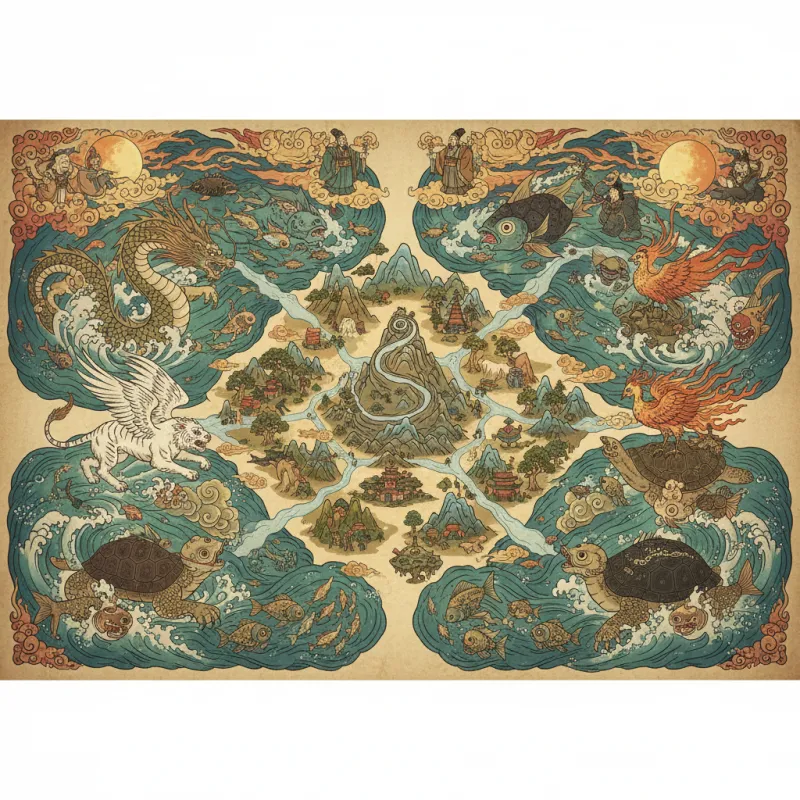
The ancient Chinese cartographers had a problem: the further their explorers traveled from the Yellow River valley, the stranger their reports became. Three-headed people. Mountains that touched the sky. Trees that bore pearls instead of fruit. Rather than dismiss these accounts as fantasy, the compilers of the Shanhai Jing (山海经 Shānhǎi Jīng, "Classic of Mountains and Seas") did something remarkable — they mapped them. The result is a geography that doesn't distinguish between the real and the mythical, because in the ancient Chinese worldview, both occupied the same continuous space. You didn't cross a border from reality into myth. You just kept walking.
The Architecture of the Ancient World
The cosmos described in the Shanhai Jing operates on a nested logic of concentric zones radiating outward from a civilized center. At the heart sits Zhongguo (中国 Zhōngguó), the "Middle Kingdom" — not yet a name for China as a nation, but a cosmological statement about humanity's place in the universe. This is where the Zhou kings ruled, where rituals were performed correctly, where the calendar aligned with heaven's movements.
Surrounding this center, the text describes the Hainei (海内 hǎinèi), literally "within the seas" — the known world of Chinese civilization and its immediate neighbors. Then come the four seas themselves, and beyond them, the Haiwai (海外 hǎiwài, "beyond the seas"), where geography begins to blur into mythology. Finally, at the uttermost edges, lie the Dahuang (大荒 Dàhuāng), the "Great Wilderness" regions, where the normal rules of nature no longer apply.
This isn't just poetic geography. It's a philosophical statement: civilization exists at the center, and chaos increases with distance. The further you travel from the ritual center, the more the world unravels into strangeness.
The Four Seas: Boundaries That Aren't Quite Boundaries
Here's where it gets interesting: the "four seas" (四海 sìhǎi) aren't oceans in the way we'd recognize them. The Shanhai Jing describes them as vast bodies of water marking the cardinal directions — the Eastern Sea (东海 Dōnghǎi), Southern Sea (南海 Nánhǎi), Western Sea (西海 Xīhǎi), and Northern Sea (北海 Běihǎi). But their exact nature remains deliberately ambiguous. Are they separate seas or parts of one continuous ocean encircling the world? The text never quite says.
What's clear is their function: they mark the boundary between the comprehensible and the incomprehensible. Within the seas, you might encounter strange customs or unfamiliar animals, but the world still makes sense. Beyond them, you enter territories where a country might be populated entirely by people with holes through their chests, or where the sun and moon rise from the same mountain.
The Eastern Sea receives the most attention in the text, probably because it corresponded to actual maritime exploration along China's coast. It's described as containing various islands, including Penglai (蓬莱 Pénglái), the legendary home of immortals — a myth that would later send Emperor Qin Shi Huang's ships searching for the elixir of eternal life. The other three seas are hazier, their descriptions mixing real geographical features with increasingly fantastical elements.
Beyond the Horizon: The Haiwai Regions
Cross the seas and you enter the Haiwai, where the Shanhai Jing's descriptions shift from "unusual" to "impossible." This is where we meet the Junzi Guo (君子国 Jūnzǐ Guó, "Country of Gentlemen"), whose inhabitants are so refined they never argue, and the Nvzi Guo (女子国 Nǚzǐ Guó, "Country of Women"), where men are absent entirely. We encounter the Changren (长人 Chángrén, "Long People"), who stand thirty feet tall, and the Xiaoren (小人 Xiǎorén, "Small People"), who barely reach your knee.
These aren't meant as literal ethnographic reports — or are they? The genius of the Shanhai Jing is its refusal to signal which descriptions are metaphorical and which are observational. A passage might describe a real mountain range, then casually mention that it's guarded by a nine-tailed fox, with the same matter-of-fact tone throughout. The text treats mythical creatures and foreign peoples with equal documentary seriousness.
The Haiwai sections also introduce us to inverted or distorted versions of Chinese civilization. There are kingdoms with their own rulers and rituals, but everything is slightly wrong — people might have the heads of animals, or their countries might be oriented in impossible directions. It's as if the further you travel, the more reality becomes a funhouse mirror of the center.
The Great Wilderness: Where Geography Becomes Cosmology
At the outermost edges lie the Dahuang regions, and here the Shanhai Jing abandons any pretense of conventional geography. These are the places where the sky meets the earth, where the sun rises and sets, where the pillars that hold up heaven are located. This is where you find Buzhou Mountain (不周山 Bùzhōu Shān), which the god Gonggong once smashed with his head, causing the sky to tilt — explaining why rivers in China flow southeast.
The Great Wilderness is populated by gods, not just strange humans. Here lives Xihe (羲和 Xīhé), who bathes the ten suns before they rise. Here you'll find the Fusang tree (扶桑 Fúsāng), from which the sun emerges each morning. The geography of these regions is cosmological — these aren't places you could reach by walking far enough. They're the machinery of the universe made spatial.
What's fascinating is that the text never explicitly says you've crossed from geography into cosmology. There's no warning label reading "beyond this point, we're talking about myth." The Dahuang regions are described with the same systematic directional organization as the inner zones. East, south, west, north — the structure holds even when describing the impossible.
The Shape of the World: Square Earth, Round Heaven
Underlying all of this is a specific cosmological model: the earth is square (or at least squarish), and heaven is round. This isn't just metaphor — it's reflected in everything from the shape of ritual vessels to the layout of cities. The emperor's capital was ideally square, aligned with the cardinal directions, a microcosm of the earth itself. Heaven, being round, rotates above this square earth, which is why the stars circle the pole.
The four seas, then, aren't just geographical features. They're part of the cosmic architecture, marking the edges of the square earth. Beyond them, you're not just in foreign territory — you're approaching the places where earth meets heaven, where the normal rules of space and time break down.
This model persisted for centuries. Even as Chinese explorers traveled further and encountered more of the real world, the conceptual framework remained. The Shanhai Jing wasn't updated with new discoveries; it was treated as a complete description of a cosmos that included both the mundane and the marvelous.
Reading the Map: What the Shanhai Jing Actually Tells Us
Modern scholars have spent decades trying to match the Shanhai Jing's descriptions to real places. Some identifications are convincing — certain mountain ranges and rivers clearly correspond to actual geography. Others are hopeless — there's no way to locate the Country of People with Holes in Their Chests on any real map.
But this might be missing the point. The Shanhai Jing isn't a failed atlas. It's a successful cosmography — a description of how the world was understood to be organized, not just physically but morally and metaphysically. The increasing strangeness as you move outward isn't a bug; it's the feature. It encodes a worldview in which civilization and cosmic order are the same thing, and both diminish with distance from the center.
The text also reveals something about how ancient Chinese culture processed information about foreign lands. Rather than creating separate categories for "real places" and "mythical places," everything got incorporated into one continuous geography. The result is a world that's simultaneously more unified and more strange than our modern division between fact and fiction allows.
The Legacy: Four Seas in Chinese Thought
The concept of the four seas became deeply embedded in Chinese language and thought. "Within the four seas" (四海之内 sìhǎi zhī nèi) became a classical phrase meaning "everywhere in the civilized world." To say someone was famous "within the four seas" meant they were universally known. The phrase "all within the four seas are brothers" (四海之内皆兄弟 sìhǎi zhī nèi jiē xiōngdì) expressed a cosmopolitan ideal of universal human kinship.
But the phrase also carried an implicit boundary. Brotherhood within the four seas didn't necessarily extend to what lay beyond them. The strange peoples and creatures of the outer regions remained fundamentally other, fascinating but not quite fully human. The geography of the Shanhai Jing thus encoded both an expansive worldview — the world is vast and full of wonders — and a limiting one — but there's a clear center, and we're standing in it.
This tension between curiosity about the distant and certainty about the center runs throughout Chinese engagement with the wider world for centuries. The Shanhai Jing is its founding document, a text that simultaneously opens the world to exploration and defines the terms on which that exploration will be understood. The map it draws isn't accurate, but it's true — true to how a civilization understood its place in a cosmos that was both larger and stranger than any modern map can capture.
Related Reading
- Kunlun Mountain: The Paradise of Immortals
- The Fusang Tree: Where Ten Suns Rest
- Kunlun Mountain: Where Heaven Meets Earth in Chinese Mythology
- Weak Water: The River Nothing Can Cross
- The Geography of the Shanhaijing: Mapping a World That Does Not Exist
- The Enigmatic Fish of Shanhaijing: Mythical Creatures of Chinese Lore
- Exploring the Enigmatic Mountains and Creatures of the Shanhaijing
- Exploring the Enigmatic Creatures and Lands of Shanhaijing: A Cultural Journey