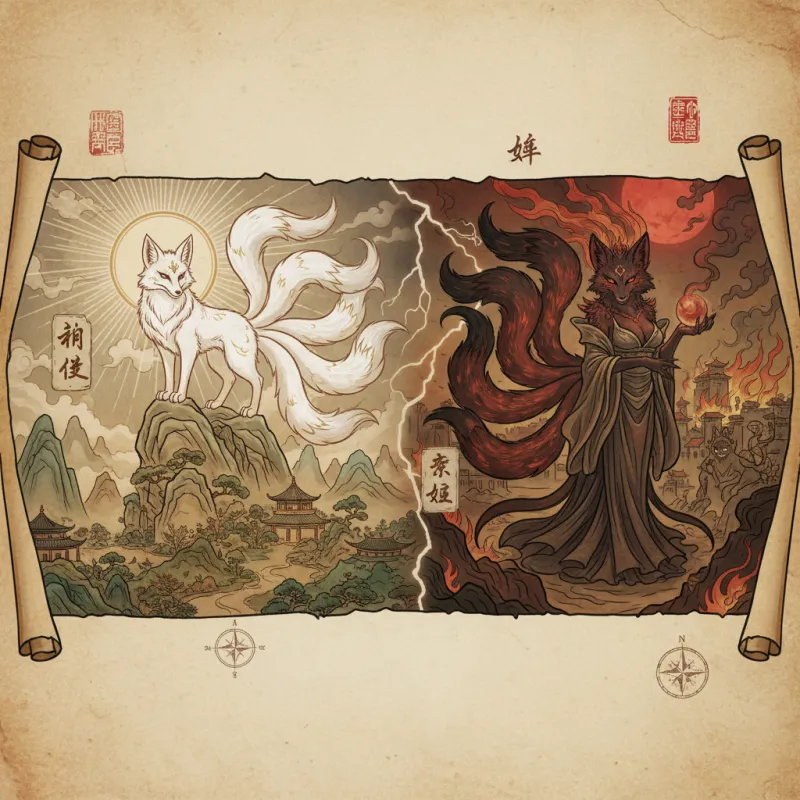
A white fox with nine tails appears in the court of King Yu the Great, and the ministers rejoice. The same creature shows up in a Tang Dynasty tale, and scholars recoil in horror. What happened in the centuries between? The nine-tailed fox (九尾狐, jiǔwěi hú) underwent one of the most dramatic transformations in Chinese mythology — from celestial messenger to demonic seductress, from symbol of dynastic legitimacy to cautionary tale about female power.
The Auspicious Beast of Green Hill
The Classic of Mountains and Seas (Shanhaijing, 山海经) describes the nine-tailed fox with characteristic brevity: it dwells on Green Hill Mountain (青丘山, Qīngqiū Shān), resembles a fox with nine tails, makes a sound like an infant crying, devours humans, and whoever sees it will be protected from poison. This last detail is crucial — the text explicitly marks the creature as auspicious (祥瑞, xiángruì).
Modern readers stumble over this contradiction. A man-eating monster as a good omen? But the Shanhaijing operates on different logic. Power is morally neutral. A nine-tailed fox signals that the land is saturated with spiritual energy (灵气, língqì), which benefits the region even if the creature itself is dangerous. It's like finding uranium deposits — valuable and hazardous simultaneously.
The Han Dynasty (206 BCE – 220 CE) made this symbolism explicit. The nine-tailed fox appeared on stone carvings alongside the Queen Mother of the West (西王母, Xī Wángmǔ), that supreme goddess who ruled the western paradise. In the Baihutong (白虎通), a Han philosophical text, the nine-tailed fox is listed among the auspicious beasts that appear when a sage king rules with virtue. The subtext is clear: this fox doesn't just predict good fortune — it validates political power.
The Fox as Divine Matchmaker
Here's where it gets interesting. The Wuyue Chunqiu (吴越春秋), a Han Dynasty text, tells us that when King Yu was struggling to control the Great Flood, a white nine-tailed fox appeared before him. An old man interpreted this as a sign that Yu should marry and produce heirs. Yu subsequently married a woman from the Tushan clan (涂山氏, Túshān shì), and their son Qi founded the Xia Dynasty.
This story reveals the fox's role as a divine intermediary between heaven and earth, specifically in matters of dynastic succession. The nine tails themselves may represent the nine provinces of ancient China — a creature embodying territorial completeness. When such a fox appears, it's heaven's way of saying: this ruler has the mandate to unite the realm.
The association with marriage and fertility persisted for centuries. Fox imagery appeared on Han Dynasty bronze mirrors given as wedding gifts. The creature's multiple tails suggested abundant offspring, while its connection to King Yu linked marriage to cosmic order and political legitimacy.
The Turning Point: Buddhism and Foreign Foxes
The nine-tailed fox's reputation began to curdle during the Tang Dynasty (618–907 CE). Two factors converged: the spread of Buddhism, which viewed foxes as trickster spirits capable of possession, and increased cultural exchange with India and Central Asia, where fox spirits had more sinister associations.
Buddhist texts introduced the concept of fox spirits (狐狸精, húlijīng) as beings who cultivated magical powers through absorbing human essence, particularly sexual energy. This was a radical departure from the earlier view. The fox was no longer a celestial messenger but a spiritual parasite.
The Youyang Zazu (酉阳杂俎), a Tang collection of strange tales, includes stories of foxes transforming into beautiful women to seduce scholars. Notably, these are not yet nine-tailed foxes — the transformation from auspicious beast to seductress happened gradually, with the nine-tailed variant initially maintaining its positive associations while ordinary foxes acquired negative ones.
Daji and the Weaponization of Fox Mythology
The final nail in the nine-tailed fox's coffin was the Fengshen Yanyi (封神演义, Investiture of the Gods), a Ming Dynasty (1368–1644) novel that retroactively inserted fox spirits into ancient history. In this version, the infamous Daji (妲己), concubine of the tyrant King Zhou of Shang, is actually a thousand-year-old nine-tailed fox spirit who possessed a human woman's body.
This was pure invention. Earlier sources describe Daji as simply a beautiful and cruel woman. The Fengshen Yanyi transformed her into a literal demon, and in doing so, weaponized the nine-tailed fox as a symbol of female sexuality destroying male virtue and toppling dynasties.
The novel's influence was enormous. It crystallized the association between nine-tailed foxes and dangerous women, particularly those who wielded sexual power over rulers. The subtext is misogynistic but politically useful: when dynasties fall, blame the woman, and better yet, claim she wasn't even human.
This narrative pattern appears repeatedly in Chinese history. Whenever a dynasty collapsed and historians looked for scapegoats, beautiful consorts were accused of bewitching the emperor. The nine-tailed fox mythology provided a supernatural explanation for what was really political and economic failure.
The Fox in Modern Media
Contemporary Chinese, Korean, and Japanese media have partially rehabilitated the nine-tailed fox, though the creature remains morally ambiguous. In the video game League of Legends, Ahri is a nine-tailed fox spirit who struggles with her predatory nature. The 2020 Chinese drama The Legend of Hao Lan features fox spirits as complex characters rather than pure villains.
What's fascinating is how modern retellings often try to reclaim the fox's original positive symbolism while acknowledging the seductress narrative. These stories ask: what if the fox was framed? What if the real monsters were the men who feared female power?
The Korean gumiho (구미호) tradition offers an interesting parallel. Korean nine-tailed foxes must eat human livers to survive, yet recent K-dramas like My Girlfriend is a Gumiho portray them sympathetically, as beings trapped between human and animal nature. This suggests a broader cultural renegotiation of what the nine-tailed fox represents.
What the Fox Reveals About Power
The nine-tailed fox's transformation mirrors changing attitudes toward power itself. In the Shanhaijing, power is natural and amoral — a force that simply exists. By the Ming Dynasty, power (especially female power) had become something that needed moral justification or condemnation.
The fox's journey from divine messenger to demonic seductress wasn't random. It reflects specific historical anxieties: about foreign influence during the Tang, about female political power during the Ming, about the boundaries between human and animal, civilization and wilderness.
When you see a nine-tailed fox in contemporary media, you're looking at thousands of years of cultural negotiation compressed into a single image. Is it the auspicious beast that appeared before King Yu? The Buddhist trickster spirit? Daji the dynasty-destroyer? The answer is all of the above, layered like geological strata.
The nine-tailed fox endures because it's useful — a shape-shifting symbol that each era can remake according to its needs. Perhaps that's the real magic: not the fox's ability to transform its body, but its ability to transform its meaning while remaining recognizably itself. In that sense, the nine-tailed fox is doing exactly what the Shanhaijing said it would: appearing as an omen, reflecting back whatever truth we're ready to see.
For more on divine beasts and their symbolism, see The Dragon Kings: Masters of Water and Weather and Phoenix and Vermillion Bird: One Myth or Two?. The transformation of mythical creatures often parallels shifts in political power, as explored in The Four Symbols: Guardians of the Directions.
Related Reading
- The Four Symbols: Azure Dragon, White Tiger, Vermillion Bird & Black Tortoise
- The Qilin: China's Sacred Unicorn and Divine Messenger
- Fenghuang: The Chinese Phoenix and Its True Meaning
- Chinese Dragons: Everything You Need to Know
- Divine Beasts of the Shanhaijing: The Four Guardians and Beyond
- Magical Artifacts of the Shanhaijing
- Chinese Dragons vs European Dragons
- Bifang: The Fire Bird That Brings Disaster