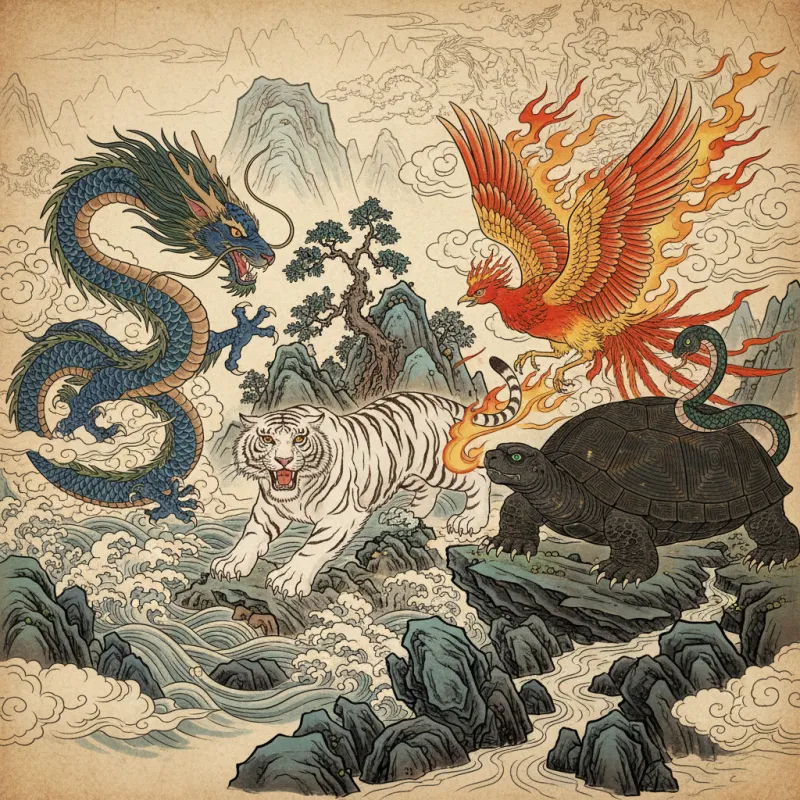
Four colossal beasts stand at the edges of the world, each one holding up a corner of reality itself. They don't just guard directions — they are the directions. Without them, the cosmos would collapse into chaos. The ancient Chinese didn't invent the Siling (四灵 Sìlíng) as decorative symbols or poetic metaphors. They mapped them onto everything: architecture, military formations, burial sites, even the human body. These creatures were the operating system of an entire civilization.
The Cosmic Quadrant System
The Four Guardian Beasts — Azure Dragon, White Tiger, Vermilion Bird, and Black Tortoise — represent the most sophisticated attempt in ancient Chinese thought to organize the universe into a comprehensible structure. Unlike the chaotic menagerie of creatures in the Shanhaijing, these four operate as a unified system. They're not random monsters wandering through mountains. They're fixed points in a cosmic grid.
Each guardian corresponds to a cardinal direction, a season, an element, a color, and a constellation cluster. The Han Dynasty astronomer Sima Qian documented this system in the Records of the Grand Historian (circa 109-91 BCE), but the concept predates him by centuries. Archaeological evidence from Warring States period tombs (475-221 BCE) shows these four creatures already positioned around burial chambers, suggesting their role as cosmic protectors was well-established.
Azure Dragon: The Eastern Awakening
The Azure Dragon (青龙 Qīnglóng) rules the east, where the sun rises and spring begins. Its element is wood — not the dead timber of construction, but living, growing, explosive vegetation. The dragon's color, qing (青), doesn't translate neatly to "azure" or "blue." It's the color of new bamboo shoots, jade, and the sky just before dawn. It's the color of potential energy.
In Chinese astronomy, the Azure Dragon isn't a single constellation but seven: Horn, Neck, Root, Room, Heart, Tail, and Winnowing Basket. These star groups stretch across the eastern sky, forming what ancient observers saw as a massive serpentine body. The Heart constellation (心宿 Xīn Xiù), containing the red supergiant Antares, was considered the dragon's vital organ — when it appeared on the eastern horizon at dusk, farmers knew spring planting season had arrived.
The dragon's association with water and rain made it essential for agricultural societies. Unlike the destructive flood dragons that terrorized river valleys, the Azure Dragon brought controlled, life-giving moisture. Emperors performed rain-summoning rituals facing east, appealing directly to this guardian's authority over weather patterns.
White Tiger: The Western Executioner
The White Tiger (白虎 Báihǔ) guards the west, where the sun dies each evening. Its element is metal — specifically, the metal of weapons and warfare. This isn't a cuddly tiger. It's an apex predator associated with autumn, harvest, and death. The ancient Chinese understood that autumn's beauty comes from decay, and the White Tiger embodied that paradox.
The tiger's white color signified mourning and the afterlife. In Han Dynasty military formations, the right flank (corresponding to the west) was called the White Tiger position and considered the most aggressive, offensive wing. Generals who commanded this flank were expected to be ruthless.
Seven western constellations form the White Tiger: Legs, Bond, Stomach, Hairy Head, Net, Turtle Beak, and Three Stars. When these appeared in the western sky at dusk during autumn, it signaled harvest time — the season of cutting down what had grown, storing grain, and preparing for winter's scarcity.
The White Tiger's role as psychopomp — a guide for souls — appears in countless tomb murals. It doesn't gently escort the dead; it hunts and captures wandering spirits, forcing them toward their proper destination in the afterlife. This aggressive guardianship made the White Tiger both protector and threat.
Vermilion Bird: The Southern Flame
The Vermilion Bird (朱雀 Zhūquè) presides over the south and summer's peak heat. Its element is fire, its color the deep red of cinnabar and blood. This creature causes endless confusion because it's often mistranslated as "phoenix," but the Vermilion Bird and the phoenix (凤凰 fènghuáng) are completely different entities in Chinese mythology.
The phoenix is a solitary, auspicious bird associated with empresses and marital harmony. The Vermilion Bird is a cosmic guardian, one-fourth of the universal structure. It doesn't die and resurrect. It simply burns, eternally, in the southern sky.
Seven southern constellations comprise the Vermilion Bird: Well, Ghost, Willow, Star, Extended Net, Wings, and Chariot. Ancient astronomers saw these as forming a bird in flight, wings spread across the summer sky. The Ghost constellation (鬼宿 Guǐ Xiù) was particularly ominous — it contained a star cluster that looked like a gathering of spirits, reinforcing the south's association with heat, fever, and death by fire.
Summer was the season of maximum yang energy, when the sun reached its highest point and crops grew fastest. The Vermilion Bird channeled this explosive energy, but also threatened to burn everything to ash if not properly balanced by the other guardians.
Black Tortoise: The Northern Fortress
The Black Tortoise (玄武 Xuánwǔ) guards the north, winter's domain. But here's where things get interesting: this isn't just a tortoise. It's a tortoise entwined with a snake, two creatures locked in either combat or cooperation — sources disagree. The name Xuanwu literally means "dark warrior" or "mysterious martial," suggesting military strength hidden in defensive posture.
The element is water, specifically the deep, still water of winter ice and underground springs. The color xuan (玄) means black, but also profound, mysterious, and ancient — the color of the night sky and the depths of the ocean.
Seven northern constellations form the Black Tortoise: Dipper, Ox, Girl, Emptiness, Rooftop, Encampment, and Wall. These stars wheel around the celestial north pole, never setting below the horizon in northern China. This eternal presence made the Black Tortoise the most stable, unchanging guardian — the cosmic anchor point.
The tortoise-snake combination represents the union of yin and yang, hard and soft, defensive shell and striking fangs. In Daoist internal alchemy, practitioners visualized the Black Tortoise in their lower abdomen, believing it governed kidney energy and sexual vitality. The creature's association with longevity made it a popular symbol in medicine and life-extension practices.
The System in Practice
These weren't abstract philosophical concepts. The Four Guardians shaped physical reality. The Han Dynasty capital Chang'an (modern Xi'an) was laid out according to their positions, with gates named after each guardian. The Azure Dragon Gate faced east, the White Tiger Gate west, and so on. Military camps followed the same pattern — the commanding general's tent at the center, with four divisions arranged around him like the guardians around the pole star.
Tomb architecture took this even further. Excavations of Han and Tang Dynasty tombs reveal elaborate murals showing all four guardians positioned on the appropriate walls. The deceased lay at the center, protected by the same cosmic forces that organized the universe. Some tombs include ceramic figurines of the guardians, positioned as sentries against malevolent spirits.
The system extended to medicine. Traditional Chinese medical texts describe the four guardians as governing different organ systems and energy channels in the body. The Azure Dragon relates to the liver and gallbladder (wood organs), the Vermilion Bird to the heart and small intestine (fire organs), the White Tiger to the lungs and large intestine (metal organs), and the Black Tortoise to the kidneys and bladder (water organs).
Beyond the Four
The Siling system sometimes includes a fifth guardian: the Yellow Dragon (黄龙 Huánglóng) or Qilin (麒麟 qílín) at the center, representing earth and the emperor's position at the axis of the world. But this fifth member never achieved the same universal acceptance as the original four. The quadrant system was too elegant, too balanced, to need a fifth wheel.
What makes the Four Guardians remarkable isn't their individual power — the Shanhaijing describes plenty of creatures with devastating abilities. It's their systematic integration into every aspect of Chinese civilization. They're not characters in stories. They're the framework that makes stories possible, the invisible architecture supporting an entire worldview.
Stand in the center of an ancient Chinese city, a tomb, or a temple, and you're standing where the ancients believed the four corners of reality converged. The guardians are still there, holding up the sky, marking the seasons, maintaining the cosmic order. They've been doing it for over two thousand years. They'll keep doing it long after we're gone.
Related Reading
- The Nine-Tailed Fox: From Divine Beast to Demonic Seductress
- Half-Human Half-Beast: The Strangest Creatures of Shanhaijing
- Human-Animal Hybrids in the Shanhai Jing: Gods with Beast Features
- Hybrid Beings of the Shanhaijing: When Animals Merge
- The Nine-Headed Bird: Terror of the Skies
- Weak Water: The River Nothing Can Cross
- The Feathered People: Winged Humans of the Shanhai Jing