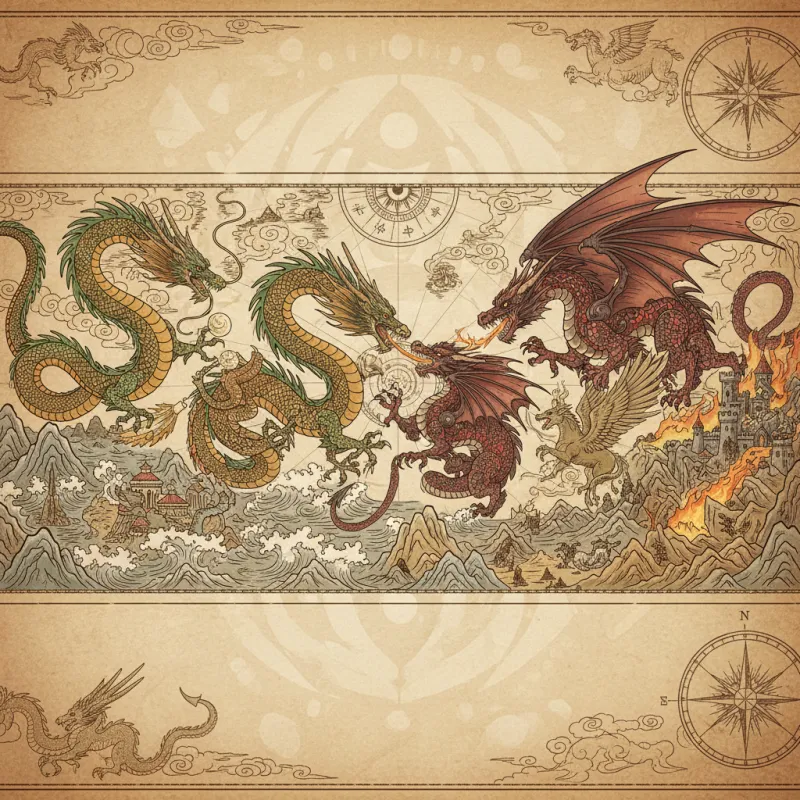
A child in Beijing draws a dragon: sinuous body, antler horns, pearl under its chin, four clawed feet, whiskers trailing like silk. A child in London draws a dragon: massive wings, scales like armor, fire pouring from its jaws, a mountain of gold beneath its belly. Show these drawings to their respective cultures, and each will nod in recognition. Show them to each other, and they'll ask: "What is that supposed to be?"
The English language committed an act of translation violence when it decided both creatures should share the same word. The Chinese lóng (龙) and the European dragon aren't distant cousins — they're not even the same species. They emerged from completely different mythological ecosystems, serve opposite symbolic functions, and embody contradictory values. Calling them both "dragons" is like calling both whales and sharks "fish" because they live in water.
The Body Problem: Anatomy of Two Myths
The Chinese dragon is a composite creature, and the texts are specific about this. The Shuowen Jiezi (说文解字), compiled around 100 CE, describes the lóng as having "the head of a camel, horns of a deer, eyes of a rabbit, ears of a cow, neck of a snake, belly of a frog, scales of a carp, claws of an eagle, and paws of a tiger." This isn't random. Each component carries symbolic weight — the deer's horns suggest longevity, the carp's scales connect to transformation and perseverance.
European dragons, by contrast, are reptilian through and through. Medieval bestiaries describe them as enormous serpents or lizards, often with bat-like wings. The Physiologus, a second-century Greek text that influenced European dragon lore for over a millennium, emphasizes their serpentine nature. When wings appear — and they don't always — they're functional, leathery, built for flight. The dragon in Beowulf flies to its hoard. Smaug soars over Lake-town. These are predators designed by nightmare.
The Chinese dragon rarely has wings, yet it flies anyway. How? Through mastery of clouds and mist. The Huainanzi (淮南子), a second-century BCE philosophical text, explains that dragons "ride the clouds and mist" — they don't need wings because they command the air itself. When wings do appear in Chinese dragon imagery, they're often decorative, added during periods of cultural exchange with the West or with Buddhist iconography from India.
Size matters too, but differently. European dragons are big in the way a castle is big — solid, physical, occupying space. Fafnir in Norse mythology is so large his body forms a mountain. Chinese dragons are big in the way weather is big. They can shrink to the size of a silkworm or expand to fill the space between heaven and earth. The Zhuangzi (庄子) describes dragons that "coil up smaller than a cocoon or stretch out to fill the cosmos." They're not bound by physical laws because they're not entirely physical beings.
Power and Purpose: What Dragons Actually Do
Here's where the divergence becomes philosophical. European dragons hoard. Chinese dragons provide.
The European dragon's relationship with treasure is almost pathological. Fafnir murders his father for gold and transforms into a dragon through his greed. Smaug's entire existence revolves around his hoard — he knows every cup, every coin. The dragon in Beowulf devastates an entire kingdom because someone stole a single goblet. These creatures don't use their wealth; they sit on it, sleep on it, kill for it. The treasure is cursed, and the dragon is the curse made flesh.
Chinese dragons control water. This isn't a minor detail — it's their primary function. In an agricultural society dependent on rivers and rainfall, the dragon's power over water made it the most important supernatural force in daily life. The Shanhaijing (山海经, Classic of Mountains and Seas) describes numerous dragons associated with specific rivers and lakes. The Dragon Kings (龙王, lóng wáng) of the four seas appear throughout Chinese literature, from the Fengshen Yanyi to Journey to the West, as bureaucratic administrators of precipitation and flood control.
When a Chinese dragon fails at its job, the consequences are catastrophic — but the failure is usually moral, not malicious. In the Journey to the West, the Dragon King of the Jing River is executed for causing a drought because he disobeyed Heaven's rainfall schedule. He wasn't evil; he made a bureaucratic error. European dragons don't make errors — they make choices, and those choices are almost always destructive.
Moral Alignment: Heroes and Villains
Every European hero worth his salt kills a dragon. Saint George, Sigurd, Beowulf, Tristan — the dragon-slayer is a foundational archetype of Western heroism. The dragon represents chaos, greed, paganism, the devil himself. Killing it is always righteous. The Golden Legend, a thirteenth-century collection of saints' lives, presents dragon-slaying as a metaphor for conquering sin.
In Chinese tradition, killing a dragon is usually a disaster. When Yu the Great (大禹, Dà Yǔ) was controlling the floods that threatened to destroy civilization, he didn't fight dragons — he worked with them. Dragons helped him dredge rivers and create channels. The Yellow Emperor (黄帝, Huángdì) rode dragons. The legendary emperors Yao and Shun consulted with dragons. Even in stories where dragons cause problems, the solution is typically negotiation, appeasement, or correction, not slaughter.
There are exceptions. The Shanhaijing mentions dragons that are hunted or eaten, but these are usually presented as exotic animals in distant lands, not the celestial dragons associated with imperial power and cosmic order. The distinction matters: some dragons are divine administrators, others are merely powerful beasts. Chinese mythology maintains these categories carefully.
The moral difference reflects deeper cultural values. European dragons embody what must be overcome — the wilderness, the pagan past, the temptation of wealth, the chaos before Christian order. Chinese dragons embody what must be harmonized with — the natural world, the cycle of seasons, the balance between heaven and earth. You don't conquer a river; you learn to work with it.
Imperial Dragons: Politics and Power
The Chinese dragon became so thoroughly associated with imperial authority that by the Yuan Dynasty (1271-1368), using dragon imagery without permission could get you executed. The emperor's robes featured the five-clawed dragon (五爪龙, wǔ zhǎo lóng) — nobles and high officials could use four-clawed dragons, but that fifth claw was reserved for the Son of Heaven alone.
This wasn't just decoration. The emperor was understood to be the earthly representative of the celestial dragon, the intermediary between heaven and earth. When the emperor performed rituals for rain, he was essentially filing a formal request with his draconic counterparts in the celestial bureaucracy. The Book of Rites (礼记, Lǐjì) specifies exact protocols for these interactions.
European dragons never achieved this kind of political integration. They remained outsiders, threats, symbols of what civilization must defend against. When dragons appear in European heraldry, they're usually being defeated — Saint George's dragon, the red dragon of Wales (which is an exception, being a symbol of Welsh resistance). No European king claimed to be a dragon or to speak for dragons. The very idea would have been blasphemous.
The closest European equivalent might be the eagle or the lion — powerful, noble, associated with rulership. But even these are fundamentally different. The eagle and lion are real animals, elevated to symbolic status. The Chinese dragon was never "real" in that sense, yet it was more real than any physical animal because it represented cosmic principles.
Transformation and Becoming: The Carp's Journey
One of my favorite Chinese dragon stories doesn't appear in any single authoritative text — it's a folk tradition that permeates Chinese culture. A carp swims upstream, fighting against the current of the Yellow River. When it reaches the Dragon Gate (龙门, Lóng Mén), a waterfall in Shanxi Province, it leaps. If it succeeds, it transforms into a dragon. If it fails, it falls back and tries again.
This story, referenced in texts as early as the Hou Han Shu (后汉书, History of the Later Han), encapsulates something essential about Chinese dragons: they're not born, they're achieved. The dragon represents the culmination of effort, perseverance, and transformation. It's why "carp leaping over the Dragon Gate" became a metaphor for passing the imperial examinations — both represent transformation through merit.
European dragons don't transform from anything. They're born as dragons, often from dragon eggs, and they remain dragons until someone kills them. There's no equivalent myth of a lizard becoming a dragon through virtue or effort. The closest parallel might be the worm that grows into a dragon in some Norse traditions, but even this is physical growth, not spiritual transformation.
This difference reveals contrasting views on the nature of excellence. In the Chinese framework, the dragon is something you can become — not literally, but as a metaphor for self-cultivation and achievement. In the European framework, the dragon is something you must overcome. One is an aspiration; the other is an obstacle.
Weather, Wisdom, and the Cosmic Order
Chinese dragons don't breathe fire. This surprises people who've grown up with European dragon imagery, but it makes perfect sense within the Chinese mythological system. Fire is destructive, associated with drought and disaster. Dragons control water — they are fundamentally opposed to fire.
When Chinese dragons do produce something from their mouths, it's usually pearls, water, or clouds. The dragon pearl (龙珠, lóng zhū) appears throughout Chinese art and literature, often shown as a flaming pearl that the dragon chases or holds. This isn't fire — it's wisdom, enlightenment, the essence of cosmic power. In Buddhist-influenced interpretations, it represents the pearl of wisdom that dispels ignorance.
European dragons breathe fire because fire is their weapon, their defense, their means of destruction. The dragon in Beowulf burns the Geatish countryside. Smaug incinerates Lake-town. Fire-breathing is so central to European dragon identity that a dragon without fire seems incomplete, diminished.
The weather connection goes deeper than rain. Chinese dragons are associated with thunder, lightning, rainbows, and mist. The Liji (礼记, Book of Rites) specifies that dragons appear in spring, when yang energy rises and rain begins. They hibernate in autumn, when yin energy dominates. They're not just controllers of weather — they're manifestations of seasonal change, embodiments of the cosmic cycle.
European dragons have no such cosmic role. They're powerful, dangerous, often intelligent, but they're not woven into the fabric of natural order. They're aberrations, not administrators. A world without European dragons would function normally. A Chinese cosmos without dragons would lack a fundamental organizing principle.
The Translation Problem: Why Words Matter
When Jesuit missionaries arrived in China in the sixteenth century, they faced a translation crisis. How do you explain the Chinese lóng to Europeans who only know dragons as monsters? Some missionaries translated lóng as "dragon," creating centuries of confusion. Others tried "serpent" or invented new terms, but nothing quite worked.
The problem persists. Modern Chinese uses 龙 (lóng) for both Chinese dragons and European dragons, adding a modifier when necessary: 西方龙 (xīfāng lóng, "Western dragon") or 中国龙 (Zhōngguó lóng, "Chinese dragon"). But this linguistic compromise obscures the fundamental difference.
Language shapes thought. When English speakers hear "dragon," they imagine Smaug. When Chinese speakers hear "lóng," they imagine something entirely different — benevolent, wise, associated with good fortune and imperial power. The same word triggers opposite associations.
This matters beyond academic curiosity. When Chinese companies use dragon imagery in international marketing, Western audiences sometimes react with confusion or unease — why would you brand yourself with a symbol of greed and destruction? When Western fantasy novels are translated into Chinese, translators must decide whether to use 龙 for creatures that behave nothing like Chinese dragons. The translation choice affects how readers understand the story.
Living Traditions: Dragons in Modern Context
Chinese dragons remain culturally active in ways European dragons don't. Dragon boat races during the Duanwu Festival (端午节, Duānwǔ Jié) commemorate the poet Qu Yuan, but they also honor the dragon's connection to water and community. The dragon dance during Chinese New Year invites good fortune and prosperity. Parents still hope their children will "become dragons" — 望子成龙 (wàng zǐ chéng lóng), a common expression meaning hoping your child will achieve great success.
European dragons, by contrast, have become primarily entertainment. They appear in fantasy novels, video games, and films, but they've lost any connection to living religious or cultural practice. No one performs dragon rituals hoping for rain. No one seriously aspires to dragon-like qualities (except perhaps in some neopagan circles, which are reconstructing rather than continuing traditions).
The Chinese dragon's survival as a living symbol reflects its fundamentally different nature. It was never just a monster to be defeated — it was a principle to be understood, respected, and harmonized with. You can't kill a principle. You can only work with it or against it.
When I think about that conversation between the Chinese exchange student and her American roommate, I realize they weren't just talking past each other about mythological creatures. They were revealing fundamentally different ways of understanding power, nature, and the relationship between humans and the cosmos. The Chinese dragon and the European dragon aren't two versions of the same thing. They're answers to completely different questions about what it means to be powerful, what it means to be wise, and what it means to live in harmony with forces greater than ourselves.
The English language gave them the same name, but that's where the similarity ends.
Related Reading
- Chinese vs. Norse Mythology: Dragons, Giants, and World Trees
- The Great Flood: Why Every Civilization Has a Flood Myth
- Chinese vs. Egyptian Mythology: Afterlives and Animal Gods
- Flood Myths: Noah vs Gun-Yu
- Discovering the Guardians of Shanhaijing: Mythical Creatures and Legendary Lands
- Hundun: The Faceless Creature of Chaos
- Immersive Wonders of Shanhaijing: Exploring Mythical Birds and Enchanted Regions