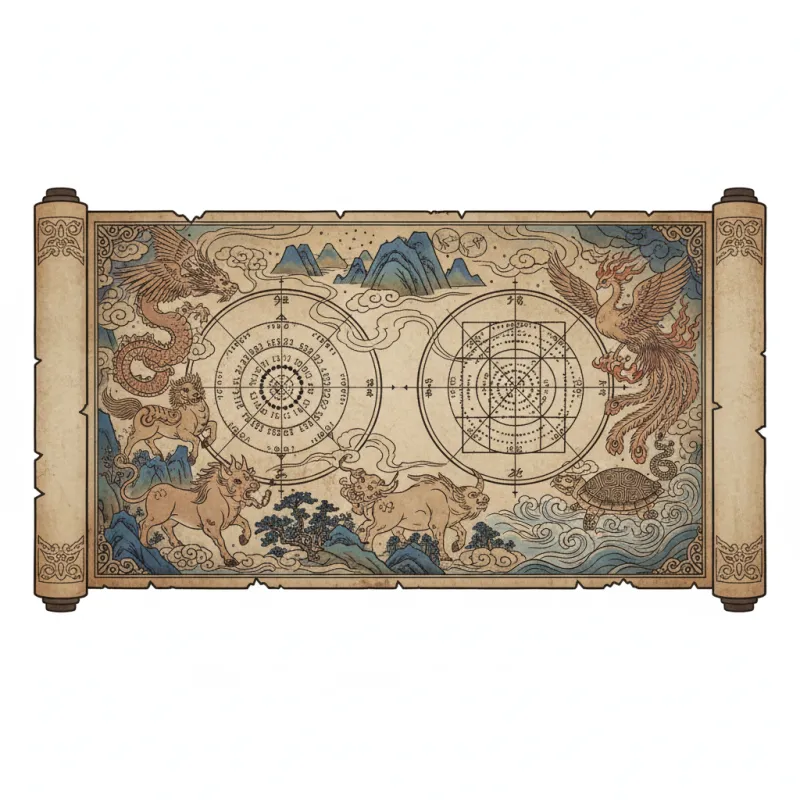
A dragon-horse emerges from the Yellow River, its scales glistening with patterns that would reshape Chinese cosmology forever. On its back: a diagram of dots arranged in a configuration so precise, so mathematically elegant, that the legendary Emperor Fu Xi immediately recognized it as a map of the universe itself. This was the Hetu (河圖, Hétú), the "River Chart," and its companion diagram, the Luoshu (洛書, Luòshū) or "Luo River Writing," would become the foundation for everything from the Yijing (Book of Changes) to feng shui, from traditional Chinese medicine to military strategy.
These aren't just pretty patterns. The Hetu and Luoshu represent something far more radical: the ancient Chinese conviction that the cosmos operates according to mathematical principles that can be decoded, understood, and applied to human affairs. While the Shanhai Jing catalogs mythical creatures and strange lands, these diagrams offer something different—a systematic framework for understanding the invisible forces that govern reality.
The Dragon-Horse and the Divine Turtle
The origin stories matter because they reveal how the ancient Chinese understood divine revelation. According to the Shanhai Jing tradition and later Confucian commentaries, the Hetu appeared during the reign of Fu Xi (伏羲, Fúxī), the legendary culture hero credited with teaching humanity fishing, hunting, and animal husbandry. The diagram emerged from the Yellow River on the back of a dragon-horse (龍馬, lóngmǎ)—a creature that appears repeatedly in Chinese mythology as a messenger between heaven and earth.
The Luoshu has an equally dramatic origin. During the reign of the legendary Emperor Yu the Great (大禹, Dà Yǔ), who tamed the Great Flood and established the Xia Dynasty around 2070 BCE, a divine turtle crawled from the Luo River bearing a pattern on its shell. Yu, who was surveying the land to establish the nine provinces of China, recognized this pattern as a key to understanding cosmic harmony and earthly governance. The connection between flood control, territorial organization, and cosmic diagrams isn't coincidental—it reflects the Chinese belief that successful rulership requires alignment with celestial patterns.
These aren't just folk tales. The Shanhai Jing and related texts like the Shujing (Book of Documents) treat these revelations as historical events, moments when the barrier between human and divine knowledge became permeable. The creatures themselves—dragon-horse and turtle—are significant. Both are associated with water, longevity, and the ability to traverse between realms. The turtle, in particular, appears throughout the Shanhai Jing as a symbol of cosmic stability, its shell representing the dome of heaven.
Decoding the Patterns
Here's where it gets mathematically fascinating. The Hetu consists of 55 dots arranged in a specific pattern: odd numbers (representing yang) are shown as white dots, even numbers (representing yin) as black dots. The arrangement follows a cross pattern with numbers 1-10, where complementary numbers always sum to 10 or 5. The center contains 5 and 10, representing earth. The four cardinal directions each contain a pair of numbers: 1 and 6 (north, water), 2 and 7 (south, fire), 3 and 8 (east, wood), 4 and 9 (west, metal).
The Luoshu is even more remarkable—it's a 3x3 magic square where every row, column, and diagonal sums to 15. The numbers 1 through 9 are arranged so that odd numbers occupy the corners and cardinal positions, while even numbers fill the intercardinal positions. The number 5 sits in the center, again representing earth and the pivot point of cosmic balance. This isn't just numerology—it's one of the earliest known magic squares in human history, predating similar discoveries in other cultures by centuries.
What makes these diagrams profound isn't just their mathematical elegance but their application. The Hetu became the basis for the Earlier Heaven (先天, xiāntiān) arrangement of the eight trigrams in the Yijing, while the Luoshu informed the Later Heaven (後天, hòutiān) arrangement. These trigrams—combinations of broken (yin) and unbroken (yang) lines—form the 64 hexagrams used for divination and philosophical contemplation. In other words, these river diagrams became the operating system for Chinese metaphysics.
From Cosmic Maps to Practical Applications
The genius of Hetu and Luoshu lies in their versatility. By the Han Dynasty (206 BCE–220 CE), scholars were using these diagrams to explain everything from seasonal changes to human physiology. The Huangdi Neijing (Yellow Emperor's Classic of Internal Medicine) incorporated Luoshu principles to map the flow of qi through the body's meridians. The five elements theory—wood, fire, earth, metal, water—found its spatial arrangement in the Hetu's directional associations.
Feng shui practitioners still use the Luoshu as the foundation for the Flying Stars system, calculating how cosmic energies move through space and time. Military strategists during the Three Kingdoms period (220–280 CE) applied Luoshu patterns to troop formations and battlefield tactics. The famous Zhuge Liang (諸葛亮, Zhūgě Liàng) allegedly used these principles to create his Stone Sentinel Maze, a defensive formation that confused enemy armies by manipulating their sense of direction and space.
Even Chinese architecture reflects these cosmic diagrams. The Forbidden City's layout incorporates Luoshu principles, with the emperor's throne positioned at the symbolic center (the number 5), surrounded by buildings arranged according to the diagram's numerical pattern. This wasn't mere superstition—it was a deliberate attempt to create earthly structures that resonated with celestial harmony, ensuring the emperor's legitimacy as the Son of Heaven.
The Philosophical Revolution
What the Hetu and Luoshu really represent is a shift in how humans understood their relationship with the cosmos. Unlike the chaotic, unpredictable world of the Shanhai Jing's strange beasts and distant lands, these diagrams suggested that underlying the apparent chaos was a mathematical order. The universe wasn't arbitrary—it followed patterns that could be learned, predicted, and harmonized with.
This had profound implications for Chinese philosophy. The Confucian emphasis on ritual and proper conduct gained cosmic justification—human behavior should align with celestial patterns just as the Luoshu's numbers align in perfect harmony. Daoist philosophy found in these diagrams evidence of the Dao's ineffable order, the way natural processes unfold according to inherent principles rather than divine whim. Even Chinese Buddhism, when it arrived from India, adapted these indigenous cosmological frameworks to explain karma and rebirth.
The Neo-Confucian philosopher Shao Yong (邵雍, Shào Yōng, 1011–1077 CE) took this further, using the Hetu and Luoshu to develop a comprehensive cosmology that explained the creation and evolution of the universe through numerical progressions. His Huangji Jingshi (Supreme Principles Governing the World) treated these diagrams as the fundamental code of reality, anticipating modern physics' search for a unified field theory by nearly a millennium.
Modern Interpretations and Enduring Mystery
Contemporary scholars debate whether the Hetu and Luoshu were genuine ancient discoveries or later inventions attributed to legendary figures. The earliest definitive textual references appear in Han Dynasty commentaries, though the concepts may be older. Some researchers see connections to ancient Chinese astronomy and calendar systems, noting that the Luoshu's sum of 15 corresponds to the number of days in a solar term.
Others point to archaeological evidence of similar numerical patterns in Shang Dynasty (1600–1046 BCE) oracle bone inscriptions, suggesting these diagrams codified mathematical knowledge that had been accumulating for centuries. The discovery of the Zhoubi Suanjing (Zhou Shadow Gauge Manual), an astronomical text from around 100 BCE, shows sophisticated mathematical thinking that could have produced such diagrams.
What's undeniable is their lasting influence. Modern Chinese mathematicians still study the Luoshu's properties, discovering new patterns and relationships. Artists incorporate these diagrams into contemporary works, finding in their ancient geometry a bridge between tradition and modernity. Even computer scientists have noted parallels between the Luoshu's structure and certain algorithms for data organization and encryption.
The Living Legacy
Walk through any Chinese temple, examine any traditional almanac, consult any feng shui master, and you'll encounter the Hetu and Luoshu. They've transcended their mythological origins to become fundamental tools for understanding and navigating reality. Whether you believe they were revealed by divine creatures or discovered by brilliant ancient mathematicians, their elegance and utility remain undeniable.
The dragon-horse and the divine turtle delivered more than diagrams—they delivered a worldview. In the Hetu and Luoshu, the ancient Chinese found proof that the universe speaks in numbers, that chaos conceals order, and that human beings can learn the language of heaven. These cosmic diagrams remind us that mythology isn't just stories about the past—it's a framework for understanding the eternal patterns that shape our world. The rivers that birthed these revelations still flow, and the patterns they revealed continue to ripple through Chinese culture, philosophy, and daily life, as relevant today as they were when Fu Xi first gazed upon that dragon-horse emerging from the Yellow River's depths.
Related Reading
- The Jade Palace of Kunlun: Home of the Queen Mother of the West — Shanhai Perspective
- Weapons of the Gods in Chinese Mythology
- Sacred Objects of Chinese Mythology: Seals, Mirrors, and Cauldrons — Shanhai Perspective
- The Hetu and Luoshu: Magical Diagrams from the Rivers — Shanhai Perspective
- Magical Artifacts of the Shanhaijing
- Exploring the Enigmatic Creatures and Lands of the Shanhaijing
- Unearthing the Cursed Beings of Shanhaijing: Myths, Creatures, and Lands
- Sea Monsters of the Shanhai Jing: Terrors of the Deep