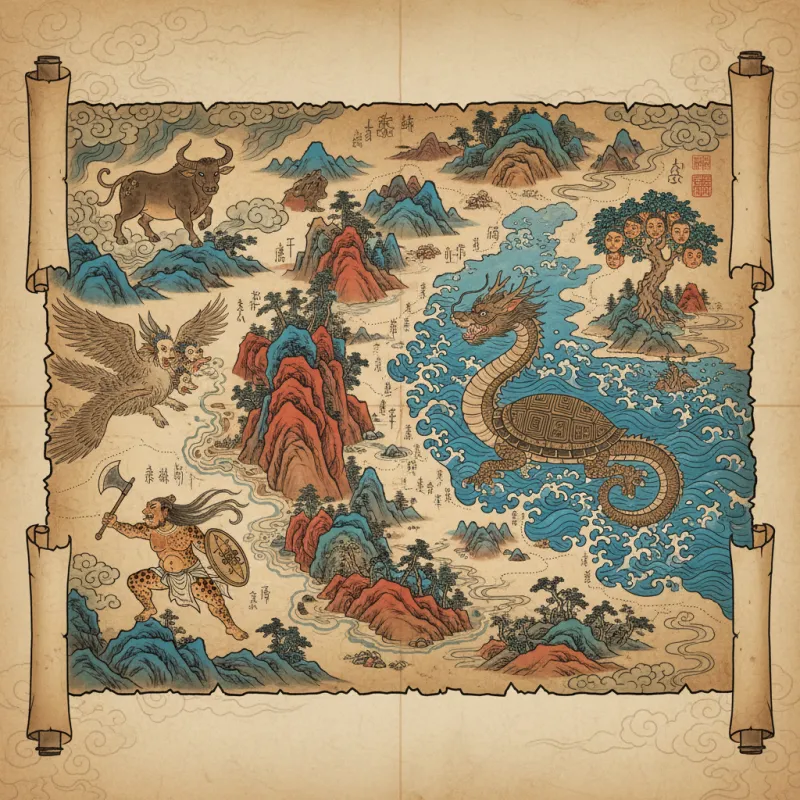
A three-headed bird perches on a bronze vessel unearthed from a Han dynasty tomb, its wings spread across the patinated surface. The archaeologist cleaning it pauses—this isn't just decorative art. It's a bifang (畢方), a creature that appears in the Shanhaijing (山海經, Classic of Mountains and Seas), described as a one-legged fire bird that brings plague wherever it lands. Except this vessel shows three heads, not one leg. The text and the artifact don't match, and that's exactly what makes the Shanhaijing so fascinating: it's not a field guide to real creatures or a consistent mythology. It's something stranger—a compilation of regional myths, half-remembered geography, and cosmological speculation that accumulated over centuries, creating a textual landscape as bewildering as it is captivating.
The Text That Refuses to Behave
The Shanhaijing frustrates anyone seeking neat categories. Compiled between the 4th century BCE and the early Han dynasty (206 BCE–220 CE), it presents itself as geography but reads like fever-dream ethnography. The text catalogs 204 mountains, 258 creatures, and countless kingdoms across 31,000 characters, organized into five sections on mountains and thirteen on seas and foreign lands. But here's the problem: the geographical descriptions are often impossible to map onto real terrain, and the creatures defy zoological classification.
Take the kaiming shou (開明獸), a beast with nine heads guarding the jade mountain of Kunlun. Or the zhuyin (燭陰), a thousand-li-long dragon whose eyes opening and closing create day and night. These aren't metaphors or allegories in the way we might interpret Greek myths—they're presented with the same matter-of-fact tone as descriptions of copper deposits and river sources. The text treats the fantastic and the mundane as equally real, reflecting a cosmology where the boundaries between natural and supernatural simply didn't exist in the way we conceive them today.
Creatures as Cosmological Markers
The mythical beings in the Shanhaijing aren't random monsters—they're markers of cosmological significance and territorial boundaries. The qiongqi (窮奇), a winged tiger that eats people starting from their heads, appears in the western regions and represents chaotic forces that must be contained. The taotie (饕餮), the infamous gluttonous beast whose face adorns countless bronze vessels, marks places of ritual importance and ancestral power.
What's particularly revealing is how these creatures cluster around sacred mountains and cardinal directions. The text describes Kunlun (崑崙) as the cosmic axis, home to the Queen Mother of the West (Xiwangmu, 西王母) and guarded by creatures like the luwu (陸吾), a deity with a tiger's body and nine tails. This isn't just mythology—it's a map of sacred geography where creatures function as cosmological coordinates. Understanding where a bifang appears tells you something about the spiritual topology of that region, its relationship to fire, disease, and transformation.
This approach to mythical creatures as geographical-spiritual markers influenced later Chinese cosmology profoundly, including concepts of feng shui and directional guardians that would develop in subsequent dynasties.
The Geography of Impossibility
The Shanhaijing describes lands that couldn't possibly exist in any physical sense, yet they reveal deep truths about how ancient Chinese cultures conceived of space and otherness. The text catalogs kingdoms of one-eyed people (yimu guo, 一目國), nations where inhabitants have holes through their chests (guanxiong guo, 貫胸國), and lands of giants and pygmies. These aren't meant as literal ethnographic reports—they're projections of difference onto geographical space, ways of imagining what lies beyond the known world.
But here's what's interesting: some of the geographical descriptions are surprisingly accurate. The text correctly identifies certain mountain ranges, river systems, and mineral deposits that archaeologists have verified. This mixing of verifiable geography with impossible lands suggests the Shanhaijing compiled information from multiple sources—merchant reports, explorer accounts, regional myths, and pure speculation—without attempting to reconcile contradictions. It's a pre-scientific text that nonetheless contains scientific observations, a mythological compendium that includes practical geography.
The concept of tianxia (天下, "all under heaven") that emerges from these descriptions would shape Chinese imperial cosmology for millennia, positioning China as the civilized center surrounded by increasingly strange and barbarous peripheries. The creatures and impossible lands of the Shanhaijing helped define what "Chinese" meant by defining what it was not.
Shamanic Roots and Ritual Functions
The Shanhaijing likely originated in shamanic traditions where knowledge of spirits, creatures, and sacred geography was essential for ritual practice. Many creatures described in the text have explicit connections to healing, exorcism, or protection. The feiyu (飛魚), a fish with bird wings, when worn as a talisman, protects against fire. The flesh of the heluo (合羅) fish cures madness. These aren't just interesting facts—they're ritual prescriptions, suggesting the text functioned as a handbook for practitioners who needed to know which creatures to invoke or avoid.
The detailed descriptions of mountains, their resident deities, and required sacrifices support this interpretation. The text specifies which animals to sacrifice at which mountains, what jade or grain offerings to present, and which spirits preside over each location. This is practical religious knowledge, the kind of information a wu (巫, shaman) would need to successfully navigate the spirit world and perform effective rituals.
This shamanic dimension connects the Shanhaijing to broader patterns in Chinese cosmological thought and spiritual practice that persisted even as Confucian and Daoist philosophies developed more systematic approaches to understanding the cosmos.
Literary Influence and Cultural Legacy
The Shanhaijing became a wellspring for Chinese literature, art, and popular culture. Lu Xun (魯迅), the father of modern Chinese literature, recalled in his essay "From Baicao Garden to Sanwei Study Hall" how the illustrated Shanhaijing was his favorite childhood book, its strange creatures firing his imagination. The text influenced everything from Tang dynasty poetry to Ming dynasty novels like Journey to the West (Xiyouji, 西遊記), which borrowed creatures and cosmological concepts directly from its pages.
Artists throughout Chinese history have attempted to visualize the Shanhaijing's creatures, from Han dynasty stone carvings to contemporary graphic novels. Each generation reinterprets these beings through its own aesthetic and cultural lens, yet the fundamental strangeness of the source material resists domestication. A jiuying (九嬰), a nine-headed monster that spits water and fire, remains unsettling no matter how it's depicted.
What's remarkable is how the Shanhaijing continues to generate new interpretations. Some scholars read it as encoded astronomical knowledge, others as shamanic geography, still others as political allegory. The text's resistance to single interpretations is perhaps its greatest strength—it remains genuinely mysterious, a window into a worldview we can glimpse but never fully inhabit.
Reading the Shanhaijing Today
Modern readers approaching the Shanhaijing face a choice: treat it as a historical curiosity or engage with it as a living cosmological text. The former approach is safer but less rewarding. The latter requires accepting that the text operates according to logic different from our own, where geographical and spiritual realities interpenetrate, where creatures are simultaneously real and symbolic, where the map and the territory exist in productive tension.
The Shanhaijing challenges our assumptions about how ancient peoples understood their world. It wasn't that they couldn't distinguish fact from fiction—it's that this distinction wasn't the organizing principle of their knowledge. The text presents a cosmos where everything is connected through webs of correspondence and resonance, where a creature's appearance in a particular location means something about that place's spiritual character, where geography is always also cosmology.
This holistic worldview, where the physical and metaphysical are inseparable, offers an alternative to modern fragmented knowledge. We've gained precision and predictive power by separating disciplines, but we've lost the sense of living in an enchanted cosmos where everything signifies. The Shanhaijing preserves that older way of knowing, not as nostalgia but as a genuine alternative that might still have something to teach us about how to inhabit a world that's more than just dead matter arranged in space.
The three-headed bifang on that bronze vessel isn't a mistake or artistic license—it's evidence that the myths were always multiple, always contested, always being remade by each community and craftsperson who encountered them. The Shanhaijing doesn't give us a single, authoritative Chinese cosmology. It gives us something better: a glimpse of how cosmologies are made, remade, and endlessly reimagined.
Related Reading
- Shanhaijing Cosmology: How Ancient China Imagined the Universe
- The Complete Guide to Shanhai Jing: China's Book of Mythical Creatures
- Kunlun Mountain: The Axis of the Chinese Cosmos
- Pangu and the Cosmic Egg: The Chinese Creation Myth
- The Four Divine Beasts: Guardians of the Compass
- Exploring the Myths of Serpents in the Shanhaijing: Creatures of Power and Mystery
- Exploring the Enigmatic Seas of the Shanhaijing: Mythical Creatures and Realms
- Discovering the Enigmatic Hybrid Creatures of Shanhaijing