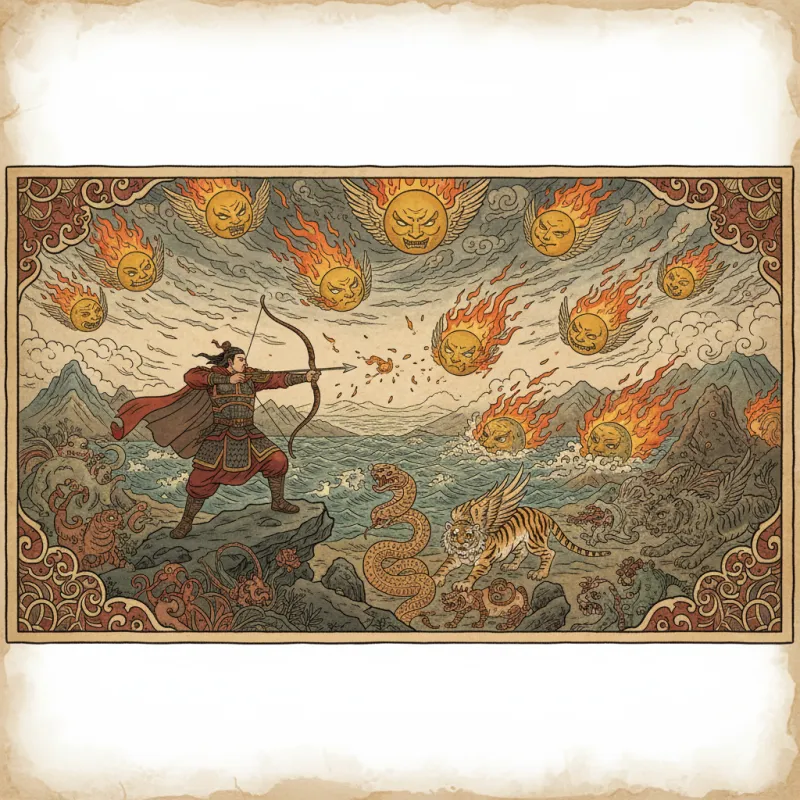
Houyi the Archer: The Hero Who Shot Down Nine Suns
Introduction: China's Greatest Archer
In the vast pantheon of Chinese mythology, few heroes command as much reverence and fascination as Houyi (后羿, Hòu Yì), the divine archer whose legendary feat of shooting down nine suns saved the world from destruction. His story, rooted in the ancient text Shanhai Jing (山海经, Shānhǎi Jīng) and elaborated in later classics like Huainanzi (淮南子, Huáinánzǐ), represents one of humanity's earliest narratives about cosmic balance, heroic sacrifice, and the consequences of hubris—both divine and mortal.
Houyi's tale transcends simple heroism. It explores the delicate relationship between heaven and earth, the price of immortality, and the tragic dimensions of love and loss. As we delve into this ancient narrative, we discover not just a marksman of supernatural skill, but a complex figure whose actions reshaped the cosmos and whose fate became intertwined with one of Chinese mythology's most poignant love stories.
The Catastrophe of Ten Suns
The Divine Children of Dijun
According to ancient texts, in the primordial age, ten suns existed simultaneously. These were not mere celestial bodies but the divine children of Dijun (帝俊, Dìjùn), the supreme deity of the eastern heavens, and his consort Xihe (羲和, Xīhé), the goddess of the sun. The Shanhai Jing describes how these ten solar deities resided in a massive fusang tree (扶桑, fúsāng)—a mythical mulberry that grew in the eastern sea at a place called Tanggu (汤谷, Tānggǔ), the "Valley of Hot Springs."
Under normal circumstances, the ten suns maintained cosmic order through a carefully orchestrated schedule. Each day, one sun would journey across the sky in a chariot driven by their mother Xihe, while the other nine rested in the fusang tree's branches. This rotation ensured that the world received exactly the right amount of light and warmth, maintaining the delicate balance necessary for life to flourish.
The Day of Rebellion
But one fateful day, the ten young suns grew restless and rebellious. Tired of their solitary daily journeys and the rigid schedule imposed upon them, they decided to rise together into the sky. The Huainanzi vividly describes the catastrophe that followed: "When the ten suns came out together, all things scorched."
The earth became a furnace. Rivers and lakes evaporated into steam. Crops withered and died in the fields. Forests burst into flames. The very rocks began to melt under the relentless heat. Humanity faced extinction as water sources disappeared and the land became uninhabitable. Even the mythical creatures and divine beasts that populated the ancient world suffered—many perished or went mad from the unbearable heat.
The people cried out to heaven for salvation, but the ten suns, reveling in their newfound freedom, ignored all pleas. They danced across the sky, oblivious to or uncaring about the devastation below. It was in this moment of supreme crisis that the legendary archer Houyi entered the stage of cosmic history.
Houyi: The Divine Archer
Origins and Divine Nature
Houyi's origins vary across different textual traditions, reflecting the complex evolution of Chinese mythology. In some accounts, he is described as a divine archer from heaven, sent by the supreme deity to restore order. Other versions present him as a semi-divine hero, born with supernatural abilities but living among mortals. The Huainanzi suggests he was originally a celestial being who descended to earth on a divine mission.
What remains consistent across all versions is Houyi's unparalleled mastery of archery. His bow was said to be crafted from the horn of a divine beast, and his arrows were made from the branches of sacred trees, tipped with jade or meteorite iron. But more than his equipment, it was Houyi's skill, courage, and unwavering determination that made him legendary. He possessed the rare combination of physical prowess and moral clarity necessary for a true hero.
The Great Shooting
When the supreme deity—identified in various texts as Dijun, Yao (尧, Yáo), or simply Tiandi (天帝, Tiāndì, "Heavenly Emperor")—witnessed the catastrophe unfolding on earth, he summoned Houyi and commanded him to discipline the rebellious suns. Armed with his divine bow and a quiver containing ten arrows, Houyi descended to the mortal realm.
Standing upon a high mountain, Houyi surveyed the scorched landscape and the suffering of humanity. He called out to the ten suns, commanding them to return to their proper order. When they refused, laughing at the lone archer below, Houyi knew what he must do.
He nocked his first arrow, drew his bow with perfect form, and released. The arrow flew true, piercing the first sun. According to the Huainanzi, when the sun was struck, it transformed into a three-legged crow (三足乌, sānzú wū) and fell from the sky. This detail is significant—the three-legged crow, or jinwu (金乌, jīnwū), was believed to be the spirit inhabiting each sun, and its appearance confirmed that Houyi had indeed struck down a divine being.
One by one, Houyi shot down the suns. Each arrow found its mark with devastating precision. Eight more three-legged crows fell from the heavens, crashing to earth in balls of flame. The world began to cool. Rivers started to flow again. The surviving vegetation stirred with renewed life.
The Wisdom of Leaving One Sun
As Houyi prepared to shoot his tenth arrow, a wise advisor—in some versions, the sage emperor Yao himself—stayed his hand. "If you shoot down all ten suns," the advisor warned, "the world will be plunged into eternal darkness and cold. One sun must remain to give light and warmth to the world."
Houyi lowered his bow. This moment of restraint is as important as the shooting itself, demonstrating that true heroism requires not just strength and skill, but wisdom and self-control. The remaining sun, chastened by the fate of its siblings and grateful to be spared, agreed to resume the daily journey across the sky alone, maintaining the cosmic order that continues to this day.
The Aftermath: From Hero to Exile
Divine Punishment and Earthly Exile
Houyi's triumph, however, came with an unexpected price. While he had saved the world, he had also killed nine divine beings—the children of Dijun and Xihe. The grief-stricken parents, despite understanding the necessity of Houyi's actions, could not forgive the slaying of their offspring.
As punishment, or perhaps simply unable to bear the sight of their children's killer, Dijun and Xihe stripped Houyi of his divine status and banished him to live as a mortal on earth. This transformation from celestial hero to earthly exile represents one of mythology's great ironies: the savior of humanity was condemned to become fully human himself, subject to all the limitations, sufferings, and mortality that entails.
Houyi's wife, Chang'e (嫦娥, Cháng'é), a goddess of extraordinary beauty, chose to follow him into exile. This decision would later become central to one of Chinese mythology's most famous and tragic love stories, celebrated annually during the Mid-Autumn Festival (中秋节, Zhōngqiū Jié).
The Hero's Continued Service
Despite his exile and loss of immortality, Houyi did not cease his heroic deeds. The Huainanzi and other texts record how he continued to protect humanity from various threats that plagued the ancient world. He slayed Yayu (凿齿, Záochǐ), a monster with chisel-like teeth who devoured humans; defeated Jiuying (九婴, Jiǔyīng), a nine-headed beast that breathed fire and water; killed Dafeng (大风, Dàfēng), a gigantic wind bird that created devastating storms; and hunted down Fengxi (封豨, Fēngxī), a colossal boar that ravaged the countryside.
These exploits established Houyi as not just a cosmic hero but a protector of civilization itself, clearing the land of monsters and making it safe for human habitation and development. In this role, he resembles other culture heroes from world mythology who helped establish the conditions necessary for human society to flourish.
The Quest for Immortality
The Elixir from the Queen Mother of the West
Houyi's mortality weighed heavily upon him, not from fear of death itself, but from the knowledge that his time with Chang'e was now limited. Determined to find a way to restore their immortality, Houyi embarked on a perilous journey to Kunlun Mountain (昆仑山, Kūnlún Shān), the mythical axis mundi of Chinese cosmology and home to Xiwangmu (西王母, Xīwángmǔ), the Queen Mother of the West.
Xiwangmu, impressed by Houyi's heroic deeds and moved by his devotion to his wife, granted him a precious gift: the elixir of immortality (不死药, bùsǐ yào). However, she provided only enough for one person to achieve full immortality, or for two people to gain eternal life without ascending to heaven. Houyi returned home with this precious substance, planning to share it with Chang'e so they could live together forever on earth.
The Tragedy of Chang'e
What happened next varies across different versions of the myth, but all end in tragedy. In the most common telling, while Houyi was away, his apprentice Fengmeng (逢蒙, Féngméng)—jealous of his master's skill and covetous of the elixir—broke into their home and threatened Chang'e, demanding she surrender the immortality potion.
Faced with this crisis and unwilling to let the elixir fall into unworthy hands, Chang'e made a desperate decision: she swallowed the entire elixir herself. Immediately, her body became weightless, and she began to float upward. Unable to return to heaven due to the shame of her husband's exile, she drifted to the moon, the closest celestial body to earth, where she would remain forever.
When Houyi returned and learned what had happened, his grief was inconsolable. He looked up at the moon and saw Chang'e's silhouette in its bright surface. In his anguish, he laid out her favorite foods and fruits in the courtyard—an offering that became the origin of the Mid-Autumn Festival tradition. From that day forward, Houyi would gaze at the moon each night, separated from his beloved by the vast distance between earth and sky, together yet forever apart.
Legacy and Cultural Significance
Symbol of Heroic Sacrifice
Houyi's story resonates through Chinese culture as a powerful meditation on heroism, sacrifice, and the costs of serving the greater good. Unlike many mythological heroes who achieve glory and reward, Houyi's heroism leads to exile, loss, and tragedy. He saves the world but loses his divine status. He seeks immortality for love but ends up eternally separated from his beloved.
This tragic dimension makes Houyi a more complex and human figure than a simple triumphant hero. His story acknowledges that doing the right thing often comes with personal costs, and that even the greatest heroes are subject to forces beyond their control—whether divine punishment, fate, or the unintended consequences of their own actions.
Artistic and Literary Representations
Throughout Chinese history, Houyi has been depicted in countless paintings, poems, operas, and stories. Tang Dynasty poets like Li Bai (李白, Lǐ Bái) referenced his legend in their verses. Ming and Qing Dynasty artists portrayed the dramatic moment of the sun-shooting in vivid detail. Modern adaptations continue to reimagine his story in films, television series, novels, and video games, each generation finding new relevance in this ancient tale.
The image of Houyi drawing his bow against the sky has become an iconic representation of human courage in the face of cosmic threats, the determination to restore balance when the natural order is disrupted, and the willingness to act decisively when others are paralyzed by fear or despair.
Astronomical and Seasonal Connections
Houyi's mythology is deeply connected to Chinese understanding of celestial phenomena and seasonal cycles. The story of the ten suns may reflect ancient observations of solar activity, droughts, or the intense heat of summer. The reduction to one sun explains the current cosmic order and the regular progression of day and night.
The Chang'e portion of the myth ties directly to lunar observation and the Mid-Autumn Festival, when the moon is fullest and brightest. During this festival, families gather to eat mooncakes (月饼, yuèbǐng), admire the moon, and remember the story of the separated lovers—a tradition that has continued for over two thousand years.
Conclusion: The Eternal Archer
Houyi's legend endures because it speaks to fundamental human experiences and questions. How do we maintain balance in a world prone to extremes? What price are we willing to pay to protect those we love? How do we cope with separation and loss? What does it mean to be a hero when heroism brings punishment rather than reward?
The archer who shot down nine suns remains one of Chinese mythology's most compelling figures precisely because his story refuses simple answers. He is simultaneously divine and mortal, triumphant and tragic, a savior and an exile. His bow, once raised against the rebellious suns, now hangs silent as he gazes at the moon, forever reaching toward what he can see but never touch.
In this eternal reaching, Houyi embodies something profoundly human: the courage to act when action is needed, the wisdom to know when to stop, and the endurance to bear the consequences of our choices, no matter how heavy they may be. His story, preserved in the ancient pages of the Shanhai Jing and elaborated through millennia of retelling, continues to inspire, caution, and move us—a testament to the enduring power of myth to illuminate the human condition.