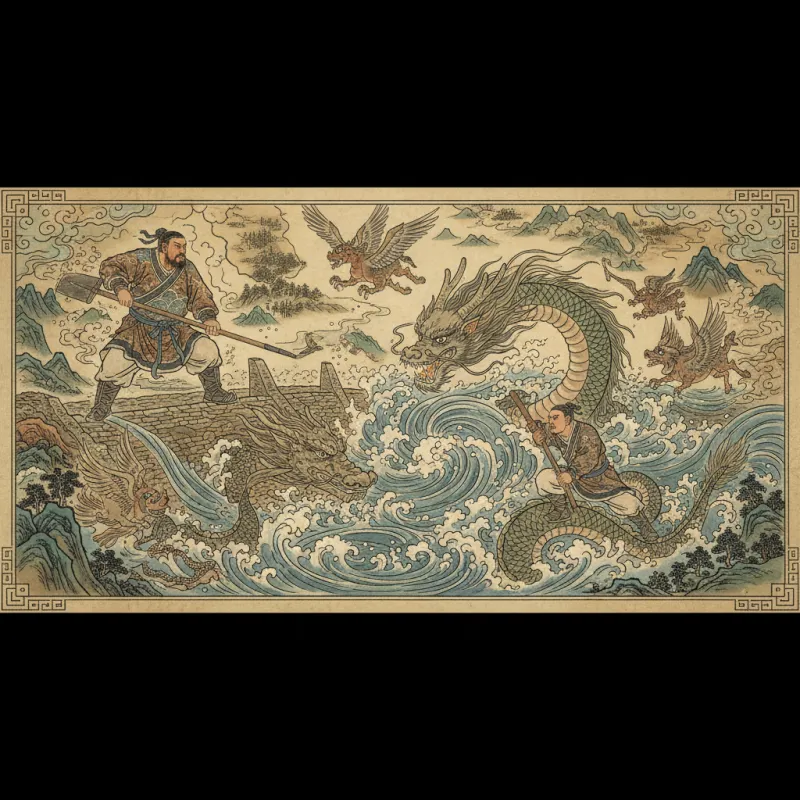
When Gun stole the xirang (息壤 xīrǎng) — the self-expanding soil — from the heavenly emperor, he wasn't just committing theft. He was challenging the fundamental order of the cosmos. The flood waters had risen for nine years, swallowing mountains and drowning valleys, and Gun believed he had found the solution. He would dam the waters, contain them, force them back. It was a plan born of desperation and hubris, and it would cost him his life.
The Flood That Wouldn't Stop
The Great Flood of Chinese mythology wasn't a forty-day downpour like Noah's deluge. It was a persistent, grinding catastrophe that lasted decades. The Shangshu (尚书 Shàngshū, "Book of Documents") describes waters that "embraced the mountains and overtopped the hills," transforming the known world into an endless sea. Villages vanished. Crops rotted. People clung to hilltops and tree branches, watching their civilization dissolve into muddy chaos.
The heavenly emperor — identified in some texts as Yao (尧 Yáo), the legendary sage-king — needed someone to fix this. He chose Gun, a figure whose parentage varies depending on which text you read. The Shanhaijing (山海经 Shānhǎi Jīng) suggests Gun was descended from the Yellow Emperor himself, while other sources make him a minor deity or simply a talented engineer. What matters is that Gun was given an impossible task: make the water go away.
Gun's approach was straightforward. He would build dams and levees, containing the flood through sheer force. For nine years he labored, piling earth and stone, trying to wall off the chaos. And for nine years, he failed. The xirang he had stolen — magical soil that supposedly grew on its own — wasn't enough. The waters kept rising, kept spreading, kept destroying.
The Price of Failure
The emperor's patience ran out. Gun was executed at Feather Mountain (羽山 Yǔshān), his body left to rot as punishment for his failure and his theft. But here's where the myth gets strange, where it stops being a simple morality tale and becomes something darker and more fascinating.
Gun's corpse didn't decay. For three years it lay on Feather Mountain, preserved by some unknown force. When it was finally cut open, out stepped Yu (禹 Yǔ) — Gun's son, fully formed, ready to finish what his father had started. Some versions say Yu emerged as a dragon or a bear. Others describe him as simply a man, but a man who understood what his father had not.
This resurrection-birth is unique in Chinese mythology. It suggests that Gun's failure wasn't complete, that something of value survived his death. The Huainanzi (淮南子 Huáinánzǐ) interprets this as a metaphor for the transmission of knowledge — Gun's methods were wrong, but his determination, his understanding of the problem, passed to his son through some mystical inheritance.
Yu's Revolution: Working With Water
Yu the Great looked at his father's dams and levees and understood the fundamental error. You cannot fight water. You cannot contain it, wall it off, pretend it doesn't exist. Water flows. Water finds cracks. Water wins.
So Yu did something revolutionary: he worked with the flood instead of against it. He dredged channels and carved valleys, giving the water paths to follow. He divided the land into nine provinces, each with its own drainage system. He spent thirteen years on this project, traveling so constantly that he passed his own house three times without stopping to visit his wife and newborn son. The Shangshu records that his hands grew callused, his legs lost their hair from constant wading, and his body became so thin that people barely recognized him.
This wasn't just engineering — it was a new philosophy of governance. Gun had tried to impose order through force, through barriers and walls. Yu created order by understanding the nature of what he was dealing with and adapting to it. He turned chaos into channels, disaster into irrigation. The flood waters that had destroyed civilization became the rivers that would sustain it.
The Shanhaijing describes Yu's travels in exhaustive detail, listing mountains he climbed, rivers he dredged, and strange creatures he encountered along the way. He met the Fangfeng (防风 Fángfēng), a giant so tall that his bones filled an entire cart. He navigated territories inhabited by mythical beasts and negotiated with local spirits. The flood control project became a survey of the entire known world, a catalog of China's geography and its supernatural inhabitants.
The Birth of the Xia Dynasty
When Yu finally succeeded, when the waters receded and the land dried, something unprecedented happened. Emperor Shun (舜 Shùn), who had succeeded Yao, didn't pass the throne to his own son. He gave it to Yu. This was the abdication system (禅让 shànràng) in action — the idea that rulership should go to the most capable person, not necessarily to one's heir.
Yu became the founder of the Xia Dynasty (夏朝 Xià Cháo), traditionally dated to around 2070 BCE, though archaeological evidence for the Xia remains controversial. What's significant is that Yu's legitimacy came entirely from his accomplishment. He didn't conquer anyone. He didn't inherit divine right. He solved a problem that threatened everyone, and that made him worthy to rule.
But here's the irony: Yu himself didn't follow the abdication system. When he died, the throne passed to his son Qi (启 Qǐ), establishing hereditary succession and ending the age of sage-kings. Some scholars see this as hypocrisy. Others argue it was inevitable — Yu had transformed the political landscape so completely that the old system couldn't survive. He had created a state that required continuity, institutions, a bureaucracy. That kind of structure doesn't work well with abdication.
Father and Son: Two Models of Power
The contrast between Gun and Yu became a template for Chinese political thought. Gun represents the ruler who relies on force, who tries to impose his will on nature and society. He's well-intentioned but rigid, unable to adapt when his methods fail. Yu represents the flexible ruler, the one who observes, learns, and works with the grain of reality rather than against it.
This dichotomy appears throughout Chinese philosophy. The Confucians loved Yu, seeing him as the model of the virtuous ruler who sacrifices personal comfort for public good. The Daoists were more ambivalent — yes, Yu succeeded, but at what cost? He worked himself to exhaustion, neglected his family, and ultimately created the very system of hereditary power that would lead to tyranny. Laozi might have asked: was the flood really a problem to be solved, or was Gun and Yu's interference the real disaster?
The Legalists, meanwhile, focused on Yu's methods. He didn't just work hard — he organized, systematized, measured. He divided the land into provinces, established tribute systems, created administrative structures. He was, in their view, the first true bureaucrat, the founder of rational governance.
The Myth's Evolution
What's fascinating is how the Gun-Yu story changed over time. The earliest versions, found in fragments of the Shangshu and references in the Shanhaijing, are fairly straightforward: Gun failed, Yu succeeded, the end. But later texts add layers of meaning.
The Huainanzi, written in the 2nd century BCE, emphasizes the xirang theft and Gun's punishment, turning the story into a meditation on the relationship between heaven and earth, between divine law and human necessity. Was Gun wrong to steal the xirang? He was trying to save humanity. Does that justify breaking cosmic law?
By the time we get to the Shiji (史记 Shǐjì, "Records of the Grand Historian") in the 1st century BCE, Sima Qian is treating Gun and Yu as historical figures, placing them in a chronology, giving them dates and genealogies. The myth has become history, or at least, history has absorbed the myth.
Modern scholars debate whether there's any historical truth to the story. Some point to evidence of major flooding in the Yellow River valley around 1920 BCE, which could have inspired the legend. Others argue that the Gun-Yu narrative is entirely mythological, a way of explaining the origins of Chinese civilization and its political structures. The truth probably lies somewhere in between — a real flood, real engineering projects, and a mythological framework that gave those events cosmic significance.
Legacy: The Flood That Never Ends
Yu's flood control is never finished. Every dynasty that followed claimed to be continuing his work, maintaining the channels he dug, repairing the systems he established. When floods came — and they came regularly — it was seen as a sign that the current rulers had failed to live up to Yu's standard. The Mandate of Heaven (天命 Tiānmìng) could be lost through poor water management.
This makes the Gun-Yu myth fundamentally different from other flood narratives. Noah's flood was a one-time event, a divine reset button. The Mesopotamian flood in the Epic of Gilgamesh was similar — the gods sent it, it happened, it ended. But China's flood is ongoing. It's a permanent condition that requires constant management, constant vigilance, constant work.
That's why Yu remains relevant. He's not the hero who saved the world once and retired. He's the model of the ruler who never stops working, who understands that civilization is not a stable state but an ongoing project. His father Gun represents the temptation to find a quick fix, a permanent solution. Yu knew better. He knew that the water would always be there, always threatening, always needing to be channeled and controlled.
The flood, in the end, wasn't just water. It was chaos itself — the disorder that constantly threatens to overwhelm human society. Gun tried to wall it out. Yu learned to live with it, to shape it, to make it serve human purposes without ever pretending it was truly conquered. That's the lesson that made him great, and that's why his story, thousands of years later, still resonates. We're all still fighting Gun's fight and learning Yu's lesson, over and over again.
Related Reading
- Kuafu Chases the Sun: The Giant's Last Run
- The Shanhaijing's Heroes: Mortals Who Challenged Gods and Won (Mostly)
- Da Yu Controls the Floods: Engineering Meets Mythology
- Yi the Archer: The Man Who Shot Down Nine Suns
- Houyi the Archer: The Hero Who Shot Down Nine Suns
- The Bizarre Plants of the Shanhaijing: Trees That Cure Death and Fruits That Grant Flight — Shanhai Perspective
- Exploring the Enigmatic Creatures and Lands of Shanhaijing: A Cultural Journey
- Kunlun Mountain: Home of the Immortals