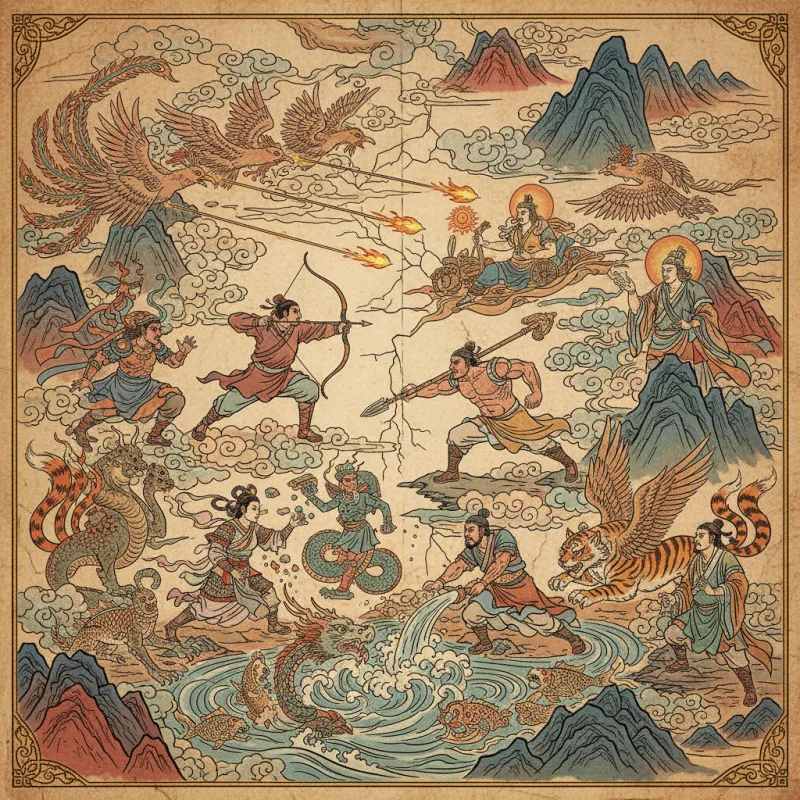
Picture this: a man standing at the edge of the world, staring at an ocean that stretches beyond comprehension, and deciding—with full knowledge that he will die—to drink it dry. Not because he's insane. Not because he thinks he'll succeed. But because the ocean wronged him, and some things matter more than survival.
That's the kind of hero the Shanhaijing (山海经, Shānhǎi Jīng) celebrates. These aren't your Marvel superheroes who save the day and get the girl. These are mortals who look at gods, demons, and the fundamental laws of nature and say, "I'm going to fight you anyway." Most of them die. Some of them win. All of them become legends.
The Defiance Principle
Western mythology loves the clever hero—Odysseus with his tricks, Perseus with his reflective shield. Chinese mythology has those too, but the Shanhaijing reserves its highest praise for a different archetype: the hero who refuses to stop even when stopping is the only rational choice.
This isn't stupidity. It's a philosophical stance. These heroes embody the Confucian ideal of yi (义, righteousness) taken to its absolute extreme—doing what's right regardless of personal cost. But they also channel something older and wilder, a pre-Confucian defiance that says the universe doesn't get to decide what's possible.
The text itself, compiled during the Warring States period through the early Han dynasty (roughly 4th century BCE to 2nd century CE), preserves these stories without moralizing. It simply states: this person did this impossible thing. Make of it what you will.
Jingwei: The Bird Who Declared War on the Ocean
The daughter of the Flame Emperor (炎帝, Yán Dì) drowned in the Eastern Sea. She transformed into a bird called Jingwei (精卫, Jīngwèi) and decided to fill the entire ocean with pebbles and twigs, one mouthful at a time.
Let's be clear about the scale here. We're talking about the Pacific Ocean. And a bird roughly the size of a crow. The math doesn't work. It will never work. Jingwei knows this.
But here's what makes the story resonate across millennia: Jingwei isn't trying to succeed. She's making a statement. The ocean took her life, and she refuses to let that be the end of the story. Every pebble is an act of defiance, a declaration that even the mightiest force in nature cannot silence her rage.
The Shanhaijing describes her cry: "精卫,精卫" (Jīngwèi, Jīngwèi)—her own name, repeated endlessly as she works. It's both heartbreaking and terrifying. This is what happens when grief becomes eternal purpose.
Kuafu: Racing the Sun to Death
Kuafu (夸父, Kuāfù) decided to race the sun. Not metaphorically—literally chase the sun across the sky and catch it. He ran so fast and so far that he drained the Yellow River and the Wei River trying to quench his thirst. He died of dehydration within sight of a great lake, and his walking stick transformed into a peach grove.
Modern readers often interpret this as a cautionary tale about hubris. They're wrong. The Shanhaijing presents no moral judgment. It simply records: here was a giant who challenged the sun, and here is what happened.
What's remarkable is that Kuafu gets closer than anyone has a right to expect. He actually catches up to the sun at Yugu (禺谷, Yúgǔ), the place where it sets. He fails only because his mortal body cannot sustain the effort. The story suggests that with a slightly better constitution, he might have actually won.
This is the pattern: these heroes fail by the narrowest of margins, suggesting that the impossible is merely the extremely difficult. Similar themes appear in stories of Gun and Yu: The Father and Son Who Tamed the Flood, where persistence across generations finally achieves what seemed impossible.
Yi the Archer: The Man Who Actually Won
Yi (羿, Yì) or Houyi (后羿, Hòuyì) stands apart because he's one of the few who succeeded completely. When ten suns appeared in the sky simultaneously—children of the Heavenly Emperor playing in the sky—Yi shot down nine of them with his divine bow.
Think about what this means. These weren't metaphorical suns. They were the literal sons of the supreme deity, and Yi killed nine of them to save humanity. The Heavenly Emperor was, understandably, not pleased. Yi was stripped of his immortality and exiled to earth.
But here's the crucial detail: Yi doesn't regret it. He made a choice—save humanity or preserve his relationship with heaven—and he chose mortals over gods. The Shanhaijing and later texts like the Huainanzi (淮南子) treat this as the correct decision, even though it cost Yi everything.
Yi's story also includes the famous episode with his wife Chang'e (嫦娥, Cháng'é), who steals his immortality elixir and flees to the moon. Even his personal life becomes a tragedy of impossible choices. Yet he remains a hero because he never compromises on what matters.
Xingtian: The Headless Warrior
After the Yellow Emperor (黄帝, Huáng Dì) defeated him in battle, Xingtian (刑天, Xíngtiān) had his head cut off. Most warriors would consider this a career-ending injury. Xingtian used his nipples as eyes and his navel as a mouth, and continued fighting.
The Shanhaijing describes him dancing with his shield and axe, still seeking revenge against the Yellow Emperor. He's been doing this for thousands of years. He will presumably continue until the end of time.
There's something almost absurdist about Xingtian's story. He cannot win. He knows he cannot win. The Yellow Emperor is the supreme ruler of the cosmos. But Xingtian keeps fighting because the alternative—accepting defeat—is unthinkable.
Later poets, particularly Tao Yuanming (陶渊明) in the 4th century CE, celebrated Xingtian as the ultimate symbol of indomitable will. "刑天舞干戚,猛志固常在" (Xíngtiān wǔ gān qī, měng zhì gù cháng zài)—"Xingtian dances with shield and axe, his fierce spirit forever present."
Gun: The Hero Who Failed So His Son Could Succeed
Gun (鲧, Gǔn) tried to stop the Great Flood by stealing the Xirang (息壤, Xīrǎng)—a magical self-expanding soil—from heaven. The Heavenly Emperor executed him for this theft. Gun's body didn't decay for three years, and when it was finally cut open, his son Yu (禹, Yǔ) emerged, ready to finish his father's work.
Gun's story is usually told as a prelude to Yu's success, but Gun himself deserves recognition. He knew stealing from heaven would result in his death. He did it anyway because people were drowning. His failure wasn't due to cowardice or incompetence—he was executed before he could complete his work.
What makes Gun heroic is that he created the conditions for his son's eventual success. Yu learned from Gun's mistakes, received official sanction from the new emperor Shun, and finally tamed the flood through thirteen years of relentless labor. Gun's sacrifice wasn't wasted; it was the necessary first step.
This generational approach to impossible tasks appears throughout Chinese mythology and history. One person starts the work knowing they won't finish it. The next generation continues. Eventually, the impossible becomes accomplished fact.
Why These Stories Still Matter
Modern China has complicated feelings about these heroes. During the Cultural Revolution, they were reinterpreted as symbols of revolutionary struggle against feudal oppression. Contemporary readers sometimes see them as cautionary tales about knowing your limits.
Both interpretations miss the point. These stories aren't prescriptive—they don't tell you how to live. They're descriptive—they show you what humans are capable of when they refuse to accept the world as it is.
Jingwei will never fill the ocean. But every environmental activist fighting climate change is Jingwei with a different ocean. Xingtian will never defeat the Yellow Emperor. But every person who continues fighting after a devastating loss is Xingtian dancing with shield and axe.
The Shanhaijing preserves these stories without judgment because it understands something fundamental: the value of an action isn't determined solely by its outcome. Sometimes the attempt itself is the point. Sometimes defiance is its own reward.
These heroes didn't challenge gods and win (mostly). They challenged gods and became immortal in the process—not through divine favor, but through the sheer force of human memory. We remember them because they showed us what we might be capable of if we cared about something more than our own survival.
That's a kind of victory the gods can never take away.
Related Reading
- Houyi Shoots the Suns: The Archer's Sacrifice
- Yi the Archer: The Man Who Shot Down Nine Suns
- Kuafu Chases the Sun: The Giant's Last Run
- Kuafu Chases the Sun: The Giant Who Ran After Light
- Da Yu Controls the Floods: Engineering Meets Mythology
- Flood Myths: Noah vs Gun-Yu
- The Four Dragon Kings: Rulers of China's Mythological Oceans
- Mountain Spirits of the Shanhaijing: The Gods Who Live in Peaks