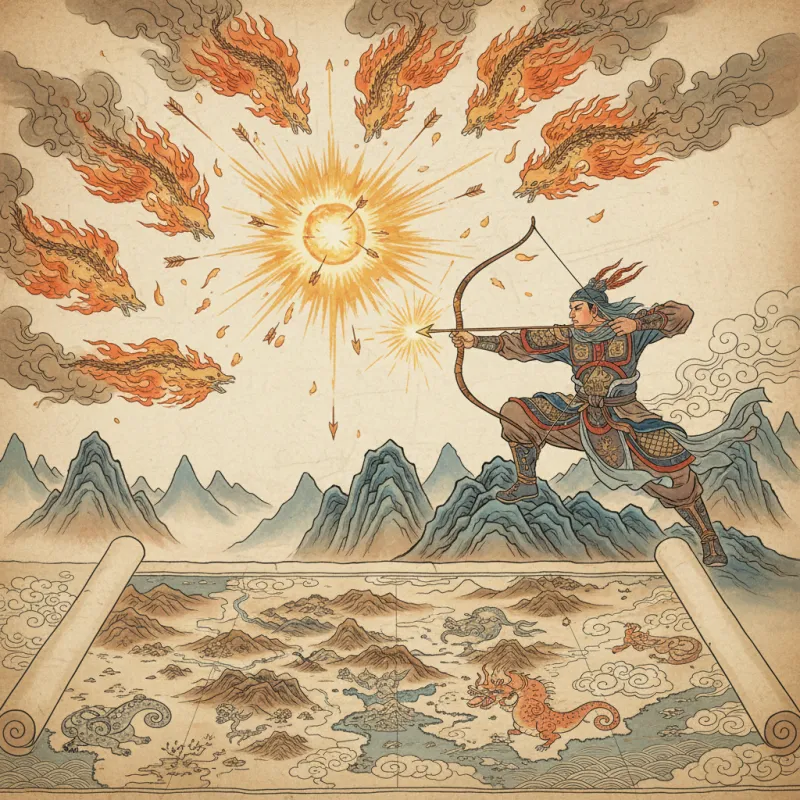
There's a cruel irony at the heart of Yi's story that I've never been able to shake. He saves the entire world—shoots down nine suns that are burning the earth to cinders, kills the monsters that emerged from the ecological collapse, restores order to a cosmos on the brink of annihilation. And his reward? He gets fired. Stripped of his divinity. Exiled to earth as a mortal. His wife steals his one chance at immortality and flies to the moon, where she spends eternity alone. Yi (羿, Yì)—sometimes called Hou Yi (后羿, Hòu Yì), though the "Hou" is a title meaning "lord" or "prince"—is the most accomplished and most punished hero in Chinese mythology. His story is a masterclass in the gap between what you deserve and what you get.
The Ten Suns and the End of the World
The crisis begins with a parenting failure of cosmic proportions. Di Jun (帝俊, Dì Jùn), the god of the eastern sky, had ten sons—each one a sun. Normally, they took turns crossing the sky, one per day, maintaining the delicate balance that kept the world habitable. But one morning, all ten decided to rise together.
Imagine ten suns blazing overhead simultaneously. The Huainanzi (淮南子, Huáinánzǐ), compiled in the 2nd century BCE, describes the devastation in visceral detail: rivers boiled dry, forests burst into flame, crops withered to ash in the fields. The earth cracked open. People couldn't venture outside without their skin blistering. Animals fled to caves and died there. The social order collapsed as communities fought over the last sources of water. This wasn't just a heat wave—it was an extinction event.
The mythological texts suggest this wasn't mere childish rebellion. The ten suns knew exactly what they were doing. They'd grown bored with the routine, tired of taking turns, resentful of the constraints placed on their divine power. So they staged what amounts to a cosmic strike, a refusal to maintain the system that depended on their cooperation. It's a surprisingly modern anxiety—what happens when those who maintain the infrastructure decide to stop?
Yi's Impossible Mission
Enter Yi, the divine archer. The Shanhaijing (山海经, Shānhǎijīng) describes him as an immortal in the service of Di Jun, though other texts place him under the Yellow Emperor or make him a minister to the legendary King Yao. What's consistent across versions is his supernatural skill with the bow. We're not talking about Olympic-level archery here—Yi could shoot a willow leaf from a hundred paces, split an arrow in flight, hit targets he couldn't see by sound alone.
Di Jun summons Yi and gives him an impossible task: go to earth and frighten his sons into submission. Scare them back into their proper rotation. Restore order without actually harming them. It's the kind of mission that's designed to fail—a father asking someone else to discipline his children while insisting they not be hurt.
Yi descends to earth with his wife Chang'e (嫦娥, Cháng'é) and his legendary bow. He tries negotiation first. The texts don't dwell on this, but you can imagine the scene: Yi standing in the scorched wasteland, shouting up at ten blazing suns, trying to reason with spoiled divine princes who are literally burning the world for fun. When words fail, he does what any practical hero would do. He nocks an arrow and shoots one of the suns out of the sky.
The Huainanzi describes the sun falling like a bird, trailing fire and feathers—because in Chinese cosmology, the suns weren't just balls of fire but three-legged crows called jinwu (金乌, jīnwū). Yi shoots down a second sun. Then a third. Each time, a massive crow corpse crashes to earth, still burning. He's methodical about it, working his way through the sky. By the time he's killed nine suns, the remaining one—terrified and alone—flees to its proper position and never strays again.
The Monster-Slaying Campaign
But Yi's work isn't finished. The ecological catastrophe caused by the ten suns has unleashed a wave of monsters across the land. The Huainanzi catalogs his subsequent campaigns like a dark bestiary: he kills Yayu (猰貐, Yàyǔ) at Chouhua, a creature that devoured humans in the wastelands. He slays Zaochi (凿齿, Záochǐ) at Shouhua, a giant with tusks like chisels who could bore through mountains. He shoots down Jiuying (九婴, Jiǔyīng) at Xiongshui, a nine-headed monster that could breathe both fire and water. He kills Dafeng (大风, Dàfēng) at Qingqiu, a massive bird that created hurricanes with its wings. He shoots Xiushe (修蛇, Xiūshé) in Dongting Lake, a serpent so large it could swallow elephants whole.
These aren't random encounters. Each monster represents a different aspect of the world thrown out of balance. The texts suggest these creatures had always existed at the margins, kept in check by the natural order. When that order collapsed under ten suns, they emerged and multiplied. Yi's campaign is essentially ecological restoration through violence—killing the invasive species that have overrun the devastated landscape.
What strikes me about this phase of Yi's story is how workmanlike it becomes. He's not a glory-seeking hero. He's more like a cosmic exterminator, methodically working through a list of problems that need solving. The texts describe him traveling from region to region, accepting requests from local communities, tracking down specific threats. It's heroism as labor, as duty, as the grinding work of putting a broken world back together.
The Punishment That Makes No Sense
Here's where the story takes its darkest turn. Yi returns to heaven expecting gratitude, maybe a promotion. Instead, Di Jun is furious. His nine sons are dead. Yes, they were burning the world to ash. Yes, Yi was following orders—sort of. But they were still Di Jun's children, and now they're corpses scattered across the earth.
Di Jun strips Yi of his immortality and exiles him to earth as a mortal. Chang'e, guilty by association, loses her divine status too. They're stuck in the world Yi just saved, now aging and vulnerable like everyone else.
The injustice is staggering. Yi did exactly what needed to be done. He made the hard choice that Di Jun couldn't make—killing his own sons to save the world. And his reward is punishment. It's a pattern you see throughout Chinese mythology: the hero who acts decisively, who takes responsibility, who does the necessary violence, gets punished for it by those who benefit from his actions but can't stomach the cost.
Some versions of the myth try to soften this by suggesting Yi exceeded his orders—he was supposed to scare the suns, not kill them. But this feels like retroactive justification. When ten suns are burning the world, negotiation isn't a viable strategy. Di Jun's anger isn't about Yi's disobedience; it's about a father's grief and his need to blame someone other than his own sons or himself.
The Quest for Immortality and Its Betrayal
Exiled and mortal, Yi becomes obsessed with regaining what he lost. He hears that the Queen Mother of the West (西王母, Xī Wángmǔ), who dwells in the Kunlun Mountains, possesses an elixir of immortality. He undertakes a perilous journey to her palace—the texts don't detail this quest, but given what we know about the Queen Mother of the West and her realm, it would have involved crossing deserts, climbing impossible peaks, and proving his worth through trials.
The Queen Mother gives him the elixir, but there's only enough for one person. Yi brings it home, planning to share it with Chang'e—half a dose each, which would grant them extended life if not full immortality. It's a compromise, but at least they'd have it together.
Chang'e makes a different calculation. The versions vary on her motivation. Some say she was afraid Yi was becoming tyrannical in his mortal life, drunk on his fame as a hero. Others suggest she was simply selfish, unwilling to settle for half-immortality when full immortality was within reach. The most sympathetic versions claim she took it to prevent Yi's enemies from stealing it.
Whatever her reasoning, she drinks the entire elixir. Her body becomes weightless, and she floats up through the roof, through the sky, all the way to the moon. There she remains, immortal and utterly alone, in a palace with only a jade rabbit for company. Yi is left on earth, mortal and betrayed, watching the moon each night and seeing the silhouette of the woman who chose eternity without him over mortality together.
The Archer's Bitter End
Yi's final years are a descent into bitterness and violence. Some texts say he became a tyrant, using his skills to dominate rather than protect. Others say he took on students, trying to pass on his legendary archery. One of these students, Feng Meng (逢蒙, Féng Méng), becomes obsessed with surpassing his master. When he realizes he never will, he kills Yi with a blow from a peach wood club—the one weapon Yi never trained to defend against.
There's a horrible poetry to this ending. Yi, who could shoot a leaf from a hundred paces, who brought down nine suns, who killed monsters that terrorized nations, is murdered by his own student with a wooden club. The greatest archer in history dies to blunt force trauma. It's as if the universe is making a point: all your skill, all your accomplishments, all your sacrifices—none of it protects you from betrayal, from mortality, from the fundamental unfairness of existence.
Why Yi's Story Still Matters
Yi's myth resonates because it captures something true about heroism that most stories avoid. We want to believe that doing the right thing leads to reward, that saving the world earns gratitude, that sacrifice is recognized and honored. Yi's story says: sometimes you do everything right and still lose everything.
He's not a tragic hero in the Greek sense, undone by a fatal flaw. His tragedy is that he has no flaws—he's supremely competent, morally clear, willing to make hard choices. His tragedy is that the world doesn't care. The cosmos he saves punishes him. The wife he protects betrays him. The student he teaches kills him.
But here's what keeps me coming back to Yi's story: he does it anyway. He shoots down the suns knowing it will cost him. He hunts the monsters knowing there's no reward coming. He seeks immortality not out of fear but out of a stubborn refusal to accept the injustice of his exile. Even in his bitter final years, he's still teaching, still practicing his art, still being Yi the Archer.
There's something defiant in that. Something that says: the world may be unfair, the gods may be ungrateful, your loved ones may betray you, but you still do the work. You still shoot down the suns. You still save the world, even if the world won't save you back.
That's why Yi endures in Chinese culture—not as a cautionary tale about hubris or disobedience, but as a clear-eyed acknowledgment that heroism is often its own punishment, and you do it anyway. Every Mid-Autumn Festival, when families gather to eat mooncakes and gaze at the moon, they're looking at Chang'e's prison and remembering Yi's sacrifice. The story refuses to let us forget what heroism actually costs, or who pays the price while the rest of us enjoy the world they saved.
Related Reading
- The Shanhaijing's Heroes: Mortals Who Challenged Gods and Won (Mostly)
- Kuafu Chases the Sun: The Giant's Last Run
- Kuafu Chases the Sun: The Giant Who Ran After Light
- Gun and Yu: Father and Son Who Tamed the Great Flood
- Houyi Shoots the Suns: The Archer's Sacrifice
- Kunlun Mountain: Home of the Immortals
- Creation Myths of the Shanhaijing: How the World Was Made (Multiple Times)
- Enigmatic Birds of the Shanhaijing: Myths, Legends, and Significance