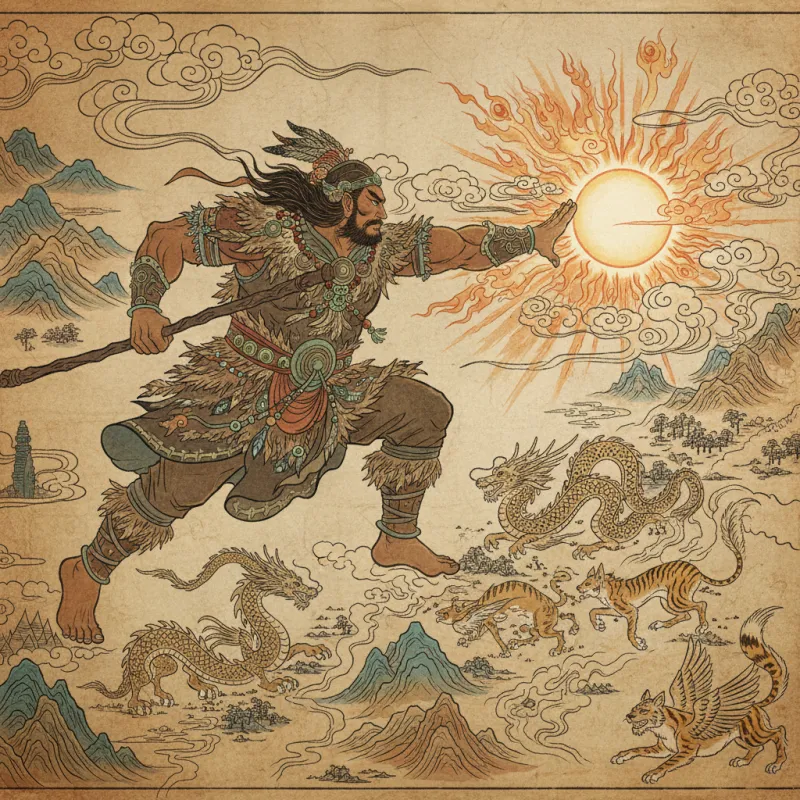
Kuafu Chasing the Sun: The Giant Who Raced Against Time
Introduction: A Race Against the Cosmos
In the vast tapestry of Chinese mythology, few tales capture the human spirit of defiance and ambition quite like the story of Kuafu (夸父, Kuāfù) chasing the sun. This ancient narrative, preserved in the Shanhai Jing (山海经, Shānhǎi Jīng, Classic of Mountains and Seas), tells of a giant who dared to race against the celestial orb itself—a pursuit that would end in both tragedy and transformation. More than a simple folktale, Kuafu's story embodies humanity's eternal struggle against natural limitations, the price of hubris, and the paradoxical beauty of noble failure.
The myth of Kuafu represents one of the earliest recorded examples of humanity's desire to conquer the unconquerable, predating similar Western myths like Icarus by centuries. Yet unlike many cautionary tales, Kuafu's story resonates with a peculiar dignity—his failure becomes a gift to future generations, his death a transformation rather than mere defeat.
The Giant of the Northern Wilderness
Origins and Identity
Kuafu was no ordinary being. According to the Shanhai Jing, he belonged to the Kuafu clan (夸父族, Kuāfù zú), a race of giants who inhabited the remote northern wilderness known as Chengdu Zaitian (成都载天, Chéngdū Zàitiān), literally "the place where Chengdu carries the sky." This geographical detail is significant—it places Kuafu's people at the very edge of the known world, where earth meets heaven, suggesting they were beings who existed at the boundary between mortal and divine realms.
The Shanhai Jing describes the Kuafu clan as descendants of Houtu (后土, Hòutǔ), the earth deity, giving them an intrinsic connection to the land itself. Some scholars interpret Kuafu's name as meaning "boastful father" or "praising father," though others suggest it may derive from ancient tribal names. His physical description varies across texts, but most sources agree on his immense stature—so tall that he could use mountains as walking sticks and drain rivers in single gulps.
The Nature of Giants in Chinese Mythology
Unlike Western giants who are often portrayed as brutish antagonists, Chinese mythological giants like Kuafu occupy a more complex position. They represent primordial forces, beings from an age when the boundaries between heaven, earth, and humanity were more fluid. The giant Pangu (盘古, Pángǔ) created the world from his body; the giant Xingtian (刑天, Xíngtiān) continued fighting even after decapitation. Kuafu fits this pattern—his actions are excessive, impossible, yet somehow noble in their ambition.
The Great Chase: Racing the Sun
The Decision to Pursue
The Shanhai Jing offers no clear motivation for why Kuafu decided to chase the sun. The text simply states: "Kuafu raced with the sun" (夸父与日逐走, Kuāfù yǔ rì zhú zǒu). This ambiguity has spawned numerous interpretations throughout Chinese history.
Some traditional commentaries suggest Kuafu sought to capture the sun to benefit humanity—perhaps the sun was scorching the earth, causing drought and suffering, and Kuafu hoped to restrain it. This interpretation aligns him with other mythological heroes like Houyi (后羿, Hòuyì), who shot down nine of ten suns to save the world from burning.
Other scholars propose more philosophical readings: Kuafu represents humanity's desire to understand and control natural phenomena, to extend the day and conquer time itself. In this view, his chase symbolizes the eternal human quest for knowledge and mastery over the environment—a theme remarkably relevant to our modern age of technological ambition.
A third interpretation, more tragic and existential, suggests Kuafu chased the sun simply because it was there—an act of pure will, a refusal to accept limitations, a gesture of defiance against the cosmic order. This reading transforms Kuafu into an ancient existentialist hero, creating meaning through action itself.
The Epic Pursuit
The chase itself is described with vivid, almost cinematic detail in various classical texts. Kuafu began his pursuit at dawn, his massive strides covering hundreds of li (里, lǐ, a traditional Chinese unit of distance) with each step. His shadow fell across entire valleys; his footsteps shook mountains and created new gorges in the earth.
As he ran, Kuafu moved from east to west, following the sun's daily path across the sky. The Shanhai Jing states he pursued the sun to Yugu (禺谷, Yúgǔ), the Valley of the Setting Sun, located at the western edge of the world. This detail is geographically significant—it suggests Kuafu nearly succeeded in his impossible task, reaching the very place where the sun descends each evening.
The race lasted an entire day, from sunrise to sunset. Imagine the spectacle: a giant racing across the ancient Chinese landscape, his determination unwavering despite the impossibility of his goal. The sun, that eternal celestial body worshipped by countless civilizations, had perhaps never before encountered such audacious pursuit.
The Fatal Thirst
Consuming Rivers and Lakes
The turning point in Kuafu's story comes not from the sun's heat or the distance traveled, but from an all-too-human need: thirst. The exertion of his cosmic race created an overwhelming thirst (渴, kě) that would prove his undoing.
The Shanhai Jing records: "He was thirsty and wanted to drink, so he drank from the Yellow River and the Wei River" (道渴而死。欲得饮,饮于河、渭, dào kě ér sǐ. Yù dé yǐn, yǐn yú Hé, Wèi). The Yellow River (黄河, Huáng Hé) and Wei River (渭河, Wèi Hé) were two of ancient China's mightiest waterways, yet Kuafu drained them both in his desperate attempt to quench his thirst.
This detail is particularly poignant. Kuafu, who could stride across mountains and race the sun itself, is ultimately defeated by thirst—a basic biological need that connects him to all living creatures. His superhuman abilities cannot overcome this fundamental requirement of existence.
The Journey North
Still unsatisfied after draining two major rivers, Kuafu turned north toward Daze (大泽, Dàzé), the Great Marsh, hoping its vast waters would finally quench his thirst. But he never reached it. The text states simply and tragically: "Before he arrived, he died of thirst" (未至,道渴而死, wèi zhì, dào kě ér sǐ).
The location of his death—somewhere between the rivers and the northern marsh—adds to the tragedy. He died in transit, still striving, still moving toward his goal even as his body failed him. There is something profoundly human in this detail: Kuafu dies not in defeat but in continued pursuit.
Transformation: The Peach Forest
Death and Rebirth
The story of Kuafu does not end with his death. In what may be the most beautiful element of the myth, his body undergoes a transformation that benefits the world he left behind. The Shanhai Jing records: "He abandoned his staff, which transformed into the Deng Forest" (弃其杖,化为邓林, qì qí zhàng, huà wéi Dèng Lín).
The Deng Forest (邓林, Dèng Lín), also called the Peach Forest (桃林, Táo Lín), sprang from Kuafu's walking stick. Some versions describe it as a vast grove of peach trees stretching for hundreds of li, providing shade, fruit, and rest for future travelers. The peach (桃, táo) holds special significance in Chinese culture—it symbolizes immortality, longevity, and the divine. The Queen Mother of the West (西王母, Xī Wángmǔ) cultivated magical peaches that granted eternal life.
This transformation elevates Kuafu's story from simple tragedy to something more profound. His failure becomes generative; his death creates life. The very staff that supported him in his impossible quest becomes a source of sustenance and shelter for others. In death, Kuafu achieves a form of immortality—not through success, but through the legacy of his attempt.
Symbolic Interpretations
The transformation of Kuafu's staff into a peach forest has inspired numerous interpretations. Some scholars see it as representing the cycle of life and death, the way individual sacrifice can benefit the collective. Others interpret it as a metaphor for how human ambition, even when it fails, can leave lasting positive impacts on civilization.
From an ecological perspective, the myth might preserve ancient memories of how human activity—even the death of individuals—contributes to the landscape's transformation. The peach forest could represent early agricultural development, the domestication of fruit trees, or the creation of oases in harsh environments.
Philosophically, the transformation suggests that the value of an endeavor lies not solely in its success but in what it creates along the way. Kuafu's journey, though ending in death, enriched the world. This aligns with Daoist concepts of wu wei (无为, wú wéi, effortless action) and the natural transformation of all things.
Cultural Significance and Interpretations
Historical Context
The Kuafu myth likely originated during the late Neolithic or early Bronze Age, a period when Chinese civilization was expanding, encountering new geographical challenges, and developing more sophisticated cosmological understanding. The story may preserve memories of ancient migrations, droughts, or the struggle to survive in harsh northern territories.
Some historians suggest Kuafu represents an actual tribal leader or group who attempted ambitious projects—perhaps irrigation systems, territorial expansion, or astronomical observations. The "chasing the sun" element might metaphorically describe attempts to extend daylight hours through artificial lighting, track solar movements for agricultural purposes, or migrate following seasonal patterns.
Literary Legacy
Throughout Chinese literary history, Kuafu has been invoked as a symbol of noble ambition and tragic heroism. The Tang Dynasty poet Li Bai (李白, Lǐ Bái) referenced Kuafu in his works to express themes of human limitation and cosmic insignificance. The Song Dynasty scholar Su Shi (苏轼, Sū Shì) used Kuafu as a metaphor for political reformers who pursued impossible ideals.
In modern Chinese literature, Lu Xun (鲁迅, Lǔ Xùn) and other writers of the May Fourth Movement reinterpreted Kuafu as representing China's struggle for modernization—a nation racing to catch up with Western powers, exhausting itself in the pursuit, yet creating something valuable through the attempt.
Philosophical Dimensions
The Kuafu myth engages with several fundamental philosophical questions:
The Nature of Heroism: Is heroism defined by success or by the nobility of the attempt? Kuafu fails utterly in his goal, yet his story has inspired admiration for millennia.
Human Limitations: The myth acknowledges that some goals are genuinely impossible, yet suggests there is value in pursuing them anyway. This tension between ambition and limitation remains central to human experience.
Transformation Through Failure: Unlike Western tragic heroes who often leave only destruction in their wake, Kuafu's failure becomes creative, generative, life-giving. This reflects a distinctly Chinese philosophical perspective on the productive potential of apparent defeat.
Comparative Mythology
Parallels with Other Traditions
Kuafu's story invites comparison with similar myths from other cultures. The Greek Icarus also pursued the sun and died in the attempt, but his story emphasizes hubris and the danger of disobedience. Kuafu's tale, by contrast, contains no moral condemnation—his ambition is presented as admirable, even if doomed.
The Norse myth of Sköll and Hati, wolves who chase the sun and moon, shares the pursuit motif but frames it as threatening rather than heroic. In Hindu mythology, the demon Rahu attempts to swallow the sun, causing eclipses—again, a hostile rather than aspirational relationship.
What distinguishes Kuafu is the absence of divine punishment or moral judgment. He is not struck down by angry gods or condemned for overreaching. He simply exhausts himself in pursuit of an impossible goal, and even in death, creates something beautiful. This reflects a more naturalistic, less moralistic approach to mythology.
Modern Relevance
Contemporary Resonance
In our age of climate change, space exploration, and technological acceleration, Kuafu's story feels remarkably contemporary. We too are racing against time—to develop sustainable energy, to reach other planets, to solve problems that may be beyond our current capabilities. Like Kuafu, we face the question of whether some pursuits are worth undertaking even if success is uncertain.
The myth also speaks to modern concerns about burnout and the cost of ambition. Kuafu literally works himself to death pursuing his goal—a fate that resonates in our era of hustle culture and constant productivity demands. Yet the story suggests that even self-destructive ambition can leave positive legacies.
Scientific and Technological Metaphors
Chinese scientists and engineers have explicitly invoked Kuafu in naming projects. The Kuafu satellite program, designed to study solar activity, directly references the myth—humanity's continued attempt to understand and "catch" the sun, now through technology rather than physical pursuit.
This modern appropriation of the myth demonstrates its enduring power as a symbol of human aspiration. We may not literally chase the sun, but we continue to pursue goals that seem impossible, to push against natural limitations, to exhaust ourselves in the attempt to achieve the extraordinary.
Conclusion: The Dignity of Impossible Dreams
The story of Kuafu chasing the sun endures because it captures something essential about the human condition: our capacity to dream beyond our limitations, to pursue goals we know may be impossible, and to find meaning in the pursuit itself rather than only in success.
Kuafu died in his attempt, but he died moving forward, still striving toward his goal. His walking stick became a forest that would shelter and feed countless travelers. His story became a myth that would inspire countless generations. In this way, he achieved a form of immortality more profound than simply catching the sun could have provided.
The myth reminds us that failure is not the opposite of success but often its foundation. The peach forest exists because Kuafu failed, died, and was transformed. Our own impossible pursuits, even when they exhaust us, may yet bear fruit we cannot foresee.
In the end, Kuafu's race against the sun is really a race against time, against mortality, against the limitations of existence itself—a race we all run, whether we acknowledge it or not. The question is not whether we will succeed in catching the sun, but whether we will run with Kuafu's courage, determination, and ultimate generosity of spirit, leaving behind forests where there was once only wilderness.