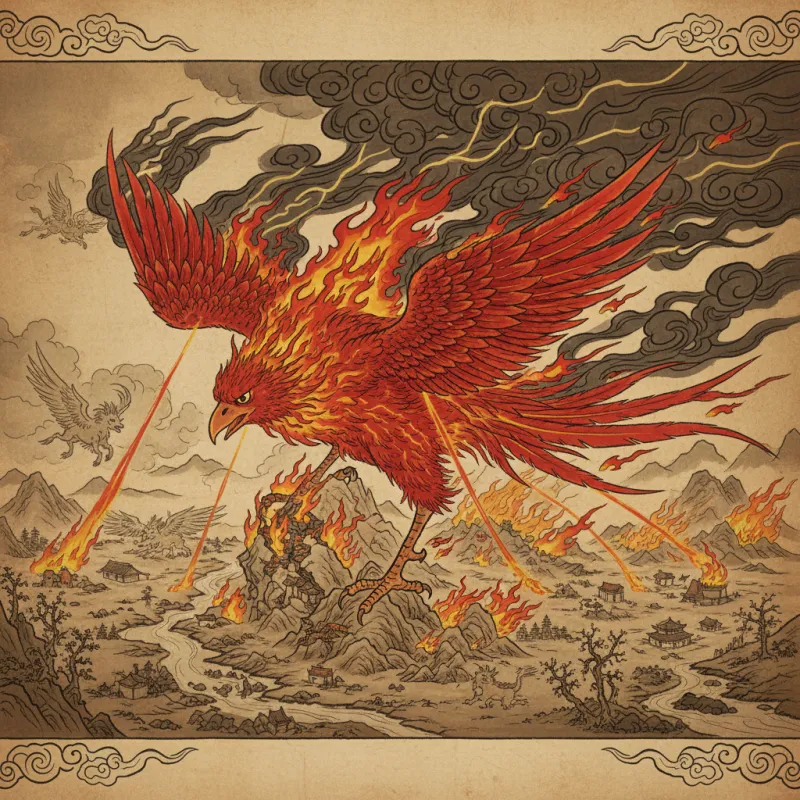
A single-legged bird wreathed in flames descends from the sky, and wherever it lands, fire follows. This isn't the majestic phoenix of rebirth and renewal—this is Bifang (畢方, bìfāng), the omen of destruction that ancient Chinese texts warned would herald catastrophe. While the phoenix symbolized imperial virtue and cosmic harmony, Bifang represented something far more unsettling: the unpredictable, consuming nature of fire itself.
The Original Text: What the Shanhaijing Actually Says
The Shanhaijing (山海經, Shānhǎi Jīng) doesn't waste words on Bifang. In the "Western Mountains Classic" section, the text describes it matter-of-factly: a bird resembling a crane, with one leg, red markings, and a blue body with red spots. Its call sounds like its own name—"bi-fang"—and wherever it appears, strange fires break out in the city. That's it. No elaborate backstory, no heroic encounters, just a terse warning that this creature's presence means trouble.
What makes this description fascinating is its specificity. The text doesn't say Bifang causes fires directly—it says fires appear where Bifang appears. This subtle distinction suggests the ancient compilers understood Bifang as an omen rather than an arsonist. The bird doesn't start the fire; it announces it. This makes Bifang less a monster to be slain and more a harbinger to be heeded, similar to how Zhuque served as a directional guardian but with far more sinister implications.
The One-Legged Mystery
Why one leg? This detail has puzzled scholars for centuries. Some argue it's symbolic—the single leg representing imbalance, the disruption of natural harmony that precedes disaster. Others suggest it might reference actual birds observed in nature, perhaps herons or cranes standing on one leg, their silhouettes distorted by heat shimmer above fires.
The Han Dynasty scholar Guo Pu (276-324 CE), who provided crucial commentary on the Shanhaijing, connected Bifang to the Yellow Emperor's legendary encounter with the creature. According to Guo Pu's notes, when the Yellow Emperor (黃帝, Huángdì) gathered spirits and deities at Mount Tai, Bifang appeared among them. The emperor's minister, Feng Hou, identified it and explained its nature, allowing the emperor to understand the omen. This story elevates Bifang from mere monster to a creature recognized even by divine beings—something significant enough to warrant imperial attention.
Fire Bird or Fire Warning?
Here's where Bifang gets interesting from a cultural perspective. In a civilization where fire could destroy entire cities built of wood and thatch, a creature associated with conflagrations would naturally inspire terror. But the Chinese approach to Bifang wasn't to hunt it down—it was to recognize and prepare.
During the Han Dynasty (206 BCE - 220 CE), images of Bifang began appearing on bronze vessels and architectural elements, not as decoration but as protective talismans. The logic was apotropaic: by acknowledging the fire-bringer, you might ward off the disaster it represented. Some buildings featured Bifang imagery on roof tiles, essentially putting the omen on guard duty against itself. This is distinctly different from how Western mythology typically handles monsters—there's no St. George slaying Bifang, no hero's quest to eliminate the threat.
The Tang Dynasty (618-907 CE) saw Bifang references in poetry and official documents about fire prevention. When the imperial library burned in 762 CE, some accounts mentioned that a strange bird had been sighted beforehand, though whether this was genuine belief or literary embellishment is unclear. What matters is that Bifang had become shorthand for "fire disaster imminent"—a cultural meme that persisted for over a millennium.
Bifang in the Broader Mythological Ecosystem
Comparing Bifang to other mythical birds reveals its unique position. The phoenix (鳳凰, fènghuáng) represented the empress, virtue, and the southern direction. The Peng (鵬, péng) was a massive bird of transformation and freedom. The Jingwei (精衛, jīngwèi) embodied determination and revenge. Bifang? Bifang was the bird nobody wanted to see.
This negative association makes Bifang rare in Chinese mythology—most creatures, even dangerous ones, have some redeeming quality or serve a cosmic purpose. Dragons bring rain. Tigers guard mountains. Even the Taotie (饕餮, tāotiè), the monstrous glutton, serves as a warning against greed. Bifang's purpose seems purely ominous, which suggests it might represent something the ancient Chinese found particularly inexplicable: spontaneous combustion, lightning strikes, or other fire phenomena they couldn't predict or control.
Some later texts tried to rationalize Bifang. The Huainanzi (淮南子), compiled around 139 BCE, mentions that Bifang emerges from wood—possibly referencing friction fires or the belief that certain trees could spontaneously ignite. This attempted naturalization of the myth shows how Chinese scholars tried to bridge folklore and observable phenomena, seeking rational explanations for supernatural claims.
Modern Interpretations and Cultural Legacy
Today, Bifang appears in Chinese fantasy literature, video games, and films, usually as a fire-element creature or boss monster. The mobile game Honor of Kings features Bifang as a summonable spirit. The novel series Grave Robbers' Chronicles references Bifang in tomb guardian contexts. These modern appearances often miss the original's subtlety—they make Bifang an active threat rather than a passive omen, turning a harbinger into a weapon.
What's lost in these adaptations is the original text's ambiguity. The Shanhaijing never says Bifang is evil or malicious. It simply exists, and its existence correlates with disaster. This is closer to how we might view certain weather patterns or geological signs today—not moral agents, but indicators of danger. Ancient Chinese observers might have noticed that certain birds appeared before fires (perhaps fleeing from distant blazes, or attracted to smoke) and codified this observation into myth.
The single-legged detail, so specific and strange, suggests Bifang might have originated from actual sightings—perhaps injured birds, or birds seen in conditions that obscured one leg. Over time, the observation became legend, and the legend became warning. This is how mythology often works: a kernel of truth wrapped in layers of cultural meaning and narrative embellishment.
Why Bifang Still Matters
In an age of fire alarms and sprinkler systems, Bifang might seem quaint. But the creature represents something timeless: humanity's need to name and recognize danger. We still have our omens—red skies, unusual animal behavior, atmospheric pressure changes—we've just stripped away the mythological packaging.
Bifang reminds us that ancient people weren't superstitious fools. They were careful observers who encoded their knowledge in memorable forms. A one-legged fire bird that calls its own name is far more memorable than "increased bird activity may correlate with approaching wildfires." The myth served a practical purpose: it kept people alert to signs of danger.
The Shanhaijing contains hundreds of creatures, but few have Bifang's stark simplicity. No elaborate origin story, no divine parentage, no moral lesson—just a warning. When you see this bird, fire follows. In that directness lies its power. Bifang doesn't need to be complex to be effective. It just needs to be remembered, and for over two thousand years, it has been.
Related Reading
- The Nine-Headed Bird: Terror of the Skies
- Hundun: The Faceless Creature of Chaos
- The Great Flood: Why Every Civilization Has a Flood Myth
- Exploring the Enigmatic Creatures and Lands of Shanhaijing: A Cultural Journey
- Unraveling the Mysteries of Shanhaijing: Myths, Creatures, and Fantastic Realms