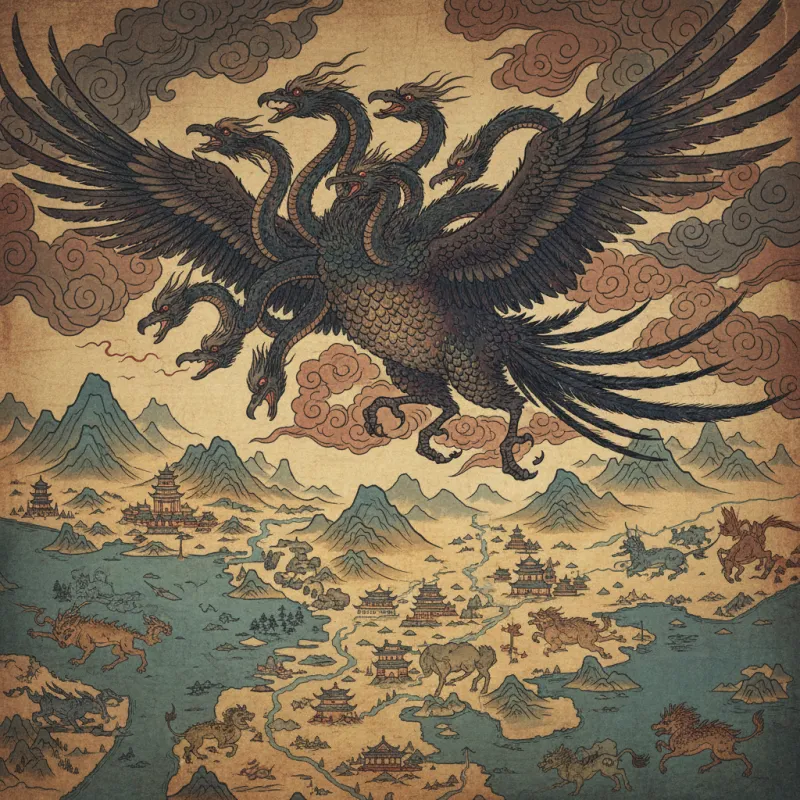
Blood drips from the night sky. Villagers across ancient China would bolt their doors when they heard the eerie cry overhead—a sound like nine voices screaming in unison. They knew what hunted above: the Jiutou Niao (九头鸟), the Nine-Headed Bird, a creature so terrifying that even emperors took precautions against its nocturnal raids.
The Original Text: What the Shanhai Jing Actually Says
The Shanhai Jing (山海经, Classic of Mountains and Seas) doesn't waste words on this monster. In the Dahuang Bei Jing (大荒北经, Classic of the Great Northern Wilderness) section, the text describes a bird with nine heads that appears in the northern wastes. But here's where it gets interesting—later commentaries and folk traditions transformed this relatively brief mention into one of Chinese mythology's most elaborate horror stories.
The Han Dynasty scholar Guo Pu (郭璞, 276-324 CE) added crucial details in his commentary, suggesting the creature once had ten heads until one was bitten off by a celestial hound. The wound never healed, and blood perpetually drips from the stump—which explains why the bird hunts at night, seeking to steal human souls to ease its eternal agony. Whether Guo Pu invented this backstory or recorded existing folklore, we'll never know, but his version became canonical.
What strikes me about the original text is its restraint. The Shanhai Jing typically catalogs creatures with clinical detachment—"there is a bird with nine heads"—but later generations couldn't resist embellishing. This pattern repeats throughout Chinese mythology, where terse ancient records become elaborate cautionary tales.
Anatomy of a Monster: Nine Heads, One Nightmare
Each of the nine heads possesses its own personality and function, according to Tang Dynasty (618-907 CE) sources. The central head commands, while the others scan in different directions, making the creature nearly impossible to ambush. Some texts claim each head speaks a different dialect, allowing it to understand prayers and curses from across China—a detail that suggests the Nine-Headed Bird represents something more than simple terror.
The body itself resembles a massive crane or heron, with blood-red plumage that appears black under moonlight. Its wingspan allegedly stretches thirty feet, and its talons can pierce bronze shields. But the most disturbing feature remains that bleeding neck stump, which folk tradition says you can hear before you see the bird—a steady drip-drip-drip from the darkness above.
Ming Dynasty (1368-1644) texts add that the creature's blood is toxic, causing crops to wither and wells to sour. Villages where the Nine-Headed Bird flew overhead would suffer misfortune for months. This detail connects it to other ominous creatures in the Shanhai Jing, like the Zhuque (朱雀, Vermillion Bird), though that celestial guardian represents benevolent fire while the Jiutou Niao embodies corruption and decay.
The Celestial Hound Connection: A Cosmic Backstory
The story of how the Nine-Headed Bird lost its tenth head deserves closer examination. According to the most popular version, the creature originally served as a celestial messenger until it grew arrogant and attempted to steal the peaches of immortality. The Jade Emperor dispatched Tiangou (天狗, the Celestial Hound) to punish the thief.
Tiangou—itself a fascinating figure that later became associated with solar eclipses—caught the bird and tore off one head. But instead of killing the creature, this punishment transformed it into something worse: an immortal being trapped in eternal suffering. The Nine-Headed Bird fell from heaven, literally and metaphorically, becoming a vengeful spirit that haunts the mortal realm.
This origin story follows a common pattern in Chinese mythology where celestial beings fall from grace and become demons or monsters. The Fenghuang (凤凰, Chinese Phoenix) represents the opposite trajectory—a bird that achieves perfection and ascends. The Nine-Headed Bird serves as its dark mirror, showing what happens when ambition curdles into malice.
Regional Variations: The Bird That Changed With Geography
Here's something most English sources miss: the Nine-Headed Bird isn't one consistent legend. In Hubei Province, locals called it the Guiche (鬼车, Ghost Carriage) and believed it carried away the souls of the dying. Hearing its cry meant someone in your family would die within the year. People would throw shoes onto their roofs to ward it off—the logic being that the bird would waste time examining the shoes and forget its murderous purpose.
In Sichuan, the creature became associated with plague and disease. A 12th-century text from the Song Dynasty records that officials would organize torch-lighting ceremonies during epidemics to frighten away the Nine-Headed Bird, which supposedly spread illness through its dripping blood. Whether these ceremonies worked is debatable, but they reveal how the myth adapted to explain real-world catastrophes.
The Yangtze River region developed the most elaborate protective rituals. Families would paint red symbols on their doors and hang garlic—yes, garlic, centuries before European vampire legends—to repel the creature. Some villages maintained "bird watchers" who would sound gongs if they spotted the creature's silhouette against the moon. This practical response to a mythical threat shows how deeply the legend penetrated daily life.
Literary Evolution: From Omen to Metaphor
By the Tang Dynasty, poets had discovered the Nine-Headed Bird's metaphorical potential. Li Bai (李白, 701-762 CE) never mentioned it directly, but his contemporary Li He (李贺, 790-816 CE)—known for his dark, supernatural imagery—used the creature to symbolize corrupt officials who "feed on the people's suffering." This political interpretation became increasingly common.
The Ming Dynasty novel Fengshen Yanyi (封神演义, Investiture of the Gods) features a character who transforms into a Nine-Headed Bird during battle, using its multiple heads to cast nine different spells simultaneously. This combat-focused interpretation influenced later martial arts fiction, where multi-headed creatures often represent masters of multiple fighting styles.
Qing Dynasty (1644-1912) scholars took a rationalist approach, suggesting the Nine-Headed Bird might be a distorted memory of actual birds. Some proposed it was an exaggerated description of the great bustard, which has elaborate head plumage. Others suggested it represented a flock of birds flying in formation. These explanations miss the point—the Nine-Headed Bird's power lies in its impossibility, not its zoological accuracy.
Modern Interpretations: The Bird in Contemporary Culture
The Nine-Headed Bird hasn't disappeared into obscurity. Modern Chinese fantasy literature and games frequently feature it as a boss monster or corrupted guardian. The creature appears in the popular game Honor of Kings as a fearsome opponent, and several contemporary wuxia novels use it as a symbol of fractured identity or competing desires—nine heads, nine different wants, one suffering body.
Environmental activists in China have occasionally invoked the Nine-Headed Bird as a metaphor for pollution and industrial damage—a creature whose blood poisons the land, much like modern contamination. This reinterpretation shows the myth's continued relevance, adapting ancient fears to contemporary concerns.
What fascinates me most is how the creature's core symbolism remains consistent across centuries: the danger of ambition, the price of immortality, and the terror of something that should be dead but refuses to die. These themes resonate regardless of dynasty or era.
The Enduring Terror: Why This Bird Still Matters
The Nine-Headed Bird endures because it embodies a specifically Chinese approach to horror—not the sudden shock of Western monsters, but the slow dread of something wrong in the cosmic order. It's not just dangerous; it's unnatural, a being that exists in a state of permanent wrongness.
Unlike the Qilin (麒麟, Chinese unicorn), which appears to herald virtuous rulers, the Nine-Headed Bird signals cosmic imbalance. Its presence suggests that heaven and earth have fallen out of alignment, that the natural order has been disrupted. This makes it more than a monster—it's a symptom of larger problems.
For modern readers, the Nine-Headed Bird offers a window into how ancient Chinese culture processed fear and misfortune. When crops failed or plague struck, people needed explanations. A blood-dripping bird with nine heads, forever suffering from its own hubris, provided both a cause and a warning: respect the cosmic order, or suffer the consequences.
The next time you hear about the Nine-Headed Bird, remember it's not just a monster from an old book. It's a story about ambition and punishment, about how the mighty fall and what they become when they refuse to stay down. It's a reminder that some wounds never heal, and some hungers can never be satisfied—nine heads or not.
Related Reading
- Bifang: The Fire Bird That Brings Disaster
- Hundun: The Faceless Creature of Chaos
- Flood Myths: Noah vs Gun-Yu
- Chinese Dragons: Everything You Need to Know
- Mystical Beasts of the Shanhaijing: A Journey Through Myth and Geography