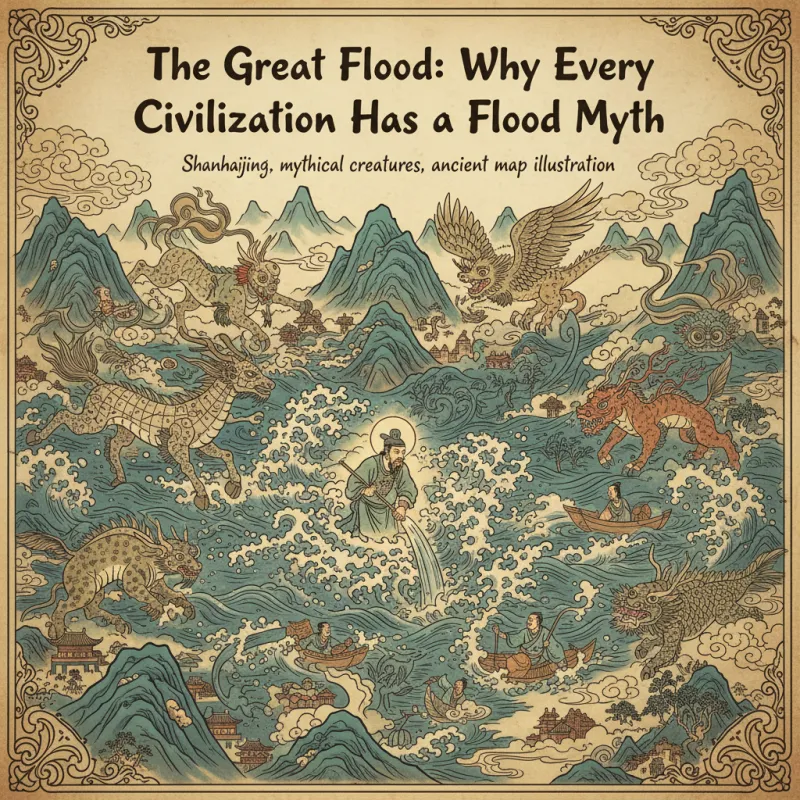
The water is rising. It has been rising for generations. In ancient China, the Yellow River doesn't just overflow—it rewrites the landscape, swallows villages, turns farmland into lakes. And in every corner of the world, from Mesopotamia to Mesoamerica, people are telling the same story: the world drowned, and we barely survived.
This isn't coincidence. This is one of humanity's most persistent memories.
When the Sky Cracked Open
The flood myth appears in virtually every ancient civilization that left written records. The Mesopotamian Epic of Gilgamesh, written around 2100 BCE, tells of Utnapishtim building an ark to survive divine wrath. The Hebrew Bible's Noah follows a nearly identical template—so similar that scholars have spent centuries debating which influenced which. The Greeks had Deucalion and Pyrrha, sole survivors who repopulated Earth by throwing stones that became people. In Hindu tradition, Manu receives warning from a fish avatar of Vishnu and builds a boat to ride out the deluge.
But here's what makes the Chinese version radically different: it's not about divine punishment. It's about engineering failure.
In the Shanhaijing (山海经 Shānhǎijīng, Classic of Mountains and Seas) and related texts, the flood isn't sent by angry gods—it's a natural disaster that the gods themselves struggle to fix. The Yellow Emperor dispatches Gun (鲧 Gǔn) to control the waters. Gun's approach? Steal xirang (息壤 xīrǎng), a magical self-expanding soil from heaven, and build dams to contain the flood. It doesn't work. The waters keep rising. Gun is executed for his failure, and from his corpse emerges his son Yu (禹 Yǔ), who will succeed where his father failed.
Yu the Great doesn't fight the water—he works with it. Instead of building walls, he dredges channels. He creates drainage systems. He spends thirteen years wading through floodwaters, supposedly passing his own house three times without stopping to visit his family. This is flood mythology as infrastructure project, and it's uniquely Chinese in its pragmatism.
The Geological Evidence Nobody Wants to Talk About
Here's where it gets interesting: there's actual evidence of catastrophic flooding in ancient China.
In 2016, a team of geologists published findings in Science about a massive flood on the Yellow River around 1920 BCE. An earthquake triggered a landslide that dammed the river, creating a lake. When the dam broke, it released a wall of water that would have been catastrophic—flows estimated at 300,000-500,000 cubic meters per second, making it one of the largest freshwater floods in human history.
The timing aligns suspiciously well with the traditional dates for Yu's flood control efforts and the founding of the Xia Dynasty (夏朝 Xià Cháo), China's first dynasty, which Yu supposedly established. Did the myth preserve a memory of a real disaster? Or did later historians retrofit geological events onto existing mythology?
The same question haunts flood myths globally. The Black Sea deluge hypothesis suggests that around 5600 BCE, the Mediterranean broke through to the Black Sea, flooding thousands of square miles of inhabited land. Could this event have seeded flood myths across multiple cultures? Some geologists think so. Others point out that catastrophic flooding is common enough that every river civilization would have experienced it independently.
Why Floods, Specifically?
Of all the disasters that could wipe out humanity—plague, famine, fire, earthquake—why does nearly every culture fixate on floods?
The answer might be simpler than we think: early civilizations clustered around rivers. The Tigris and Euphrates. The Nile. The Indus. The Yellow River. These waterways made agriculture possible, but they also flooded regularly and unpredictably. A flood could destroy a year's harvest, kill livestock, wash away homes, and drown entire communities. Unlike earthquakes or storms, floods could last for weeks or months, transforming the entire landscape.
Water also carries symbolic weight that other disasters don't. It's both life-giving and life-destroying. It cleanses and it drowns. It's the original chaos from which order emerges—in Genesis, in the Enuma Elish, in countless creation myths, the world begins as formless water. A flood myth is really a creation myth in reverse: the world returns to primordial chaos, then is reborn.
The Chinese flood myth emphasizes this regenerative aspect. Yu doesn't just stop the flood—he reorganizes the entire geography of China. The Shanhaijing describes him measuring the land, categorizing mountains and rivers, establishing the boundaries of the known world. The flood becomes an opportunity to impose order on chaos, to transform wilderness into civilization. Compare this to the role of mythical creatures in establishing cosmic order, where beings like the Four Symbols serve similar organizational functions.
The Ark Problem
Most flood myths include a survival vessel. Noah's ark is the most famous, but Utnapishtim's boat in Gilgamesh is nearly identical—both are massive rectangular barges, both carry breeding pairs of animals, both land on a mountain when the waters recede. The Hindu Manu ties his boat to a fish's horn. The Greek Deucalion builds a chest.
The Chinese version? No ark.
Gun and Yu don't escape the flood—they wade into it. They don't preserve the old world; they build a new one. This reflects a fundamentally different worldview. In Mesopotamian and Hebrew tradition, the flood is a reset button. Humanity is corrupt, so God wipes the slate clean and starts over with one righteous family. The flood is punishment and purification.
In Chinese tradition, the flood is a problem to be solved through human effort and ingenuity. There's no moral dimension. The waters aren't rising because people sinned—they're rising because that's what water does. And the solution isn't divine intervention or miraculous survival, it's backbreaking labor and clever engineering.
This distinction matters. It reveals different assumptions about the relationship between humans, nature, and the divine. Western flood myths emphasize human helplessness before divine power. The Chinese version emphasizes human agency and the possibility of mastering nature through persistence and skill.
The Survivors and What They Remember
Every flood myth includes survivors who preserve knowledge and restart civilization. But what they preserve varies dramatically.
Noah brings animals and his family. Utnapishtim brings craftsmen and seeds. Manu brings the Vedas, the sacred texts. Deucalion and Pyrrha bring nothing—they create new humans from stones, a blank slate.
Yu brings administrative knowledge. He brings surveying techniques, hydraulic engineering, systems of measurement and classification. The post-flood world in Chinese mythology isn't just rebuilt—it's organized, mapped, catalogued. The Shanhaijing itself can be read as Yu's flood control project in textual form: an exhaustive inventory of mountains, rivers, creatures, and resources. The geographical organization of mythical beasts reflects this same impulse to impose order on a chaotic world.
This suggests that different cultures feared losing different things in a catastrophe. Mesopotamians feared losing their animals and agricultural knowledge. Indians feared losing their sacred texts. Chinese feared losing their administrative systems and geographical knowledge—the organizational structures that held civilization together.
The Flood That Never Ends
Here's the uncomfortable truth: the flood myth persists because flooding persists.
The Yellow River has flooded more than 1,500 times in recorded history. It's killed millions. It's changed course dramatically at least nine times, sometimes shifting hundreds of miles. The Chinese called it "China's Sorrow." Every generation experienced catastrophic flooding. Every generation needed the story of Yu, the man who tamed the waters.
The same is true globally. The Tigris and Euphrates still flood. The Ganges still floods. The Mississippi still floods. We build better levees, better drainage systems, better early warning systems—we become Yu, over and over again. But the water keeps rising.
Maybe that's why the flood myth won't die. It's not really about the past. It's about the eternal struggle between human civilization and the natural forces that threaten to overwhelm it. Every dam we build, every channel we dredge, every flood control system we engineer is a reenactment of Yu's thirteen-year labor.
The myth isn't asking whether a global flood happened. It's asking: when the waters rise—and they will rise—what kind of people will we be? Will we wait for divine rescue, or will we wade into the flood and start digging channels?
The Chinese answered that question 4,000 years ago. We're still answering it today.
Related Reading
- Chinese vs. Egyptian Mythology: Afterlives and Animal Gods
- Chinese vs. Norse Mythology: Dragons, Giants, and World Trees
- Chinese Dragons vs European Dragons
- Flood Myths: Noah vs Gun-Yu
- Weapons of the Gods in Chinese Mythology
- Shanhaijing Cosmology: How Ancient China Imagined the Universe
- Pangu and the Cosmic Egg: Chinese Creation Story