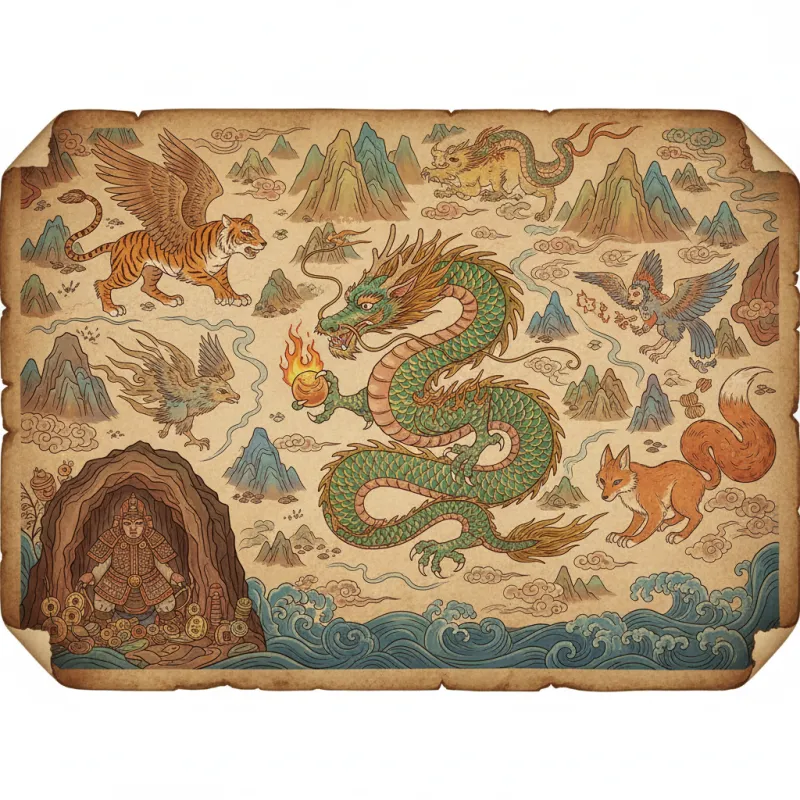
Picture this: It's 206 BCE, and Liu Bang — a former peasant turned rebel leader — has just defeated his rivals to become the first emperor of the Han Dynasty. His official historians immediately get to work on a crucial task: fabricating his divine ancestry. The story they concoct? His mother dreamed of a dragon the night before his conception. This wasn't creative fiction. This was political necessity. Because in China, if you wanted to rule, you needed dragon blood.
Chinese dragons (龙 lóng) operate on completely different logic than their Western counterparts. They don't terrorize villages or guard treasure hoards. They're not obstacles to overcome — they're the ultimate symbol of cosmic power, imperial legitimacy, and natural harmony. And unlike the Phoenix, which represents the empress and yin energy, the dragon embodies yang, masculine authority, and the emperor himself.
The Nine Resemblances: Anatomy of a Composite Deity
Song Dynasty scholar Luo Yuan (罗愿 Luó Yuàn) documented what every Chinese artist already knew: dragons are magnificent chimeras. His "nine resemblances" (九似 jiǔ sì) catalog reads like a divine recipe:
The horns of a deer (鹿 lù), the head of a camel (驼 tuó), the eyes of a rabbit (兔 tù), the neck of a snake (蛇 shé), the belly of a clam (蜃 shèn), the scales of a carp (鲤 lǐ), the claws of an eagle (鹰 yīng), the paws of a tiger (虎 hǔ), and the ears of an ox (牛 niú).
This isn't random. Each component carries symbolic weight. The carp scales reference the legend of carp leaping over the Dragon Gate (龙门 Lóngmén) — a metaphor for passing the imperial examinations that every scholar knew by heart. The deer horns suggest longevity and spiritual power. The snake body allows for that characteristic sinuous movement through clouds and water.
Most dragons sport 117 scales — 81 infused with yang energy, 36 with yin. Why 117? Because Chinese cosmology loves numerology, and these numbers align with the 9×9 magic square and the 36 heavenly spirits. The pearl often depicted under a dragon's chin or in its claws represents wisdom, spiritual energy, and — depending on which text you're reading — either the moon or the dragon's own concentrated essence.
The Four Dragon Kings and the Bureaucracy of Rain
Chinese cosmology doesn't do chaos. Everything has hierarchy, job descriptions, and reporting structures — even mythical creatures. The Four Dragon Kings (四海龙王 Sìhǎi Lóngwáng) govern the seas in each cardinal direction, and they're essentially middle managers in the celestial bureaucracy.
Ao Guang (敖广 Áo Guǎng) rules the East Sea and gets the most screen time in Journey to the West (西游记 Xīyóujì), where Sun Wukong raids his palace for the magical staff Ruyi Jingu Bang. Ao Qin (敖钦 Áo Qīn) manages the South Sea, Ao Run (敖闰 Áo Rùn) handles the West, and Ao Shun (敖顺 Áo Shùn) oversees the North. Their primary job? Rain distribution.
This wasn't metaphorical. When droughts struck, emperors performed elaborate rituals to petition these dragon kings. During the Tang Dynasty, Emperor Xuanzong (玄宗 Xuánzōng) officially granted them noble titles. When rain came, they received promotions. When droughts persisted, they got demoted. The Ming Dynasty even had protocols for punishing dragon statues — removing them from temples, exposing them to sun, or symbolically "imprisoning" them until the weather improved.
The Classic of Mountains and Seas (山海经 Shānhǎijīng) mentions numerous dragon-like creatures, though the text predates the fully developed dragon mythology. The Yinglong — a winged dragon who helped the Yellow Emperor defeat Chi You — represents an earlier, more martial conception of dragon power before they became primarily associated with water and imperial authority.
From Neolithic Jade to Imperial Robes: Seven Millennia of Dragon Evolution
The archaeological record doesn't lie. The Chahai site in Inner Mongolia yielded a dragon made from stones arranged in a 19.7-meter pattern, dated to around 6,000 BCE. The Hongshan culture (红山文化 Hóngshān wénhuà) produced jade dragons around 4,500 BCE — curved, pig-like creatures that barely resemble later dragons but establish the symbolic continuity.
By the Shang Dynasty (1600-1046 BCE), dragons appeared on bronze vessels with more recognizable features. The Zhou Dynasty (1046-256 BCE) began associating dragons with royal authority. But the real transformation happened during the Han Dynasty (206 BCE - 220 CE), when dragon imagery became inseparable from imperial identity.
The emperor's throne was the "dragon throne" (龙椅 lóng yǐ). His face was the "dragon face" (龙颜 lóng yán). His robes featured the five-clawed dragon (五爪龙 wǔzhǎo lóng) — a design so restricted that commoners caught wearing it faced execution. Lesser nobles could wear four-clawed dragons. Commoners got three claws maximum, and even then, only in specific contexts.
The Ming and Qing dynasties took this further. The Forbidden City contains approximately 13,844 dragon images — someone actually counted. The number nine appears repeatedly in dragon symbolism because it's the highest single-digit number and represents ultimate yang. The Nine Dragon Wall (九龙壁 Jiǔlóng Bì) in Beihai Park showcases nine different dragons in glazed tiles, each with distinct personalities and poses.
Dragons in Literature: From Divine Helpers to Complex Characters
Early texts treat dragons as forces of nature or divine servants. The Zuo Zhuan (左传 Zuǒzhuàn), a historical chronicle from around 400 BCE, mentions dragons matter-of-factly — they're raised, they're ridden, they serve rulers. No drama, just facts.
Journey to the West changed the game. Ao Guang's Dragon Palace becomes a fully realized underwater kingdom with bureaucracy, family drama, and political intrigue. The dragon kings have daughters who fall in love with mortals, sons who get into trouble, and treasuries that get robbed by monkey kings. They're not abstract symbols — they're characters with personalities and problems.
The Investiture of the Gods (封神演义 Fēngshén Yǎnyì) features Nezha killing Ao Bing (敖丙 Áo Bǐng), the third son of Ao Guang, which triggers a diplomatic crisis between heaven and the sea. This story has been retold countless times, most recently in the 2019 animated film Ne Zha, which grossed over $700 million and reimagined Ao Bing as a tragic figure rather than a simple antagonist.
Strange Tales from a Chinese Studio (聊斋志异 Liáozhāi Zhìyì) by Pu Songling includes multiple stories of dragons in human form, dragon-human romances, and dragons who fail at their jobs and face celestial punishment. These tales humanize dragons while maintaining their supernatural status — they're powerful but not omnipotent, divine but not infallible.
The Dragon Dance and Living Tradition
Walk through any Chinatown during Lunar New Year, and you'll see the dragon dance (舞龙 wǔlóng) — a tradition that dates back to the Han Dynasty. But watch closely. The dragon doesn't move randomly. Skilled performers make it "swim" through the air, mimicking the sinuous movement through water and clouds that classical texts describe.
The dance requires 9 to 15 performers, each controlling a section of the dragon's body with poles. The lead dancer manipulates the head, which can weigh up to 30 kilograms and contains mechanisms for moving eyes, mouth, and ears. The performance follows specific patterns: "dragon chasing pearl," "dragon looking at the moon," "dragon rolling on the ground." Each pattern has symbolic meaning related to prosperity, harmony, or seasonal change.
Southern Chinese dragon dances differ from northern styles. Guangdong dragons tend to be longer and more elaborate, with more performers and more acrobatic movements. Northern dragons are often shorter and emphasize martial arts influences. The Hakka people perform fire dragon dances where the dragon is covered in incense sticks, creating a spectacular nighttime display.
This isn't museum culture. This is living tradition that adapts while maintaining core symbolism. Modern dragon dances incorporate LED lights, synchronized music, and competitive elements. The World Dragon and Lion Dance Championship attracts teams globally, judged on technique, synchronization, and artistic interpretation.
Dragons Beyond China: The East Asian Dragon Complex
Chinese dragon mythology didn't stay contained within China's borders. Korean dragons (용 yong) share the basic form but emphasize different aspects — they're more associated with agriculture and less with imperial power, reflecting Korea's different political history. Korean dragons often have longer beards and more pronounced whiskers.
Japanese dragons (竜 ryū or 龍 tatsu) underwent significant transformation. Early Japanese dragons closely resembled Chinese versions, but by the medieval period, they developed distinct characteristics: three claws instead of five, more serpentine bodies, and stronger associations with Buddhism. The dragon king Ryūjin (龍神) rules an underwater palace called Ryūgū-jō, similar to but distinct from the Chinese dragon kings.
Vietnamese dragons (rồng) split the difference. They retain the Chinese association with imperial power — the Nguyễn Dynasty used dragon imagery extensively — but incorporate Southeast Asian elements. Vietnamese dragons are often depicted without wings but with a more crocodilian head, reflecting local fauna.
The Qilin, sometimes called the "Chinese unicorn," shares the dragon's composite anatomy and auspicious symbolism but represents different virtues — gentleness, benevolence, and the arrival of wise rulers rather than the ruler's own power.
The Dragon Today: From Communist Ambivalence to National Symbol
Here's something most people don't know: the early Communist Party had complicated feelings about dragons. During the Cultural Revolution (1966-1976), dragon imagery was sometimes criticized as feudal superstition. The dragon represented imperial authority — exactly what the revolution opposed.
But symbols are resilient. By the 1980s, dragons were being rehabilitated as cultural heritage rather than political symbols. The 1988 Year of the Dragon saw a massive resurgence in dragon imagery. Today, China embraces the dragon as a national symbol, though carefully distinguishing it from the emperor-worship of the past.
The phrase "descendants of the dragon" (龙的传人 lóng de chuánrén) became popular through a 1978 song by Hou Dejian and now serves as a pan-Chinese ethnic identifier. It's nationalism wrapped in mythology — claiming dragon ancestry without claiming imperial legitimacy.
Modern Chinese science fiction and fantasy literature is reclaiming and reimagining dragon mythology. Liu Cixin's works reference traditional cosmology while subverting it. Online novels feature dragon cultivation systems, dragon-human hybrids, and dragons as misunderstood ancient species rather than divine beings. The mythology evolves while maintaining recognizable core elements.
The dragon remains what it's always been: a mirror reflecting Chinese cultural values, political structures, and cosmic understanding. It's just that the reflection keeps changing as China itself transforms. Seven thousand years of continuous symbolic evolution, and the dragon still hasn't finished its journey through the clouds.
Related Reading
- The Nine-Tailed Fox: From Divine Messenger to Demonic Seductress
- Divine Beasts of the Shanhaijing: The Four Guardians and Beyond
- The Four Symbols: Azure Dragon, White Tiger, Vermillion Bird & Black Tortoise
- The Qilin: China's Sacred Unicorn and Divine Messenger
- Fenghuang: The Chinese Phoenix and Its True Meaning
- Exploring the Enigmatic Creatures and Lands of Shanhaijing: A Cultural Journey
- The Jade Palace of Kunlun: Home of the Queen Mother of the West — Shanhai Perspective
- Discovering the Guardians of Shanhaijing: Mythical Creatures and Legendary Lands