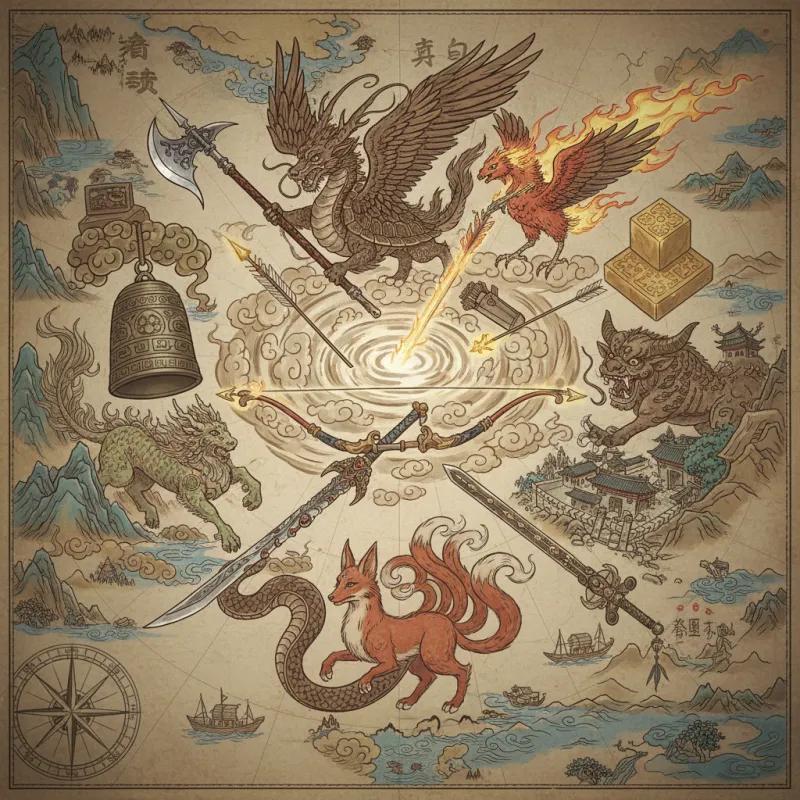
I mean, some of them do. But compared to Greek mythology, where every other deity has a signature weapon — Zeus's thunderbolt, Poseidon's trident, Athena's spear — Chinese mythology distributes its divine armaments differently. The most powerful gods often wield objects that Westerners wouldn't recognize as weapons at all. A whip. A pagoda. A ring. A gourd.
It took me a long time to understand that this isn't a gap in the mythology. It's a fundamentally different philosophy of divine power.
The Principle: Authority Over Force
Western divine weapons tend to amplify physical force. Thor's hammer hits harder. Excalibur cuts deeper. The logic is straightforward: the weapon makes you stronger, faster, more lethal.
Chinese divine weapons work differently. They don't amplify force — they manifest authority. The distinction matters. When Nezha (哪吒, Nézhā) wields his Universe Ring (乾坤圈, Qiánkūn Quān), he's not hitting harder. He's imposing cosmic order. When Erlang Shen (二郎神, Èrláng Shén) uses his Three-Pointed Double-Edged Blade (三尖两刃刀, Sānjiān Liǎngrèn Dāo), the weapon channels his divine mandate to hunt demons, not just his physical strength.
This reflects a deeper Daoist and Confucian worldview: true power comes from alignment with the Dao (道, Dào) or the Mandate of Heaven (天命, Tiānmìng), not from brute force. A god's weapon is less a tool of destruction and more a symbol of their cosmic role. It's why the Jade Emperor (玉皇大帝, Yùhuáng Dàdì), the supreme deity, doesn't carry any weapon at all — his authority is absolute and needs no physical manifestation.
The Binding Weapons: Control, Not Destruction
The most distinctively Chinese category of divine weapons are the binding implements. These don't kill — they restrain, capture, and transform.
Take the Diamond Snare (金刚琢, Jīngāng Zhuó), wielded by Taishang Laojun (太上老君, Tàishàng Lǎojūn). In Journey to the West (西游记, Xīyóu Jì), this bracelet-like weapon defeats Sun Wukong (孙悟空, Sūn Wùkōng) not by overpowering him, but by binding his limbs and nullifying his transformations. It's a weapon that says: "Your rebellion ends here. Submit to cosmic order."
Or consider Nezha's Red Armillary Sash (混天绫, Hùntiān Líng), a seven-foot-long piece of silk that can extend infinitely to bind opponents. When Nezha fights the Dragon King's son Ao Bing (敖丙, Áo Bǐng) in the East Sea, he doesn't stab or slash — he wraps, constricts, and subdues. The message is clear: divine power is about bringing chaos under control, not annihilating it.
This binding philosophy extends to containers. The most famous is probably Taishang Laojun's Purple-Gold Red Gourd (紫金红葫芦, Zǐjīn Hóng Húlu), which doesn't attack enemies — it sucks them inside and dissolves them. The gourd appears throughout Journey to the West, and its logic is fascinating: it calls your name, you respond, and you're trapped. It's a weapon that operates on the principle of true names and cosmic recognition, not physical combat.
The Whip: Discipline and Hierarchy
If there's one weapon that encapsulates Chinese divine philosophy, it's the whip. Not the bullwhip of Western imagination, but the ceremonial whip (鞭, biān) that represents authority and discipline.
Jiang Ziya (姜子牙, Jiāng Zǐyá), the mortal general who becomes the God-Conferring Marshal in Investiture of the Gods (封神演义, Fēngshén Yǎnyì), wields the Divine Whip for Beating Gods (打神鞭, Dǎshén Biān). This weapon can strike any deity below the rank of saint, regardless of their power level. It doesn't matter if you're a dragon king or a celestial warrior — if Jiang Ziya has the mandate to discipline you, the whip will hurt.
The whip's power comes entirely from bureaucratic authority. It's the divine equivalent of an imperial edict. This is why Jiang Ziya, a relatively weak cultivator compared to the immortals he commands, can control beings far more powerful than himself. He's not stronger — he's authorized.
Compare this to the divine bureaucracy of Chinese heaven, where rank and title matter more than raw power. The whip is the perfect weapon for such a system: it enforces hierarchy, not dominance.
The Pagoda: Architecture as Weapon
Li Jing (李靖, Lǐ Jìng), the Pagoda-Bearing Heavenly King and father of Nezha, carries one of the strangest "weapons" in any mythology: the Exquisite Pagoda of Yellow Gold (玲珑黄金宝塔, Línglóng Huángjīn Bǎotǎ).
This isn't a weapon you swing or throw. It's a miniature tower that can expand to trap demons inside its multiple levels. Each floor of the pagoda represents a different realm of Buddhist cosmology, and beings trapped inside experience time differently, undergo purification, or face judgment. The pagoda doesn't kill — it transforms and redeems.
The pagoda-as-weapon reveals the Buddhist influence on Chinese mythology. Buddhism entered China during the Han Dynasty (206 BCE – 220 CE) and gradually merged with indigenous Daoist and folk traditions. By the Ming Dynasty (1368-1644 CE), when Journey to the West was written, Buddhist concepts of karma, reincarnation, and redemption had thoroughly permeated Chinese divine weaponry.
Li Jing's pagoda is also deeply personal. In some versions of the Nezha myth, the pagoda was given to Li Jing by the Buddha specifically to suppress his own son, Nezha, after their violent conflict. The weapon literally mediates their father-son relationship, preventing Nezha from killing Li Jing while giving Li Jing authority over his rebellious child. It's family therapy through divine architecture.
The Transforming Weapons: Fluidity Over Fixity
Some Chinese divine weapons refuse to stay in one form. They shift, adapt, and transform according to need.
Sun Wukong's Ruyi Jingu Bang (如意金箍棒, Rúyì Jīngū Bàng) — the Compliant Golden-Hooped Rod — is the most famous example. Originally a pillar used by Yu the Great (大禹, Dà Yǔ) to measure ocean depths, it can shrink to the size of a needle or expand to prop up the sky. It weighs 17,550 pounds but Sun Wukong can store it behind his ear. It's a weapon that embodies the Daoist principle of wu wei (无为, wúwéi) — effortless action and natural adaptation.
What makes the Ruyi Jingu Bang distinctly Chinese is that it's not inherently a weapon. It's a tool of cosmic engineering that Sun Wukong repurposes for combat. This reflects the Chinese philosophical preference for dual-use objects and the blurring of boundaries between categories. A measuring rod becomes a weapon. A weapon becomes a walking stick. Form follows function, and function is fluid.
Erlang Shen's Three-Pointed Double-Edged Blade operates similarly. It's part spear, part halberd, part plow — a weapon that can fight demons, till fields, or channel water. Erlang Shen himself is a god of irrigation and flood control, and his weapon reflects this multiplicity of roles. Divine power in Chinese mythology is rarely specialized; it's comprehensive and adaptive.
The Talismans and Seals: Written Authority
Perhaps the most uniquely Chinese divine weapons are the ones made of paper and ink: talismans (符, fú) and seals (印, yìn).
The Celestial Master Zhang Daoling (张道陵, Zhāng Dàolíng), founder of the Celestial Masters school of Daoism during the Eastern Han Dynasty (25-220 CE), wielded talismans that could command spirits, heal diseases, and protect against demons. These weren't physical weapons in any conventional sense — they were written contracts between the human and spirit worlds, enforced by cosmic law.
The logic here is deeply Confucian: writing creates reality. An imperial edict written on paper can mobilize armies, redistribute land, or execute criminals. Similarly, a properly written talisman, inscribed with the correct characters and activated through ritual, can bind demons or summon gods. The weapon is language itself, formalized and empowered.
Seals work similarly. The Seal of the Celestial Masters (天师印, Tiānshī Yìn) doesn't strike or cut — it stamps. But that stamp carries the full authority of the Daoist hierarchy. When pressed onto a talisman or document, it transforms ordinary paper into a binding cosmic contract. It's bureaucracy as magic, or magic as bureaucracy — the distinction collapses.
This reflects the historical reality of imperial China, where written documents and official seals held immense power. The mythology simply extends this logic into the divine realm. The celestial bureaucracy operates on the same principles as the earthly one, and its weapons are correspondingly administrative.
The Mirrors and Gourds: Reflection and Containment
Two other weapon categories deserve mention: mirrors and gourds, both of which operate on principles of reflection and containment rather than direct force.
The Demon-Revealing Mirror (照妖镜, Zhàoyāo Jìng) appears throughout Chinese mythology and folklore. It doesn't attack demons — it reveals their true form, stripping away illusions and disguises. The weapon's power is epistemological: it grants knowledge, and knowledge enables action. Once a demon's true nature is revealed, it can be properly addressed.
This reflects the Confucian emphasis on rectification of names (正名, zhèngmíng) — the idea that social order depends on calling things by their proper names and ensuring that reality matches designation. A demon pretending to be human creates disorder. The mirror restores truth and, therefore, order.
Gourds appear repeatedly as divine weapons, most famously in the hands of Taishang Laojun but also wielded by various immortals and demon hunters. The gourd's power is containment — it creates a separate space where normal rules don't apply. Time moves differently inside a gourd. Demons can be dissolved. Elixirs can be brewed. The gourd is a portable cosmos, a weapon that operates by creating alternative realities.
The gourd's shape matters too. In Chinese symbolism, the gourd represents fertility, abundance, and the union of heaven and earth (its two bulbous sections). As a weapon, it transforms these generative principles into destructive ones — or rather, it reveals that creation and destruction are two aspects of the same cosmic process.
What This Tells Us About Power
Chinese divine weapons reveal a fundamentally different understanding of power than Western mythology. Power isn't about individual strength or martial prowess — it's about position within a cosmic hierarchy, alignment with natural principles, and the authority to command rather than compel.
This is why the most powerful beings in Chinese mythology often don't fight at all. The Jade Emperor delegates. Guanyin (观音, Guānyīn) persuades. Taishang Laojun advises. When they do intervene, their weapons reflect this: they bind, contain, transform, and redirect rather than destroy.
There's a practical wisdom here. In a mythology that emerged from a civilization obsessed with bureaucratic order and social harmony, weapons that annihilate create problems. Dead demons can't be reformed. Destroyed enemies can't be integrated into the hierarchy. But bound demons can be assigned roles. Contained threats can be studied. Transformed rebels can become loyal servants.
Look at Sun Wukong's arc in Journey to the West. He's not killed for his rebellion — he's bound under a mountain for five hundred years, then recruited as a Buddhist pilgrim. His weapon, the Ruyi Jingu Bang, stays with him throughout his transformation from rebel to protector. The weapon doesn't change; his relationship to authority does.
This is the genius of Chinese divine weaponry: it's designed for a cosmos where power is relational, authority is hierarchical, and even the most chaotic forces can eventually be brought into harmony with the Dao. The weapons don't just reflect this worldview — they enforce it, one binding, one containment, one transformation at a time.
Related Reading
- Magical Artifacts of the Shanhaijing
- Sacred Objects of Chinese Mythology: Seals, Mirrors, and Cauldrons — Shanhai Perspective
- The Jade Palace of Kunlun: Home of the Queen Mother of the West — Shanhai Perspective
- Hetu and Luoshu: The Cosmic Diagrams
- Peaches of Immortality: The Most Coveted Fruit
- The Fusang Tree: Where the Suns Rise and the World Begins — Shanhai Perspective
- Exploring the Enigmatic Seas of the Shanhaijing: Mythical Creatures and Realms
- Flood Myths: Noah vs Gun-Yu