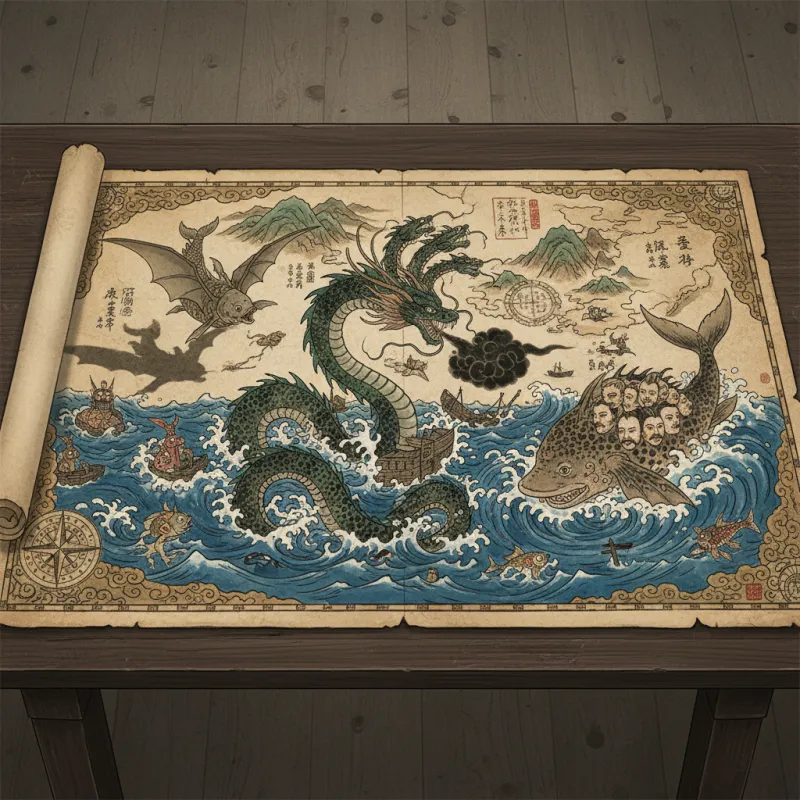
The fishermen of ancient China didn't fear the ocean because it was unknown — they feared it because they knew exactly what lived there. When boats disappeared, when entire crews vanished between one harbor and the next, the survivors didn't shrug and blame bad weather. They blamed the Jiao. They blamed the Jiaolong. They blamed creatures with names that still make your skin crawl when you read them in the original Classical Chinese. The Shanhaijing (山海经 Shānhǎi Jīng, Classic of Mountains and Seas) wasn't written as mythology — it was written as a survival manual.
The Jiao: Dragon-Serpents That Drown Villages
The Jiao (蛟 jiāo) appears repeatedly in the Shanhaijing, and every mention carries the same warning: this creature kills. Not occasionally. Not in self-defense. The Jiao is described as a scaled serpent-dragon that inhabits rivers and coastal waters, capable of summoning floods and capsizing vessels with a single thrash of its body. The text specifies that Jiao can reach lengths of several zhang (丈 zhàng, roughly 10 feet per unit), meaning the largest specimens stretched 30 to 40 feet.
What makes the Jiao particularly terrifying is its amphibious nature. Unlike purely aquatic monsters, the Jiao could pursue victims onto land during floods — which it caused deliberately. The Shuowen Jiezi (说文解字 Shuōwén Jiězì), the Han dynasty etymological dictionary, defines the Jiao as "a dragon that can cause floods," and archaeological evidence suggests coastal communities built specific architectural defenses against flood-borne predators. These weren't metaphorical floods. These were tactical weapons wielded by intelligent predators.
The Jiao's relationship with the Jiaolong is complex and often confused in later texts, but the Shanhaijing treats them as distinct species — the Jiao being smaller, more aggressive, and more commonly encountered.
The Kun and Peng: When Fish Become Sky
The Kun (鲲 kūn) technically appears in the Zhuangzi (庄子 Zhuāngzǐ) rather than the Shanhaijing, but no discussion of Chinese sea monsters is complete without it. Zhuangzi describes the Kun as a fish "thousands of li in size" — and a li (里 lǐ) in ancient measurements was roughly a third of a mile. We're talking about a creature the size of a small country.
But here's what makes the Kun genuinely unsettling: it transforms. When the Kun decides to leave the ocean, it doesn't beach itself or evolve over millennia. It metamorphoses into the Peng (鹏 péng), a bird so massive that "its wings are like clouds hanging from the sky." The transformation isn't gradual — it's catastrophic. Imagine the displacement of water when something the size of Rhode Island suddenly takes flight. The tsunamis alone would obliterate coastlines.
Zhuangzi presents this as a philosophical metaphor about perspective and transformation, but read the passage literally and you're looking at an extinction-level event with wings. The text specifies that when the Peng flies north to the Celestial Lake, it beats the water for three thousand li before taking off, and its wings create a whirlwind that rises ninety thousand li into the sky. These aren't poetic exaggerations — they're measurements. Someone calculated this.
The Yufu: Humanoid Horrors of the Deep
The Shanhaijing describes the Yufu (鱼妇 yúfù, "fish woman") in its catalog of the Eastern Sea, and the entry is brief but deeply disturbing: "There is a fish with a human face." That's it. No elaboration on size, behavior, or habitat. Just the fact of its existence.
But other passages fill in the gaps. The Yufu appears to be part of a broader category of humanoid sea creatures that the ancient Chinese encountered — or believed they encountered — with disturbing regularity. These weren't mermaids in the Disney sense. The descriptions emphasize wrongness: human features grafted onto fish bodies in ways that violated natural order. Some entries mention Yufu that could speak, which somehow makes them worse.
The Shanhaijing also catalogs the Lingyu (陵鱼 língyú), a creature with a human face, hands, and feet but the body of a fish, found in the waters near Mount Longhou. The text notes that eating its flesh prevents scabies, which suggests people were desperate enough to hunt and consume these things despite their unsettling appearance. Desperation or not, imagine the first fisherman who pulled up a net and found something with his daughter's face staring back at him.
The Qinyuan: The Bird That Poisons the Sea
Technically a bird rather than a sea creature, the Qinyuan (钦原 qīnyuán) deserves mention because of what it does to the ocean. The Shanhaijing describes it as a bird resembling a bee, roughly the size of a mandarin duck, whose sting kills other creatures — and whose presence poisons water sources. When a Qinyuan flies over the sea, fish die. When it lands near a river, the water becomes toxic.
This isn't metaphorical pollution. The text treats the Qinyuan's toxicity as a measurable, predictable phenomenon. Coastal communities tracked Qinyuan migrations the way modern meteorologists track hurricanes, because a flock passing overhead could render fishing grounds unusable for months. The creature's name combines qin (钦), meaning "respect" or "reverence," with yuan (原), meaning "source" — suggesting the ancient Chinese viewed it as a fundamental force of nature rather than merely an animal.
The Qinyuan's existence raises questions about the Shanhaijing's relationship with observable reality. Did ancient Chinese witnesses encounter some real species — perhaps a toxic seabird — and extrapolate its effects? Or is the Qinyuan pure mythology, a narrative explanation for algal blooms and natural die-offs? The text doesn't care about our epistemological anxiety. It simply records: this creature exists, and it kills.
The Heling: Fish That Scream Like Humans
The Heling (何罗鱼 hélíng yú) appears in the Shanhaijing's catalog of the Western Sea, described as a fish with ten bodies and a single head. But the detail that haunts readers is its voice: "Its sound is like a barking dog." Other entries mention fish that "cry like babies" or "wail like mourning women."
These acoustic descriptions appear throughout the Shanhaijing's marine entries, and they're oddly specific. The text doesn't just say creatures make noise — it compares their vocalizations to recognizable human and animal sounds. This suggests the compilers were working from eyewitness accounts, trying to catalog something genuinely heard rather than purely imagined.
Modern marine biology confirms that many fish species vocalize, and some deep-sea creatures produce sounds that, when recorded and played back, do resemble human screaming or crying. Did ancient Chinese fishermen encounter these species and interpret their calls as evidence of supernatural origin? Or were they describing something else entirely — perhaps the sounds of drowning victims, attributed to monsters as a psychological defense mechanism?
The Shanhaijing doesn't speculate. It records the sounds, catalogs the creatures, and moves on. The horror is in the matter-of-fact tone: yes, there are fish that scream like humans. Next entry.
The Jiaoren: Weeping Pearls and Silk from the Sea
The Jiaoren (鲛人 jiāorén, "shark people") represent the Shanhaijing's most economically valuable sea monsters. Described as humanoid creatures living in the ocean depths, the Jiaoren possess two remarkable abilities: they weave an extraordinarily fine silk that never gets wet, and their tears crystallize into pearls.
Multiple historical texts reference Jiaoren silk as a luxury commodity, with some Han dynasty sources claiming that merchants traded for it in southern coastal markets. Whether this represents actual trade in some rare marine-derived fiber or pure mythology is unclear, but the economic details are suspiciously specific. The Shuyi Ji (述异记 Shùyì Jì) notes that Jiaoren silk could be woven so fine that an entire bolt weighed less than a few ounces, and that it remained dry even when submerged.
The pearl-tears are even stranger. The Soushen Ji (搜神记 Sōushén Jì) includes a story about a man who sheltered a Jiaoren, and when the creature departed, it wept tears that solidified into pearls as payment. This isn't presented as magic — it's presented as biology. The Jiaoren's tears contain some substance that crystallizes upon contact with air, producing gemstones.
Compare this to the Longnu, the dragon princess who also produces pearls but through entirely different mechanisms, and you see the Shanhaijing tradition attempting to catalog distinct species with distinct properties. These aren't interchangeable "magical sea people" — they're separate creatures with separate evolutionary adaptations.
Why These Monsters Still Matter
The sea creatures of the Shanhaijing weren't designed to entertain. They were designed to explain. When fishermen disappeared, when floods destroyed villages, when strange sounds echoed across the water at night — these creatures provided answers. Not comforting answers. Not even particularly logical answers. But answers that gave shape to chaos, that transformed random tragedy into something with a name, a form, a pattern.
Modern readers often dismiss the Shanhaijing as primitive superstition, but that misses the point entirely. The text represents humanity's first systematic attempt to catalog the unknown, to impose order on an environment that killed without warning or mercy. Yes, the creatures are impossible. Yes, the geography is fantastical. But the impulse behind the text — the desperate need to understand what's out there in the dark water — that's as modern as any marine biology textbook.
The ocean is still terrifying. We've just replaced the Jiao with giant squid, the Kun with blue whales, the Yufu with deep-sea anglerfish. We've traded one set of monsters for another, and we call it progress. But read the Shanhaijing on a dark night with the sound of waves in the distance, and tell me you're certain we've got it all figured out. Tell me there's nothing left in the deep that we haven't named yet. The ancient Chinese knew better than to make that claim.
Related Reading
- Sea Creatures of the Shanhaijing: Monsters from the Deep
- Leviathans of the Eastern Sea: Giant Sea Creatures in Chinese Myth
- The Four Dragon Kings: Rulers of China's Mythological Oceans
- Merfolk in Chinese Mythology: The Shark People and Sea Maidens
- Unraveling the Mysteries of Shanhaijing: Mythical Creatures and Enigmatic Lands
- Unearthing the Cursed Beings of Shanhaijing: Myths, Creatures, and Lands
- The Nine-Headed Bird: Terror of the Skies