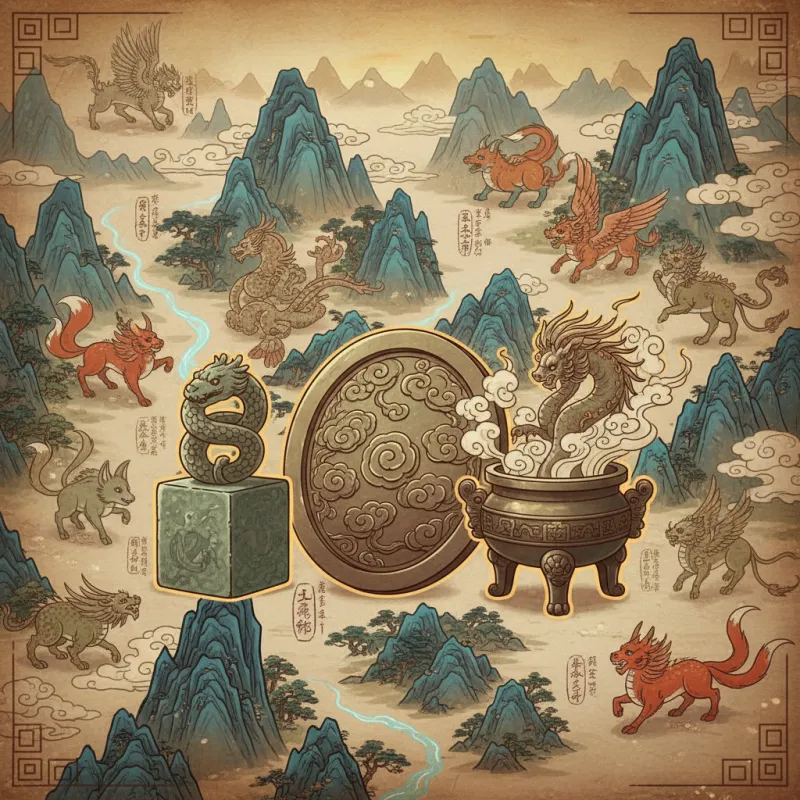
When the First Emperor of Qin unified China in 221 BCE, he didn't just conquer territories — he commissioned a jade seal carved with eight characters that would haunt Chinese politics for two millennia. "Having received the Mandate from Heaven, may the Emperor lead a long and prosperous life" (受命于天,既壽永昌 shòu mìng yú tiān, jì shòu yǒng chāng). This wasn't jewelry. This was the physical embodiment of legitimacy itself, and its loss or possession could topple dynasties.
The concept seems alien to Western mythology, where power objects amplify the hero's strength. Mjolnir makes Thor mighty. Excalibur proves Arthur's worthiness but also makes him formidable in battle. Chinese sacred objects work differently. They don't make you powerful — they make you legitimate. And in the Chinese cosmological order, legitimacy is the only power that matters.
The Seal: When Heaven Speaks Through Jade
The Imperial Seal (传国玉玺 chuán guó yù xǐ) has a documented history more dramatic than most novels. After the First Emperor's death, it passed through hands both imperial and desperate. The child emperor Huhai. The rebel Liu Bang, who founded the Han Dynasty. Wang Mang, the usurper who tried to establish his own dynasty and had to literally pry it from the Empress Dowager's hands — she threw it on the ground in fury, chipping one corner that was later repaired with gold.
The seal disappeared and reappeared throughout Chinese history like a ghost that refused to rest. It surfaced during the Three Kingdoms period, vanished again, was claimed by various dynasties (some claims certainly fraudulent), and finally disappeared for good sometime during the chaos of the late Yuan or early Ming Dynasty. Its last confirmed appearance was in 1370.
What makes this object fascinating from a Shanhaijing perspective is how it embodies the principle of tianming (天命 tiān mìng) — the Mandate of Heaven. The Shanhaijing doesn't explicitly mention imperial seals (it predates the concept), but it's saturated with the idea that certain objects mark cosmic authorization. The Yellow Emperor's regalia functioned similarly: not as weapons of war, but as symbols that heaven had chosen this particular human to order the world.
The seal's power was so absolute that possessing it could legitimize a peasant rebel, while losing it could delegitimize an emperor with a thousand-year lineage. This is power as credential, not capability. The seal doesn't help you govern well. It simply declares that you have the right to try.
Bronze Mirrors: Reflecting More Than Faces
If seals represented political legitimacy, bronze mirrors (铜镜 tóng jìng) represented cosmic clarity — the ability to see truth through deception. The most famous is the Mirror of Qin (秦镜 Qín jìng), which supposedly could reveal a person's true nature, showing demons in their actual form and exposing lies.
Bronze mirrors appear throughout Chinese mythology and history with surprising frequency. They're not passive objects. In the Shanhaijing tradition, mirrors are active tools of discernment. The text describes various spirits and demons, many of which can assume human form. A mirror that could pierce such deceptions would be invaluable — not as a weapon, but as a tool of cosmic justice.
The historical Qin Mirror was said to belong to Qin Shihuang (yes, the same First Emperor who commissioned the seal). According to legend, he used it to examine his officials and concubines, revealing their true intentions. Whether this specific mirror existed is debatable, but the concept reveals something crucial about Chinese mythological thinking: the greatest power is not to destroy your enemies but to see them clearly.
This connects to the Shanhaijing's obsessive cataloging impulse. The text doesn't just list creatures — it describes them with precise detail, as if accurate knowledge itself is a form of power. Know the name, appearance, and nature of a spirit, and you have power over it. A mirror that reveals true nature is the ultimate expression of this principle.
Bronze mirrors also served as protective talismans. Placed above doorways or worn on the body, they were believed to repel evil spirits. The logic is elegant: if demons fear being seen in their true form, a mirror becomes a weapon of exposure. This appears in countless Chinese ghost stories and supernatural tales, where mirrors reveal fox spirits, hungry ghosts, and other entities masquerading as humans.
The Nine Cauldrons: Geography Made Metal
The most explicitly Shanhaijing-adjacent artifacts are the Nine Cauldrons (九鼎 jiǔ dǐng), legendary bronze vessels cast by Yu the Great after he tamed the floods and divided China into nine provinces. Each cauldron represented one province and was decorated with images of the creatures, plants, and geographical features of that region.
This is the Shanhaijing principle made physical. The text itself is essentially a catalog of geography, creatures, and resources — a map of the known and unknown world. The Nine Cauldrons performed the same function in three-dimensional bronze. They were a physical manifestation of cosmic order imposed on chaotic nature.
According to legend, Yu cast the cauldrons using metal tributes from all nine provinces, and each was inscribed with images of the strange creatures and spirits that inhabited that region. The purpose was both practical and mystical: by depicting these entities, Yu demonstrated his knowledge and therefore his power over them. The cauldrons were a declaration that the wild world had been mapped, named, and brought under human (specifically imperial) authority.
The Nine Cauldrons became the ultimate symbol of dynastic legitimacy, even more than the Imperial Seal. Dynasties rose and fell, but the cauldrons were supposed to be eternal. They passed from the Xia to the Shang to the Zhou Dynasty. Then, like the Imperial Seal, they vanished. The last confirmed sighting was during the Zhou Dynasty, around 256 BCE. One legend claims they sank into the Si River. Another says the First Emperor of Qin tried to recover them but failed.
Their disappearance is symbolically perfect. The cauldrons represented a unified cosmic order, a world fully mapped and understood. Their loss suggests that such complete knowledge and control was always an illusion — or perhaps that the world itself had changed, becoming too complex for nine bronze vessels to contain.
The Difference: Authorization vs. Amplification
Western mythology loves transformation. Drink from the Holy Grail and gain eternal life. Wield Mjolnir and command lightning. Put on the One Ring and become invisible (and eventually corrupted). These objects change the user, granting abilities they didn't possess before.
Chinese sacred objects rarely work this way. The Imperial Seal doesn't make you a better ruler. The Mirror doesn't make you wiser. The Cauldrons don't grant you power over nature. Instead, these objects testify. They bear witness. They say: "Heaven has chosen this person. The cosmic order recognizes this authority. Proceed accordingly."
This reflects a fundamentally different understanding of power. In the Chinese cosmological system, power flows from alignment with the natural order (天道 tiān dào). You cannot seize cosmic authority through strength alone. You must be recognized by heaven, and that recognition is symbolized through objects.
The Shanhaijing embodies this principle throughout. It doesn't describe how to gain power over the creatures and spirits it catalogs. It describes how to recognize them, how to understand them, how to know their nature. Knowledge is the foundation of authority. The sacred objects of Chinese mythology are physical manifestations of that knowledge — proof that the holder understands the cosmic order well enough to participate in it.
When Objects Vanish: The Meaning of Loss
Both the Imperial Seal and the Nine Cauldrons eventually disappeared, and their loss carries symbolic weight. In Western mythology, when a sacred object is lost, it becomes a quest objective. Find the Holy Grail. Recover Excalibur. Reclaim the Ring.
Chinese mythology treats these losses differently. The disappearance of the Nine Cauldrons wasn't a tragedy requiring heroes to recover them — it was a sign that the cosmic order they represented had fundamentally changed. The world had become too complex, too fragmented, too transformed for those ancient symbols to function.
Similarly, the Imperial Seal's final disappearance didn't end imperial legitimacy. Dynasties continued to rise and fall without it. New seals were carved. The Ming and Qing emperors ruled without the original seal, and their authority was no less real. The object mattered, but what it represented mattered more.
This is very Shanhaijing in spirit. The text itself is fragmentary, corrupted, clearly incomplete. Entire sections are missing or garbled. Yet it remains authoritative not because it's perfect, but because it represents an attempt to understand and catalog the world. The map is not the territory, but the effort to create the map is itself meaningful.
Objects as Cosmic Contracts
What makes Chinese sacred objects distinctive is their contractual nature. They're not gifts from gods or rewards for heroism. They're more like cosmic receipts — proof of a transaction between heaven and earth, between the natural order and human authority.
The Imperial Seal says: "Heaven has granted this person the right to rule." The Mirror says: "This person can perceive truth." The Cauldrons say: "This person has mapped and understood the world." These are claims that can be verified or disputed. Lose the object, and the claim becomes questionable. Rule poorly, and heaven might revoke the mandate, causing the seal to pass to another.
This makes Chinese mythology remarkably pragmatic. Power isn't mystical or arbitrary — it's based on demonstrable alignment with cosmic principles. The sacred objects are the demonstration. They're evidence in an ongoing cosmic trial where every ruler must prove their legitimacy not once, but continuously.
The Shanhaijing fits perfectly into this framework. It's not a book of spells or divine revelations. It's a catalog, a reference work, a compendium of knowledge. Possessing this knowledge — knowing which mountains contain jade, which rivers harbor dragons, which creatures are dangerous and which are auspicious — is itself a form of power. Not the power to command, but the power to understand. And in the Chinese cosmological system, understanding is the foundation of all legitimate authority.
Related Reading
- Weapons of the Gods in Chinese Mythology
- Magical Artifacts of the Shanhaijing
- The Jade Palace of Kunlun: Home of the Queen Mother of the West — Shanhai Perspective
- Hetu and Luoshu: The Cosmic Diagrams
- Peaches of Immortality: The Most Coveted Fruit
- Exploring the Enigmatic Mountains and Creatures of the Shanhaijing
- Kunlun Mountain: Home of the Immortals
- Exploring the Enigmatic Creatures and Lands of the Shanhaijing