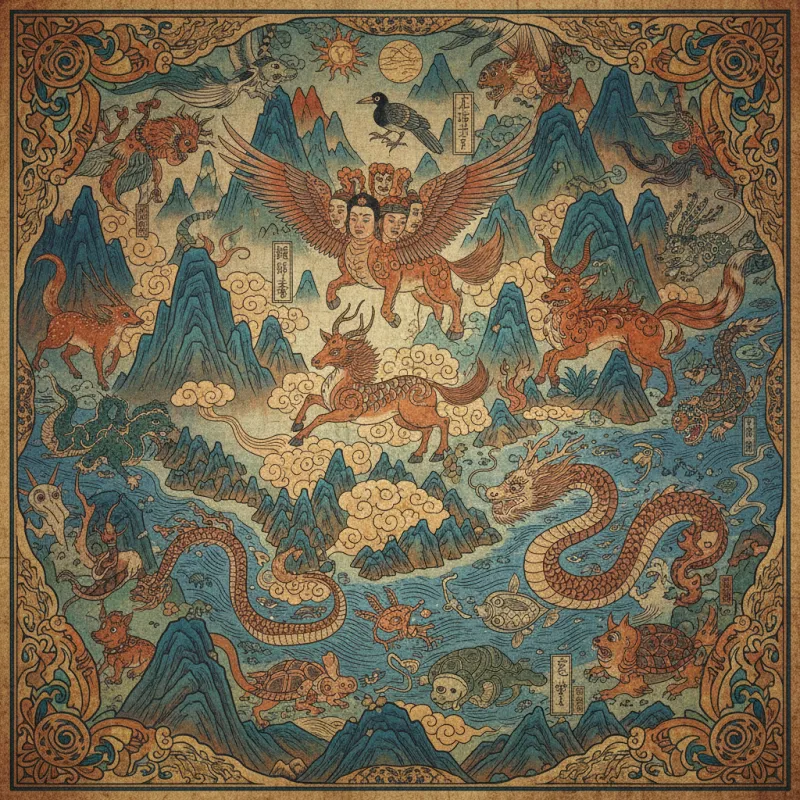
Picture this: A Ming dynasty scholar sits in his studio, brush poised over silk, trying to draw a creature that has "the body of a sheep, nine tails, and four ears, with eyes on its back." He's never seen such a thing — nobody has. Yet he must make it visible, must transform the Shanhaijing's (山海经, Shānhǎijīng) cryptic words into an image that will satisfy readers who are equally curious and equally clueless. This is the paradox at the heart of illustrating the Classic of Mountains and Seas: how do you draw the impossible?
For over two thousand years, Chinese artists have wrestled with this question, and their answers tell us as much about themselves as they do about the text. The Shanhaijing describes hundreds of creatures in maddeningly vague terms — "a beast like a horse with a white head and tiger markings" could be visualized in a thousand different ways. This ambiguity hasn't frustrated artists; it's liberated them. Every generation has reimagined these creatures through the lens of their own aesthetic values, scientific knowledge, and cultural anxieties. The result is one of the richest visual traditions in Chinese literature, a two-millennia-long game of telephone where each player adds their own interpretation.
The Lost Origins
We don't actually have the earliest Shanhaijing illustrations. The text itself dates to somewhere between the 4th century BCE and the early Han dynasty, but the oldest surviving illustrated editions are from the Ming dynasty (1368-1644). Everything before that is gone — lost to fire, flood, war, and the simple entropy of time. We know earlier illustrated versions existed because Song dynasty (960-1279) scholars mention them in their writings, often complaining about how crude or inaccurate they were. But "inaccurate" compared to what? There's no fossil record for the Jiuwei Hu, no skeletal remains of the Zhulong (烛龙, Zhúlóng), the torch dragon that lights the world with its eyes.
This gap in the historical record is both frustrating and revealing. It means that when Ming artists sat down to illustrate the Shanhaijing, they weren't copying from ancient models — they were inventing from scratch, guided only by the text and their own imaginations. They were, in effect, the first illustrators, even though they came fifteen hundred years after the text was written.
The Ming Dynasty Woodblock Tradition
The Ming dynasty editions are where the visual tradition really begins for us. These were woodblock prints, mass-produced for a growing literate class hungry for illustrated books. The 1597 edition, illustrated by Jiang Yinghao (蒋应镐, Jiǎng Yìnghào), is the most famous and influential. Jiang's creatures are wonderfully literal — if the text says "nine tails," he draws exactly nine tails, arranged in a neat fan. If it says "eyes on its back," there they are, positioned symmetrically like buttons on a coat.
What strikes you about these Ming illustrations is their matter-of-factness. The creatures aren't particularly frightening or majestic; they're just... there, standing in profile like specimens in a natural history museum. A beast with a human face and a snake's body doesn't writhe or menace — it poses politely for the viewer. This reflects Ming scholarly culture, which valued encyclopedic knowledge and systematic classification. The Shanhaijing wasn't read as fantasy literature; it was treated as a genuine (if puzzling) geographical and zoological text. The illustrations had to be clear, informative, and reproducible.
Jiang's edition became the template that later illustrators either followed or rebelled against. Even today, when you see Shanhaijing creatures in popular culture, they often trace their visual DNA back to these Ming woodblocks.
The Qing Dynasty Refinements
By the Qing dynasty (1644-1912), illustrated Shanhaijing editions had become more sophisticated and more varied. Artists had access to Jiang's work and could choose to imitate it, improve upon it, or ignore it entirely. Some Qing editions are exquisitely detailed, with creatures rendered in fine brushwork and subtle color washes. Others are crude and rushed, clearly produced for a less discriminating market.
What's interesting is how Qing illustrators began to inject more personality and dynamism into the creatures. The stiff, profile poses of the Ming editions give way to more naturalistic postures. Creatures crouch, leap, turn their heads. They exist in space rather than floating in a void. This reflects broader changes in Chinese painting — the influence of Western perspective techniques, the rise of individualist painting styles, and a growing interest in capturing movement and emotion.
The 1667 edition by Hu Wenhuan (胡文焕, Hú Wénhuàn) is particularly notable for its attempt to make the creatures look plausible. His Qilin doesn't just have scales and a horn; it has the muscular structure of a real animal, with weight and mass. You can almost imagine it walking. This is the Enlightenment impulse creeping into Chinese illustration — the desire to rationalize the fantastic, to make the impossible seem merely improbable.
The Modern Reimaginings
The 20th century brought radical changes to how the Shanhaijing was illustrated. As China modernized and Western artistic techniques flooded in, artists had to decide what to do with these ancient creatures. Some chose archaeological realism, trying to imagine what Bronze Age people might actually have seen (perhaps deformed animals, or misidentified foreign species). Others went full fantasy, treating the Shanhaijing as a source for imaginative art rather than a text to be faithfully illustrated.
The most influential modern edition is probably the 1980s version illustrated by Qian Shengpu (钱圣普, Qián Shèngpǔ), which uses a semi-realistic style that makes the creatures look like they could exist in some alternate evolutionary history. His Bifang isn't a cartoon or a symbol; it's a bird, albeit one with only one leg and the ability to start fires. This approach has been enormously influential in contemporary Chinese fantasy art and game design.
Contemporary digital artists have taken this even further, rendering Shanhaijing creatures with photorealistic textures and cinematic lighting. These images circulate on social media, often divorced from the original text, becoming pure visual spectacle. The creatures have escaped the book entirely and now live in a digital bestiary where they can be endlessly remixed and reinterpreted.
What the Images Reveal
Here's what's fascinating: none of these illustrations are "correct," because there's no correct way to draw a creature that never existed. But each set of illustrations is correct for its time. The Ming woodblocks reflect Ming values — order, classification, scholarly precision. The Qing refinements show a culture becoming more cosmopolitan and visually sophisticated. The modern versions reveal our own obsessions with biological plausibility and visual spectacle.
The Shanhaijing illustrations are a mirror held up to Chinese culture across two millennia. They show us what each era found beautiful, frightening, or interesting. They reveal changing attitudes toward nature, toward the past, toward the relationship between word and image. A Ming scholar wanted to catalog the world; a Qing painter wanted to capture its vitality; a modern digital artist wants to make you gasp at the screen.
The Unfinished Project
The project of illustrating the Shanhaijing will never be finished, because the text itself is inexhaustible. Every generation will find new meanings in those ancient descriptions, new ways to visualize the impossible. The creatures will keep changing, adapting to new artistic technologies and cultural contexts. In another hundred years, artists will be creating Shanhaijing illustrations in media we can't yet imagine, and those images will tell future historians something essential about the early 22nd century.
That's the real magic of the Shanhaijing — not that it describes impossible creatures, but that it keeps generating new visions of impossibility. The text is a seed that blooms differently in every soil. And we, the viewers, get to watch this garden grow across the centuries, each flower strange and beautiful in its own way.
Related Reading
- The Illustrated Shanhaijing: How Artists Have Imagined the Unimaginable for Two Thousand Years
- How Shanhai Jing Inspired Modern Fantasy Art and Design
- East vs. West: Comparing Mythical Creatures Across Cultures
- How to Read the Shanhai Jing: A Beginner's Guide
- Exploring the Enigmatic Creatures and Lands of the Shanhaijing
- Discovering the Enigmatic Hybrid Creatures of Shanhaijing
- Exploring the Myths of Serpents in the Shanhaijing: Creatures of Power and Mystery