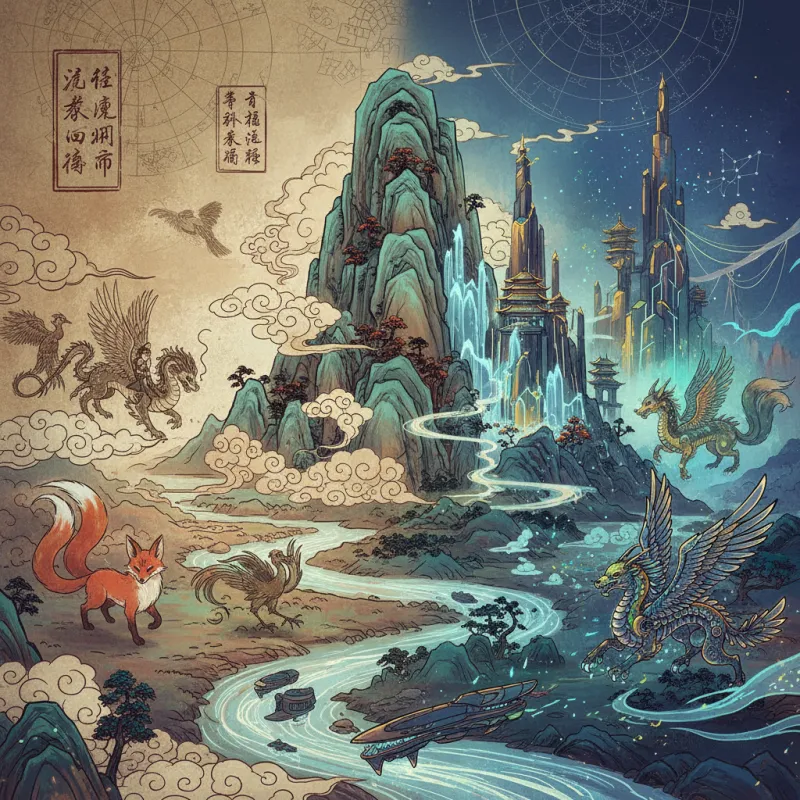
A nine-tailed fox rendered in neon against a cyberpunk skyline. A winged tiger prowling through the ruins of a post-apocalyptic Shanghai. A fish with a human face staring out from the screen of a AAA video game. If you've seen any of these images in the past five years — and you almost certainly have — you've witnessed the Shanhaijing's (山海经 Shānhǎi Jīng, Classic of Mountains and Seas) quiet conquest of modern visual culture.
This two-thousand-year-old text wasn't written as an art manual. It's a chaotic catalog of geography, ritual, and monsters that reads more like field notes from a fever dream than a coherent narrative. Yet it has become the single most influential source book for contemporary fantasy artists working in Chinese-inspired settings. Walk through any major game studio in Shanghai, Seoul, or Los Angeles, and you'll find dog-eared copies on concept artists' desks, their margins filled with sketches and color notes.
Why the Shanhaijing Works for Visual Design
The genius of the Shanhaijing as a design resource lies in its peculiar balance of specificity and ambiguity. Take the Jiuwei Hu (九尾狐 jiǔwěi hú), the nine-tailed fox. The text tells us it has nine tails, sounds like a baby crying, and eats people. That's it. No color specified. No exact proportions. No behavioral details beyond "man-eater." This minimalism is a feature, not a bug.
Compare this to European bestiaries, which often include moral allegories and symbolic meanings that constrain interpretation. The Shanhaijing rarely moralizes. It simply reports: "There is a beast here. It looks like this. It does that." This documentary tone gives artists maximum creative latitude while providing just enough structure to maintain cultural authenticity.
Modern concept artists have exploited this flexibility brilliantly. The nine-tailed fox alone has been reimagined as everything from a seductive spirit in flowing hanfu to a biomechanical horror in the game Black Myth: Wukong. Each interpretation can claim legitimacy because the source text never locked down the details. The Shanhaijing provides the skeleton; artists provide the flesh.
From Woodblock to Digital: The Visual Evolution
The Shanhaijing's influence on visual art isn't new — it's been illustrated continuously since at least the Ming Dynasty (1368-1644). But those early woodblock prints, charming as they are, look nothing like contemporary interpretations. Ming-era illustrators worked within strict conventions: flat perspectives, limited color palettes, symbolic rather than naturalistic rendering.
The real transformation began in the 1980s and 1990s, when Chinese artists trained in Western techniques started revisioning these creatures. Artists like Jiang Cheng and Xu Longfei began painting Shanhaijing creatures with oil paints, adding musculature, realistic lighting, and emotional depth. Their work bridged traditional subject matter with contemporary visual language, making these ancient monsters feel immediate and visceral.
The digital revolution accelerated this evolution exponentially. Software like ZBrush and Blender allows artists to sculpt creatures in three dimensions, testing how they'd look from any angle, how light would catch their scales or fur. The Qilin, once rendered as a flat, decorative motif, can now be designed as a fully realized creature with anatomically plausible joints, weight distribution, and movement patterns.
The Game Industry's Shanhaijing Obsession
If you want to see the Shanhaijing's modern influence at its most concentrated, look at Chinese game development. The text has become required reading for creature designers at major studios. Honor of Kings, China's most popular mobile game, draws heavily from Shanhaijing creatures for its character roster. Gujian Qitan (Ancient Sword Tale) built its entire bestiary around Shanhaijing entries, with design documents that explicitly cite chapter and verse.
But the most ambitious Shanhaijing adaptation in gaming might be Tale of Immortal, an indie cultivation game that treats the text almost like a field guide. Players encounter creatures in specific geographic regions that correspond to the text's mountain and sea catalogs. A Feiyi (飞鱼 fēi yú, flying fish) appears near water sources in the eastern regions, just as the text describes. This geographic fidelity adds a layer of worldbuilding depth that Western fantasy games rarely achieve.
Western studios have taken notice. League of Legends introduced Ahri, a nine-tailed fox character, in 2011, and she became one of the game's most popular champions. Riot Games' art team studied Shanhaijing illustrations and contemporary Chinese art to create a design that felt both authentic and accessible to global audiences. The character's success proved that Shanhaijing-inspired designs could resonate far beyond Chinese-speaking markets.
Design Principles from an Ancient Text
Working artists have extracted several practical design principles from the Shanhaijing that apply regardless of medium or style. First: hybrid forms create instant visual interest. The text is full of creatures that combine unexpected elements — a bird with a human face, a fish with snake's body, a beast with six legs and four wings. These combinations violate expectations in ways that make creatures memorable.
Second: specific anatomical details ground the fantastic. The Shanhaijing rarely describes entire creatures in detail, but it often mentions one or two specific features: "white head," "red beak," "eyes on its back." Modern artists have learned to use this technique, designing creatures that are mostly familiar but with one or two elements that make them alien. The Taotie works precisely because it's recognizable as a face while being fundamentally wrong in its proportions and features.
Third: function suggests form. Many Shanhaijing creatures are defined by what they do or what they're used for: "eating it cures jealousy," "its cry sounds like thunder," "wearing its skin prevents poison." Contemporary designers use these functional descriptions as starting points for visual problem-solving. If a creature's cry sounds like thunder, maybe it has a specialized vocal structure. If its skin prevents poison, perhaps it has unusual scale patterns or secretes protective oils.
The International Shanhaijing Renaissance
The Shanhaijing's influence has exploded beyond China in the past decade, driven partly by the global success of Chinese media and partly by artists' hunger for fresh mythological material. Western fantasy has recycled the same European creatures — dragons, unicorns, griffins — for so long that they've lost their capacity to surprise. The Shanhaijing offers hundreds of creatures that feel genuinely novel to international audiences.
Artists like Victo Ngai, a Hong Kong-born illustrator working in New York, have built careers partly on introducing Shanhaijing imagery to Western editorial and commercial markets. Her work for The New Yorker and National Geographic often features creatures pulled directly from the text, rendered in a style that blends traditional Chinese painting techniques with contemporary illustration aesthetics.
The text has also influenced Western fantasy authors and worldbuilders looking to move beyond Tolkien-derived conventions. N.K. Jemisin's Broken Earth trilogy, while not directly based on the Shanhaijing, shows clear influence in its approach to creature design — hybrids that serve specific ecological and narrative functions rather than existing purely as obstacles or set dressing.
Challenges and Controversies
This widespread adoption hasn't been without friction. Some Chinese artists and scholars worry about cultural dilution — that as the Shanhaijing becomes global creative commons, its specific cultural context gets lost. When a Korean game studio or American animation house uses Shanhaijing creatures, are they engaging with Chinese culture or just strip-mining it for cool monster designs?
The debate intensified after the success of Avatar: The Last Airbender, which borrowed heavily from Chinese aesthetics and mythology (including Shanhaijing-inspired creatures) but was created entirely by Western artists. Some praised it as respectful cultural exchange; others saw it as appropriation. The Shanhaijing, as a text without clear ownership or religious significance, sits in an ambiguous zone that makes these questions particularly thorny.
There's also the question of historical accuracy versus creative freedom. Some artists and studios treat the Shanhaijing as sacred text, striving for designs that ancient Chinese readers might recognize. Others see it as a jumping-off point, fair game for radical reinterpretation. Both approaches have merit, but they can lead to wildly different results — and occasionally to accusations that certain designs are "inauthentic" or "disrespectful."
The Future of Shanhaijing-Inspired Art
As AI image generation becomes more sophisticated, the Shanhaijing is likely to become even more influential. These systems are trained on existing art, and as more Shanhaijing-inspired work enters their training data, they'll become better at generating creatures in this style. We're already seeing AI-generated art that combines Shanhaijing creature descriptions with various artistic styles — traditional ink painting, photorealistic rendering, anime aesthetics.
But this technological shift also raises questions about artistic authenticity and cultural understanding. An AI can combine "nine-tailed fox" with "cyberpunk aesthetic" and produce something visually striking, but it can't understand the cultural weight of the jiuwei hu in Chinese folklore, or why certain design choices might be more resonant than others. The best Shanhaijing-inspired art comes from artists who've read the text, studied its historical context, and made informed creative decisions. That kind of deep engagement is hard to automate.
What seems certain is that the Shanhaijing will continue shaping fantasy art for years to come. As global audiences grow more sophisticated about non-Western mythology, and as Chinese creative industries continue their international expansion, these ancient creatures will appear in more games, films, comics, and illustrations. The text that once documented the mythical geography of ancient China has become a map for contemporary artists exploring the boundaries of imagination.
Related Reading
- The Illustrated Shanhaijing: How Artists Have Imagined the Unimaginable
- How to Read the Shanhai Jing: A Beginner's Guide
- East vs. West: Comparing Mythical Creatures Across Cultures
- The Illustrated Shanhaijing: How Artists Have Imagined the Unimaginable for Two Thousand Years
- The Peoples of the Shanhaijing: Foreign Nations at the Edge of the World
- Exploring the Enigmatic Creatures and Lands of Shanhaijing: A Cultural Journey
- Exploring the Enigmatic Creatures and Lands of the Shanhaijing