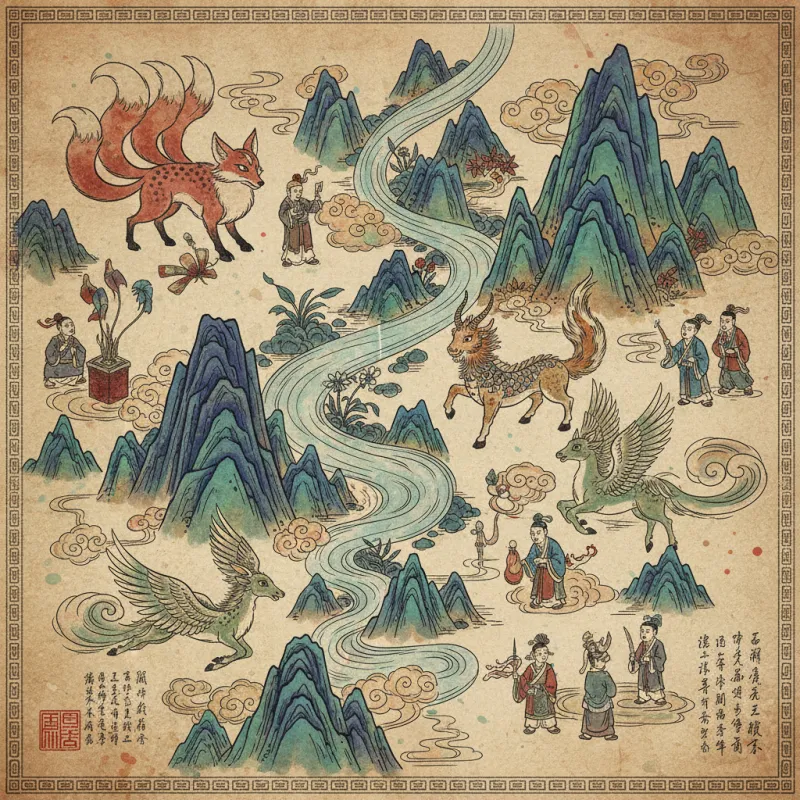
You open the Shanhai Jing expecting mythology and find yourself reading what looks like a Bronze Age field guide: "Three hundred li to the east is Mount Gouwu. Many jade deposits. The Gouwu River originates here. A beast dwells there that looks like a sheep with a horse's tail. Its fat is good for chapped skin." Wait—what? This is one of China's most celebrated ancient texts?
The Shanhai Jing (山海经, Shānhǎi Jīng)—Classic of Mountains and Seas—confounds first-time readers precisely because it refuses to be what we expect. It's not quite mythology, not quite geography, not quite natural history. Compiled between the 4th century BCE and early Han Dynasty (around 200 BCE), it reads like someone took a shaman's fever dream, a merchant's travel log, and a pharmacist's notebook, then shuffled them together. Learning to read it means unlearning what you think an ancient text should be.
Forget Linear Narrative
Western readers trained on Homer or the Bible expect story arcs. The Shanhai Jing offers none. It's organized geographically, not narratively—imagine reading an encyclopedia from A to Z rather than following a plot. The text marches methodically through mountain ranges and cardinal directions: "Three hundred li east... two hundred li north... four hundred li south..." Each entry catalogs what's there: minerals, plants, animals (real and fantastic), rivers, and resident deities.
This structure isn't a bug; it's the feature. The compilers were creating a cosmological map, a way to organize and control knowledge about the world. The repetitive "X li in Y direction" formula becomes hypnotic, almost ritualistic. You're not reading for plot—you're absorbing a worldview where geography and mythology occupy the same ontological space.
The Classic of Mountains (Shan Jing, 山经) comprises the first five chapters, systematically documenting five mountain ranges. The Classic of Seas (Hai Jing, 海经) fills chapters 6-18, radiating outward to describe foreign lands, strange peoples, and cosmic events. Start with the Mountain Classic—it's more grounded, more concrete, easier to visualize.
Embrace the Bestiary Mindset
The creatures in the Shanhai Jing aren't characters with personalities—they're specimens. The nine-tailed fox appears not as the seductive shapeshifter of later folklore, but as a clinical observation: "A beast that looks like a fox with nine tails. Its cry sounds like a baby. It eats people. Those who eat it will be protected from insect poison."
Notice the pattern: appearance, sound, behavior, utility. Nearly every creature entry follows this formula. The text cares deeply about what things do—especially what they're good for. Can you eat it? Does it cure disease? Will it protect you from evil? This is practical magic, the kind that assumes the natural and supernatural are equally real and equally useful.
Some creatures appear once and vanish. Others, like the Zhuque (朱雀, Vermillion Bird) or Qilin (麒麟, Chinese unicorn), become foundational to Chinese mythology. But in the original text, they're all treated with the same matter-of-fact tone. A phoenix gets the same clinical description as a weird fish. This flattening of the marvelous is part of the text's strange power.
Read for Texture, Not Comprehension
Here's a secret: even Chinese scholars don't fully understand the Shanhai Jing. The language is archaic, many place names are unidentifiable, and the text has been corrupted through centuries of copying. Commentators from Guo Pu (276-324 CE) onward have been guessing at meanings.
So release yourself from the burden of total comprehension. Read for the texture of the world it creates—the sheer abundance of strangeness. In one passage, you'll encounter a country where people have holes through their chests and carry poles through them. A few lines later, there's a mountain where the stones scream. Then a tree that cures jealousy. The Shanhai Jing is maximalist in its weirdness, piling marvel upon marvel without pause or explanation.
Pay attention to recurring motifs: the color red (often associated with divine or dangerous creatures), the number nine (nine-tailed foxes, nine-headed birds), transformations between human and animal forms. These patterns reveal the text's underlying logic, even when individual entries remain opaque.
Use Illustrations as Your Guide
The Shanhai Jing has been illustrated for over a thousand years, and these images are essential reading companions. The earliest surviving illustrated edition dates to the Ming Dynasty, but the tradition likely goes back much further. Artists have always understood what readers sometimes miss: this text is fundamentally visual.
When you read "a beast with a human face, one arm, and three eyes," your brain might struggle. But see it drawn—even crudely—and the description clicks into place. The illustrated bestiary tradition transforms cryptic text into vivid presence. Modern editions often include these historical illustrations alongside the text.
Don't worry about "accuracy." The illustrators were interpreting, not documenting. A Ming artist's nine-tailed fox looks nothing like a Qing artist's version. Each generation reimagines these creatures through its own aesthetic lens. That's part of the text's living tradition.
Recognize the Layers
The Shanhai Jing wasn't written by one person at one time. It's a palimpsest, with older material (possibly from the Warring States period, 475-221 BCE) overlaid with Han Dynasty additions and later interpolations. You can sometimes feel the seams where different hands took over.
The Mountain Classic feels older—more systematic, more focused on practical geography and resources. The Sea Classic gets wilder, more mythological, more concerned with cosmic events and divine genealogies. By the time you reach the Classic of the Great Wilderness (Da Huang Jing, 大荒经, chapters 14-17), you're in full mythological mode: creation stories, divine battles, the origins of humanity.
Some scholars think the core text was a genuine attempt at geographical documentation, later embellished with mythology. Others argue it was always a cosmological text using geographical form. You don't need to choose sides—just notice how the text shifts registers, sometimes within a single chapter.
Connect It to Later Traditions
The Shanhai Jing is the source code for much of Chinese mythology. That dragon in a Tang Dynasty poem? Probably draws on Shanhai Jing descriptions. The immortals in Daoist texts? Many originated here. The strange creatures in Journey to the West or Strange Tales from a Chinese Studio? Authors were mining this text.
Reading the Shanhai Jing is like discovering the ur-text behind two thousand years of Chinese fantasy literature. You'll experience constant moments of recognition: "Oh, that's where that comes from!" The nine-tailed fox, the Kunlun Mountains as axis mundi, the Queen Mother of the West, the cosmic tree connecting heaven and earth—all here, in their earliest textual forms.
But here's the twist: the Shanhai Jing versions are often stranger and less refined than later adaptations. The Queen Mother of the West isn't yet the elegant goddess of Han art—she's described as having a leopard's tail, tiger's teeth, and a talent for whistling. The text preserves these creatures in their raw, pre-literary state.
Start Small, Read Aloud
Don't try to read the Shanhai Jing cover to cover in one sitting. It's not that kind of book. Pick a chapter—I recommend starting with the first chapter of the Mountain Classic, the Classic of the Southern Mountains (Nan Shan Jing, 南山经). Read slowly. Read aloud if possible; the rhythmic, repetitive language works better spoken than silently scanned.
Keep a notebook. Sketch the creatures as you imagine them. Map the geography, even though the place names are mostly lost. Make lists of your favorite weird details. The Shanhai Jing rewards active, creative reading. It's not a text to passively consume—it's a text to inhabit, to play with, to use as a springboard for your own imagination.
And remember: you're reading one of the strangest books ever written, a text that has puzzled and fascinated readers for over two millennia. If you're confused, you're in good company. If you're enchanted, you're reading it right.
Related Reading
- The Illustrated Shanhaijing: How Artists Have Imagined the Unimaginable
- East vs. West: Comparing Mythical Creatures Across Cultures
- The Illustrated Shanhaijing: How Artists Have Imagined the Unimaginable for Two Thousand Years
- The Feathered People: Winged Humans of the Shanhai Jing
- Exploring the Enigmatic Mountains and Creatures of the Shanhaijing
- Unraveling the Mysteries of Shanhaijing: Myths, Creatures, and Fantastic Realms