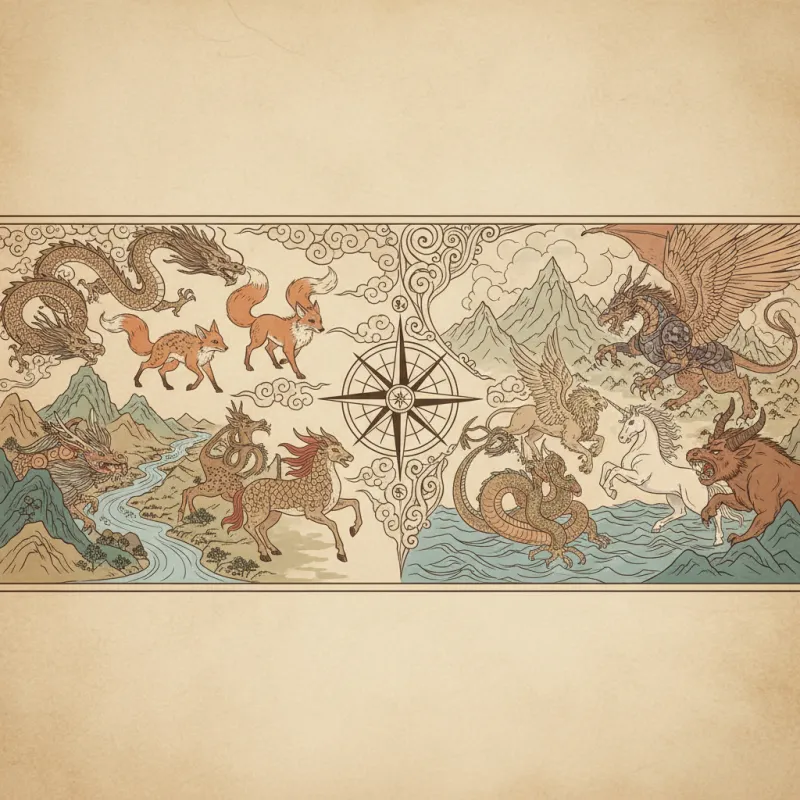
Dragons coil through Chinese palaces as symbols of imperial divinity while European knights earn glory by slaying them. Same creature, opposite meanings — and that's just the beginning. When you place Eastern and Western bestiaries side by side, you're not just comparing monsters. You're looking at two fundamentally different ways of understanding power, nature, and what it means to be human.
The Dragon Paradox: Divine vs. Demonic
The dragon (龙, lóng) embodies everything noble in Chinese cosmology. These serpentine beings without wings control rain, guard rivers, and literally represent the emperor himself. The five-clawed dragon was reserved exclusively for imperial use during the Ming and Qing dynasties — wearing unauthorized dragon imagery could get you executed. Dragons speak, grant wishes, and transform into human form in texts like the Fengshen Yanyi (封神演义). They're fundamentally benevolent unless provoked.
European dragons? They're treasure-hoarding, maiden-kidnapping, village-burning menaces. From Beowulf's gold-guarding wyrm to the dragon slain by Saint George, Western dragons represent chaos that heroes must destroy. They breathe fire instead of controlling water. They have wings and legs like corrupted lizards. Killing one makes you a legend; befriending one makes you suspect.
This isn't just aesthetic difference. It reflects core philosophical divides. Chinese cosmology sees nature as something to harmonize with — the dragon embodies natural forces that bring prosperity when respected. Western medieval Christianity saw nature as fallen, requiring domination. The dragon became a stand-in for Satan himself, something to conquer rather than revere. The Nine Sons of the Dragon each govern different aspects of cosmic order, a concept utterly foreign to European dragon lore.
Phoenix Rising: Rebirth vs. Virtue
The phoenix appears in both traditions, but again with crucial differences. The Western phoenix burns itself to ash every 500 years and resurrects — a solitary cycle of death and rebirth that early Christians adopted as a resurrection symbol. It's fundamentally about individual transformation through destruction.
The Chinese phoenix (凤凰, fènghuáng) doesn't die at all. This composite creature — rooster's head, swallow's chin, snake's neck, fish's tail, crane's legs — represents the union of yin and yang. It appears only during times of peace and prosperity, serving as a cosmic barometer of good governance. The fènghuáng pairs with the dragon as empress to emperor, feminine to masculine. It's about harmony and balance, not destruction and renewal.
The Japanese hō-ō borrowed from Chinese tradition but added its own twist, appearing in Buddhist contexts as a symbol of the sun and imperial household. Meanwhile, the Arabian phoenix (possibly the origin of the Western version) was said to live in the Arabian Desert and carry cinnamon bark to build its funeral pyre. Same bird, completely different life story.
Serpent Wisdom: Temptation vs. Transformation
Snakes slither through both mythologies with radically different reputations. In Genesis, the serpent tricks Eve into eating forbidden fruit, introducing sin and death to humanity. European folklore continued this pattern — serpents represent deception, poison, and evil. Medusa's snake hair turns men to stone. The basilisk kills with its gaze.
Chinese and broader Asian traditions see serpents as symbols of transformation and wisdom. The White Snake (白蛇, bái shé) from Legend of the White Snake is a snake spirit who cultivates herself into human form through centuries of practice, falls in love with a mortal, and becomes a tragic romantic heroine. Snake spirits in Chinese tales often seek enlightenment, not corruption. The Xiangliu, despite being a nine-headed monster, represents the power of water and transformation rather than pure evil.
Nāgas in Hindu and Buddhist mythology are divine serpent beings who guard treasures and sacred knowledge. The Buddha himself was protected by a nāga king during meditation. In Chinese Buddhism, nāgas became dragon kings (龙王, lóng wáng) who control weather and water. The serpent's ability to shed its skin made it a natural symbol for spiritual transformation and immortality — the exact opposite of its Western association with death.
Composite Creatures: Order vs. Chaos
Both traditions love mixing animal parts, but the results reveal different anxieties. Western composite creatures tend toward the monstrous: the chimera (lion-goat-snake), manticore (human head, lion body, scorpion tail), and griffin (eagle-lion) are dangerous beings to avoid or defeat. They represent nature gone wrong, violations of divine order.
Chinese composite creatures are auspicious. The qilin (麒麟, qílín) — often called the "Chinese unicorn" though it looks nothing like one — combines dragon, deer, ox, and fish features. It appears only during the reign of benevolent rulers or to herald the birth of sages. Confucius's mother supposedly encountered one before his birth. The qilin walks so gently it doesn't bend grass, embodying perfect harmony with nature.
The bixie (辟邪, bìxié), a winged lion-like creature, guards tombs and wards off evil spirits. The taotie (饕餮, tāotiè) mask — a composite face with no lower jaw — decorates ancient bronzes as both warning against greed and protective symbol. These creatures aren't aberrations but intentional combinations that concentrate positive or protective qualities.
Western composite creatures often guard treasures or places (griffins guard gold, sphinxes guard Thebes), but they're obstacles to overcome. Eastern composites are more likely to be guardians you want around, protective forces that maintain cosmic order rather than threaten it.
Immortals and Heroes: Cultivation vs. Conquest
The path to transcendence differs dramatically. Western heroes prove themselves through conquest — Hercules completes twelve labors, Perseus slays Medusa, Beowulf defeats Grendel. They're born special (often demigods) and achieve glory through violence against monsters. The hero stands apart from and above nature.
Eastern immortals (仙, xiān) achieve transcendence through cultivation (修炼, xiūliàn) — decades or centuries of meditation, alchemy, and self-refinement. The Eight Immortals each achieved immortality through different paths, but all required patience and harmony with natural forces. They often start as ordinary humans. The Kunlun Mountain serves as the dwelling place of immortals who have successfully cultivated themselves.
This reflects different concepts of power. Western mythology emphasizes power over — dominating nature, defeating enemies, ruling kingdoms. Eastern mythology emphasizes power through — understanding natural laws, refining oneself, achieving harmony. A Daoist immortal riding a crane represents a fundamentally different relationship with the supernatural than a knight slaying a dragon.
Underworld Beings: Punishment vs. Bureaucracy
The Western underworld is relatively simple: Hell for sinners, Heaven for the righteous, maybe Purgatory in between. Demons torture the damned. It's about punishment and reward, good versus evil.
The Chinese underworld (地府, dìfǔ) is a bureaucracy. The Ten Courts of Hell each handle specific types of sins, with judges, clerks, and detailed record-keeping. Ox-Head and Horse-Face (牛头马面, niútóu mǎmiàn) are bailiffs, not torturers. You can appeal your sentence. Your family can burn paper money to help you. The system is complex, negotiable, and fundamentally administrative.
This extends to ghost stories. Western ghosts are often trapped by unfinished business or divine punishment. Chinese ghosts (鬼, guǐ) navigate a complex afterlife system, sometimes returning to settle affairs, sometimes stuck due to improper burial, sometimes just hungry during Ghost Month. They're not necessarily evil — just dead people dealing with bureaucratic afterlife problems.
The Trickster Divide: Chaos Agents vs. Clever Survivors
Trickster figures appear everywhere, but their roles differ. Western tricksters like Loki bring chaos that threatens cosmic order. They're often punished severely — Loki bound with his son's entrails, Prometheus chained to a rock with an eagle eating his liver daily. The message: don't challenge the gods.
Chinese trickster figures like Sun Wukong (孙悟空, Sūn Wùkōng), the Monkey King, start as chaos agents but become heroes through redemption. Sun Wukong rebels against Heaven, eats the peaches of immortality, and defeats celestial armies — but then spends Journey to the West protecting a Buddhist monk, ultimately achieving enlightenment. The trickster energy gets channeled toward positive ends.
The fox spirit (狐狸精, húli jīng) embodies this complexity. Fox spirits can be seductive dangers who drain men's life force, but they can also be romantic heroines seeking enlightenment, like in Strange Tales from a Chinese Studio. They're morally ambiguous, capable of good or evil depending on their cultivation level and choices. Western shapeshifters are usually just evil — werewolves, vampires, witches in animal form.
Why These Differences Matter
These aren't just fun folklore comparisons. They reveal how cultures process fundamental questions: Is nature something to conquer or harmonize with? Is power about domination or cultivation? Are supernatural beings fundamentally other, or can they transform and integrate?
Western mythology, shaped heavily by Christianity, tends toward dualism: good versus evil, human versus monster, civilization versus wilderness. Eastern mythology, influenced by Daoism and Buddhism, tends toward transformation: monsters can become enlightened, humans can become immortals, everything exists on a spectrum of cultivation.
Neither approach is "better" — they're different tools for different cultural needs. But understanding these differences helps explain why Chinese audiences don't find dragons scary, why Western audiences might find the bureaucratic underworld anticlimactic, and why the same archetypal creatures can carry completely opposite meanings.
The next time you see a dragon, ask yourself: would you slay it or bow to it? Your answer reveals more about your cultural programming than you might think.
Related Reading
- The Illustrated Shanhaijing: How Artists Have Imagined the Unimaginable for Two Thousand Years
- How to Read the Shanhai Jing: A Beginner's Guide
- How Shanhai Jing Inspired Modern Fantasy Art and Design
- The Illustrated Shanhaijing: How Artists Have Imagined the Unimaginable
- Exploring the Myths of Serpents in the Shanhaijing: Creatures of Power and Mystery
- Mythical Plants of the Shanhaijing: Trees That Grant Immortality and Flowers That Kill — Shanhai Perspective
- Discovering the Guardians of Shanhaijing: Mythical Creatures and Legendary Lands