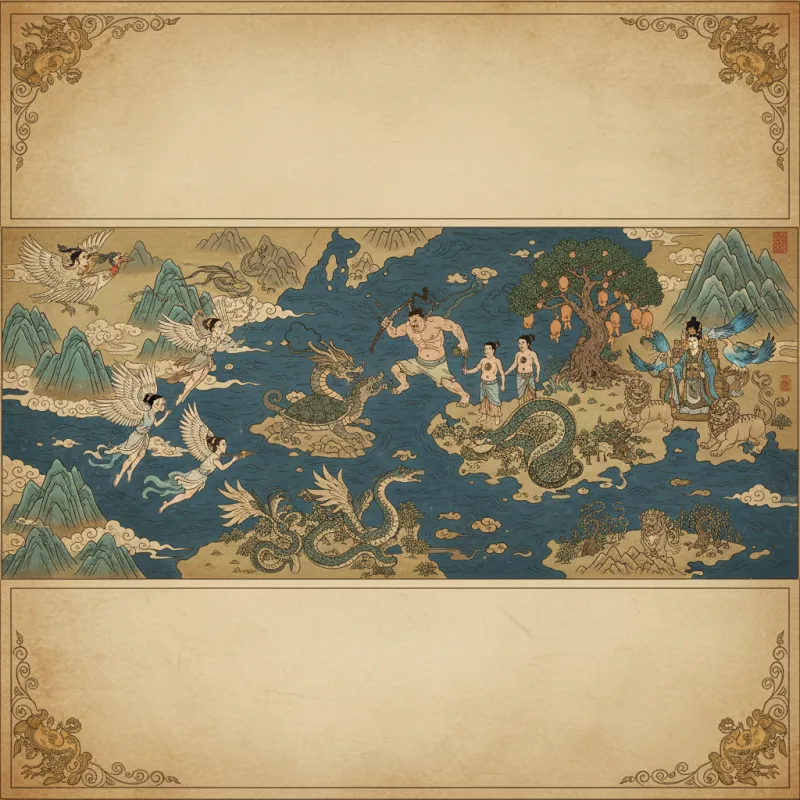
Beyond the known world, where maps dissolve into speculation and geography bleeds into nightmare, the ancient Chinese cartographers who compiled the Shanhaijing encountered a problem: how do you describe people who shouldn't exist? Not monsters, not gods, but people — organized into nations, wearing clothes, eating food — whose bodies violated every assumption about what a human could be.
The Uncomfortable Zone Between Ethnography and Fantasy
The Shanhaijing (山海经 Shānhǎi Jīng, "Classic of Mountains and Seas") dedicates entire sections to cataloging foreign nations with the same bureaucratic precision it uses for mountains and rivers. The "Overseas Classic" (海外经 Hǎiwài Jīng) and "Great Wilderness Classic" (大荒经 Dàhuāng Jīng) read like census reports from an impossible world. Each entry follows a formula: location, physical characteristics, customs, sometimes diet. The tone never wavers into wonder or horror — it simply records.
This is what makes these passages so deeply strange. When the text describes the Jiuwei Fox or other mythical beasts, we understand we're in the realm of pure mythology. But the foreign nations occupy an ambiguous space. They have governments. They farm. They trade. The text occasionally notes their relationships with neighboring peoples. Everything suggests real ethnographic observation — except for the minor detail that the inhabitants might have holes through their chests or heads growing from their armpits.
Modern scholars have spilled considerable ink trying to rationalize these descriptions. Were they garbled accounts of real foreign peoples, their unusual customs exaggerated through repeated retellings? Symbolic representations of cultural differences? Pure invention? The text itself offers no help — it presents the Nation of Long-Arms and the Nation of One-Eye with identical narrative authority.
The Geography of Impossibility
The foreign nations cluster at the cardinal edges of the known world, arranged in a cosmological pattern that suggests deliberate symbolic organization rather than random distribution. To the east, across the Eastern Sea, lie nations associated with solar mythology and longevity. To the west, beyond the Kunlun Mountains, dwell peoples connected to death and transformation. The north hosts nations adapted to cold and darkness, while the southern peoples exhibit traits suggesting heat and abundance.
The Nation of the Feathered People (羽民国 Yǔmín Guó) appears in the southeast, its inhabitants covered in feathers and capable of flight — though the text notes they cannot fly far. The Nation of Gentlemen (君子国 Jūnzǐ Guó) lies to the east, where people are unfailingly courteous, wear swords they never draw, and yield to each other constantly. These eastern nations often possess traits suggesting refinement or transcendence.
Western nations tend toward the grotesque. The Nation of the Pierced-Chest People (贯胸国 Guànxiōng Guó) has inhabitants with holes through their chests, through which they thread carrying poles. The Nation of the Three-Bodied People (三身国 Sānshēn Guó) features individuals with one head but three bodies. The Nation of the Headless People (无头国 Wútóu Guó) — also called the Xingtian Nation — has faces on their chests and navels for mouths, a description that echoes the mythical warrior Xingtian who continued fighting after decapitation.
Bodies That Break the Rules
The physical variations described go far beyond simple deformity. These are bodies that operate on different biological principles entirely. The Nation of the Long-Arms (长臂国 Chángbì Guó) has people whose arms extend to impossible lengths, which they use for fishing in deep waters. The Nation of the Long-Legs (长股国 Chánggǔ Guó) features inhabitants who stride across vast distances on legs like stilts. These aren't disabilities — they're adaptations, evolutionary responses to specific environmental niches.
Some nations possess traits that defy physics rather than biology. The Nation of the No-Shadow People (无影国 Wúyǐng Guó) casts no shadows regardless of light source. The Nation of the No-Intestines People (无肠国 Wúcháng Guó) eats but never excretes, their bodies somehow processing food without digestive systems. The Nation of the Immortals (不死国 Bùsǐ Guó) simply doesn't die — the text offers no explanation, treating immortality as just another ethnic characteristic.
The most disturbing descriptions involve multiplication or absence of standard features. The Nation of the Three-Heads (三首国 Sānshǒu Guó) has people with three heads on one body. The Nation of the One-Eye (一目国 Yīmù Guó) has exactly what you'd expect — though the text specifies the eye is centered in the face, not offset. The Nation of the One-Arm-One-Leg (一臂一股国 Yībì Yīgǔ Guó) describes people with one arm and one leg who somehow function normally, sometimes depicted in pairs who embrace to walk together.
The Ethnographic Impulse
What's remarkable is how the text treats these impossible peoples as subjects of genuine ethnographic interest. It notes their customs, their technologies, their relationships with neighbors. The Nation of the Black-Toothed People (黑齿国 Hēichǐ Guó) not only has black teeth but also eats rice and keeps four birds — details that suggest real cultural observation mixed with the fantastic.
The Nation of the Hairy People (毛民国 Máomín Guó) is covered in body hair and lives in caves, but the text also notes they're skilled at weaving. The Nation of the Pygmies (焦侥国 Jiāoyáo Guó) stands only a few feet tall, but they've developed sophisticated agriculture adapted to their scale. These aren't just physical descriptions — they're attempts to understand how different body types would generate different cultures.
Some nations are defined entirely by their relationship to food or resources. The Nation of the Grain-Eaters (粟食国 Sùshí Guó) subsists entirely on millet. The Nation of the Fish-Eaters (鱼食国 Yúshí Guó) eats nothing but fish. The Nation of the Immortality-Grain People (不死之国 Bùsǐ Zhī Guó) cultivates a grain that grants eternal life — a detail that transforms agriculture into alchemy.
Symbolic Bodies, Political Messages
By the Han Dynasty (206 BCE - 220 CE), commentators were already reading these foreign nations as political allegory. The Nation of Gentlemen represented Confucian ideals taken to absurd extremes — so polite they could barely function. The Nation of the Pierced-Chest People might symbolize peoples who had been "penetrated" by foreign influence. The headless nations could represent societies that had lost their leadership or moral direction.
This allegorical reading gained traction because it solved the embarrassing problem of educated people taking the text literally. But it may miss something important: the Shanhaijing's foreign nations might be thought experiments about human variation. What if bodies were radically different? How would culture adapt? What would remain essentially human?
The text occasionally hints at interactions between these nations and the Chinese heartland. Some nations send tribute. Others are described as descendants of Chinese culture heroes who migrated to the edges of the world and transformed. The Nation of the Yan (奄国 Yǎn Guó) is said to descend from the Shang Dynasty, suggesting that distance from civilization causes physical transformation — a deeply unsettling implication.
The Colonial Gaze and the Monstrous Other
Modern postcolonial readings see these descriptions as early examples of how dominant cultures process difference — by making it monstrous. The foreign nations of the Shanhaijing represent the ultimate othering: peoples so different they're barely recognizable as human, yet organized into nations that mirror Chinese political structures. They're simultaneously inferior (physically deformed) and threatening (organized, numerous, possessing strange powers).
This reading has merit, but it may be too simple. The text doesn't consistently portray these nations as inferior. The Nation of Gentlemen is explicitly superior in moral terms. The Nation of the Immortals has achieved what Chinese alchemists desperately sought. The Nation of the Feathered People can fly. These aren't just degraded humans — they're variations that sometimes represent improvements or at least interesting alternatives.
The Shanhaijing might be doing something more complex than simple othering: it's exploring the boundaries of the human category itself. At what point does physical difference make someone non-human? If a person has three heads but follows social norms, are they still a person? The text never explicitly addresses these questions, but by presenting such extreme variations within the framework of human nations, it forces readers to confront them.
Legacy in Chinese Imagination
These foreign nations became permanent fixtures in Chinese literary and artistic imagination. The Tang Dynasty (618-907 CE) saw a boom in "strange lands" literature that drew heavily on Shanhaijing descriptions. The novel "Flowers in the Mirror" (镜花缘 Jìnghuā Yuán, 1828) by Li Ruzhen sends its protagonist on a journey through nations clearly inspired by the Shanhaijing, though often with satirical intent — the Nation of Gentlemen becomes a commentary on excessive politeness, the Nation of Women a vehicle for gender critique.
Artists loved depicting these peoples. Qing Dynasty illustrated editions of the Shanhaijing show the foreign nations in meticulous detail: the Pierced-Chest People threading poles through their torsos, the Long-Arms People fishing with impossibly extended limbs, the Headless People with faces on their chests staring out at the viewer. These images are both fascinating and deeply uncomfortable — they invite us to look while making us question what we're seeing.
The foreign nations also influenced how Chinese travelers described real foreign peoples. Early accounts of Southeast Asian and Central Asian peoples sometimes borrowed Shanhaijing language and categories, blurring the line between observation and mythological template. When you expect to find strange peoples at the edges of the world, you're more likely to interpret what you see through that lens.
The Question That Remains
The Shanhaijing's foreign nations leave us with an unresolved question: were the compilers describing what they believed to be real peoples, or were they engaged in a sophisticated form of speculative anthropology? The text's tone suggests the former — it never winks at the reader or signals that these descriptions are metaphorical. Yet the sheer impossibility of the bodies described suggests the latter.
Perhaps the answer is that the distinction didn't matter in the same way to the text's original audience. In a world where transformation was possible, where immortals walked the earth and divine creatures intervened in human affairs, why couldn't there be nations of people with holes through their chests? The boundary between possible and impossible was drawn differently.
What remains constant across all interpretations is the text's fundamental assertion: humanity is more variable than we imagine, and at the edges of the known world, that variability explodes into forms that challenge every assumption about what bodies can be and do. The foreign nations of the Shanhaijing are impossible, but they're impossible in ways that reveal the limits of our categories — and perhaps the poverty of our imagination about what human might mean.
Related Reading
- Giants and Gods: The Titans of the Shanhai Jing
- The Feathered People: Winged Humans of the Shanhai Jing
- Strange Nations of the Shanhai Jing: A Catalog of Impossible Peoples
- The Peoples of the Shanhaijing: One-Eyed Nations, Winged Tribes, and the Edges of Humanity
- The Enigmatic Fish of Shanhaijing: Mythical Creatures of Chinese Lore
- Unearthing the Cursed Beings of Shanhaijing: Myths, Creatures, and Lands
- Divine Beasts of the Shanhaijing: The Four Guardians and Beyond