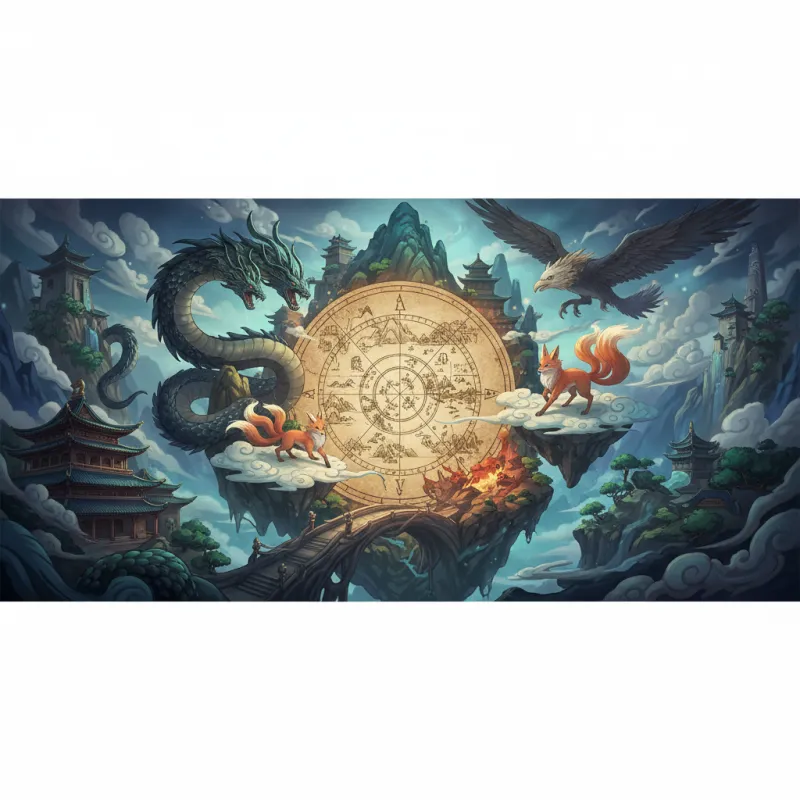
Something strange happened around 2018. Game developers and anime studios — mostly Chinese, but increasingly Japanese and Western — started mining a 2,000-year-old geographic catalog for content. The Shanhaijing (山海经, Shān Hǎi Jīng), a text that most Chinese students encounter as a footnote in history class, suddenly became the hottest intellectual property in entertainment. Walk into any gaming convention in Shanghai or Tokyo, and you'll see cosplayers dressed as nine-tailed foxes, bird-fish hybrids, and multi-headed serpents — all pulled straight from passages written during the Warring States period. The question isn't why this happened. It's why it took so long.
The Shanhaijing is basically a game design document that someone wrote two millennia early. It's got everything: a bestiary of 277 creatures with specific abilities and habitats, a world map divided into regions with resource nodes (jade deposits, medicinal herbs, metal ores), and a mythology system that connects gods, monsters, and geography into a coherent — if bizarre — cosmology. Modern game designers don't need to invent lore. They just need to translate it.
The Perfect Source Material
Here's what makes the Shanhaijing irresistible to game developers: specificity without constraint. The text tells you that the Zhuque (朱雀, Zhū Què) — the Vermillion Bird — guards the southern regions and controls fire. It doesn't tell you what the Zhuque's attack patterns should be, or whether it's a raid boss or a summonable companion. The Shanhaijing provides the skeleton; developers add the muscles and skin.
Compare this to Greek mythology, which has been strip-mined by Western games for decades. Everyone knows Zeus throws lightning bolts. Everyone's fought Medusa in some dungeon. The stories are so familiar they've lost their edge. But ask a Western gamer what a Taowu (梼杌, Táo Wù) is — a tiger-like creature with human face, boar tusks, and a taste for human flesh — and you'll get a blank stare. That's novelty. That's marketable mystery.
Chinese developers figured this out first. Honor of Kings (王者荣耀, Wáng Zhě Róng Yào), Tencent's mobile MOBA that prints money faster than the Chinese mint, has been steadily adding Shanhaijing creatures since 2016. The Bifang (毕方, Bì Fāng) — a one-legged bird that appears before fires — became a playable character with abilities themed around flame and prophecy. The Qiongqi (穷奇, Qióng Qí), described in the text as a winged tiger that eats people starting from their heads, got redesigned as an edgy assassin character. The game doesn't just borrow names; it translates ancient descriptions into modern gameplay mechanics.
From Text to Pixels
The translation process reveals something interesting about how we read ancient texts. When the Shanhaijing describes the Jiuwei Hu (九尾狐, Jiǔ Wěi Hú) — the nine-tailed fox — it gives you maybe three sentences: appears in Qingqiu Mountain, sounds like a baby crying, eats people, and wearing its fur protects against poison. That's it. No personality, no backstory, no moral alignment.
Game designers have to make choices. Is the nine-tailed fox a villain or a misunderstood spirit? In Onmyoji (阴阳师, Yīn Yáng Shī), NetEase's mobile RPG, the fox becomes a tragic figure — beautiful, powerful, and lonely. In Genshin Impact, miHoYo gives us multiple fox-inspired characters with different personalities and motivations. The Shanhaijing provides the seed; each game grows a different tree.
This interpretive freedom is why you see such wild variation in how these creatures appear across different media. The Taotie (饕餮, Tāo Tiè) — the gluttonous monster whose face appears on ancient bronze vessels — shows up as a cosmic horror in some games, a comic relief character in others, and a tragic figure cursed by endless hunger in still others. The text doesn't constrain interpretation; it invites it.
Anime's Slower Adoption
Japanese anime took longer to embrace the Shanhaijing, which is odd considering how much Chinese mythology has already infiltrated Japanese culture. The Kirin (麒麟, Qí Lín) has been a staple of Japanese fantasy for centuries, even though it originated in Chinese texts. But direct Shanhaijing adaptations? Those are newer.
Hitori no Shita: The Outcast (一人之下, Yī Rén Zhī Xià), a Chinese webcomic adapted into anime by Japanese studios, weaves Shanhaijing creatures throughout its story about modern-day cultivators and ancient powers. The anime doesn't just drop in monsters for fight scenes; it treats the Shanhaijing as a living text that characters study and reference. When a character encounters a Feiyi (飞鱼, Fēi Yú) — a flying fish with six legs — they actually discuss what the classical text says about it before fighting it. It's mythology as scholarship, which feels appropriate for a text that was originally meant to be educational.
The difference between Chinese and Japanese adaptations often comes down to reverence. Chinese developers feel free to remix and reimagine because the Shanhaijing is their cultural inheritance. Japanese creators tend to approach it more carefully, treating it as foreign mythology that deserves respect. Neither approach is better; they just produce different results. Chinese games give you a Shanhaijing that's alive and evolving. Japanese anime gives you a Shanhaijing that's preserved and studied.
The Western Discovery
Western game developers discovered the Shanhaijing around 2020, mostly through Chinese games that had already done the heavy lifting of visual translation. Smite, the third-person MOBA from Hi-Rez Studios, added several Shanhaijing-inspired gods to its roster. Their version of Jing Wei (精卫, Jīng Wèi) — the bird that tries to fill the ocean with pebbles — became a ranged carry with abilities themed around persistence and revenge.
What's fascinating is watching Western developers try to fit Shanhaijing creatures into familiar fantasy archetypes. The Xuanwu (玄武, Xuán Wǔ) — the Black Tortoise of the North — gets translated as a "tank" character. The Qinglong (青龙, Qīng Lóng) — the Azure Dragon of the East — becomes a "mage" or "caster." These translations aren't wrong, exactly, but they flatten the creatures into roles that Western gamers understand. The original text doesn't think in terms of game balance or party composition. It just describes weird animals that live in weird places.
The best Western adaptations are the ones that embrace the weirdness. Indie developers, especially, have started creating games that treat the Shanhaijing as surrealist literature rather than a monster manual. These games don't try to explain why a creature has six legs or why a mountain produces jade that cures deafness. They just present the information and let players figure out what to do with it, which is closer to how the original text actually works.
The Mythology-to-Mechanics Pipeline
Here's the process most developers follow when adapting Shanhaijing content:
First, they read the original passage. Let's use the Bi Fang (毕方, Bì Fāng) as an example: "There is a bird that looks like a crane, with one leg, red markings, and a blue body with white beak. It is called Bi Fang. Its call sounds like its name. When it appears, there will be strange fires in the city."
Second, they extract the core elements: one-legged, bird-like, associated with fire, appears as an omen. Third, they translate these into game mechanics. One leg might mean high mobility but poor stability — fast movement but vulnerable to knockback. Fire association becomes elemental damage. Omen status might translate into a passive ability that reveals enemy positions or predicts danger.
The best adaptations find the metaphorical connection between ancient description and modern gameplay. The Shanhaijing says the Bi Fang appears before fires; a game might make it a character that excels at initiating team fights or starting chain reactions. The text says it has one leg; a game might give it abilities that require careful positioning and timing. The translation isn't literal — it's interpretive.
This is why the Shanhaijing works better for games than more narrative-heavy mythologies. Greek myths tell you what Achilles did and why. The Shanhaijing just tells you what a creature looks like and where it lives. The "why" is up to you.
Visual Translation Challenges
The hardest part of adapting the Shanhaijing isn't the lore — it's the visuals. The text describes creatures in ways that are anatomically impossible or deliberately vague. "A fish with a bird's wings" could mean a dozen different things depending on how you interpret the proportions, the placement, and the style.
Chinese artists have a head start here because they've been illustrating these creatures for centuries. There's a visual tradition to draw from, even if it's not consistent. The Qilin appears in countless paintings and sculptures, so game artists have references. But creatures like the Zouyu (騶虞, Zōu Yú) — described as a white tiger with black markings that appears during times of peace — don't have as much visual history. Artists have to invent.
The most successful visual adaptations are the ones that commit to a specific interpretation rather than trying to please everyone. Genshin Impact's designers took the concept of the Qilin and created Ganyu, a character who's half-qilin and fully integrated into the game's anime aesthetic. She doesn't look like a traditional Qilin illustration, but she captures something essential about the creature's grace and otherworldliness. That's good translation — preserving the spirit while adapting the form.
The Lore Integration Problem
Here's where most games stumble: they treat Shanhaijing creatures as isolated assets rather than parts of a coherent world. The original text is obsessive about geography and relationships. It tells you which mountains connect to which rivers, which creatures live near which plants, which gods rule which regions. Everything is connected.
Most games just cherry-pick the cool monsters and ignore the connective tissue. You'll fight a Taotie in one level and a Qiongqi in another, with no acknowledgment that the original text places them in specific locations with specific relationships to the landscape. It's like adapting The Lord of the Rings but putting Mordor next to the Shire because it makes for a better level progression.
The games that do this well — like Tale of Immortal (鬼谷八荒, Guǐ Gǔ Bā Huāng), a Chinese cultivation RPG — treat the Shanhaijing as a world-building framework rather than a monster database. Creatures appear in regions that match their textual descriptions. The game's map mirrors the Shanhaijing's geographic structure. When you encounter a creature, you're not just fighting a random enemy; you're exploring a specific part of the ancient cosmology.
This approach requires more work, but it pays off in immersion. Players start to understand the Shanhaijing not as a list of monsters but as a way of organizing the world — which is what it was originally meant to be.
Why Now?
So why did this explosion happen in the late 2010s? Three reasons:
First, Chinese game development matured. For years, Chinese studios were copying Western and Japanese games. Around 2015-2016, they started developing their own aesthetic and drawing from their own cultural sources. The Shanhaijing was right there, waiting.
Second, global audiences got hungry for non-Western fantasy. After decades of elves, dwarves, and dragons, players wanted something different. The Shanhaijing offered that difference without requiring a PhD in Chinese literature to understand. The creatures are weird enough to feel fresh but comprehensible enough to be accessible.
Third, the text itself is weirdly modern. The Shanhaijing doesn't moralize or explain. It just catalogs and describes, which is exactly how modern games present lore — through item descriptions, bestiary entries, and environmental storytelling. The text's neutral, documentary tone translates perfectly into game design language.
The Future of Shanhaijing Adaptations
We're still in the early stages of this trend. Most games are still doing surface-level adaptations — borrowing creature designs without engaging with the text's deeper structure. But I'm seeing signs of more sophisticated approaches.
Some developers are starting to explore the Shanhaijing's geographic obsessions, creating games where location and landscape matter as much as combat. Others are digging into the text's stranger passages — the ones about mountains that produce specific metals, or rivers that cure specific diseases, or plants that grant specific powers. These elements could become crafting systems, resource management mechanics, or environmental puzzles.
The most exciting possibility is games that treat the Shanhaijing as a mystery to be decoded rather than a source of content to be extracted. What if a game presented you with the original text and asked you to figure out what it means? What if the creatures behaved according to their textual descriptions, and you had to study the Shanhaijing to understand how to interact with them? That would be a game that respects the text's original purpose — not as entertainment, but as a guide to understanding a strange and wondrous world.
The Shanhaijing has survived for two thousand years by being useful. It was a geographic reference, a medical manual, a religious text, and a work of literature. Now it's a game design document. The text doesn't care. It just keeps describing mountains and monsters, waiting for the next generation to figure out what to do with them.
For more on how ancient Chinese texts influence modern media, check out Shanhaijing in Modern Literature and Contemporary Art Inspired by Shanhaijing.
Related Reading
- Chinese Mythology in Hollywood: From Mulan to Shang-Chi — Shanhai Perspective
- Shanhai Jing in Modern Art: Contemporary Illustrations of Ancient Beasts — Shanhai Perspective
- Modern Artists Reimagining the Classic of Mountains and Seas
- Shanhai Jing Creatures in Modern Video Games — Shanhai Perspective
- Shanhai Jing vs. Greek Mythology: Ancient Bestiaries Compared
- Discovering the Guardians of Shanhaijing: Mythical Creatures and Legendary Lands
- Bifang: The Fire Bird That Brings Disaster