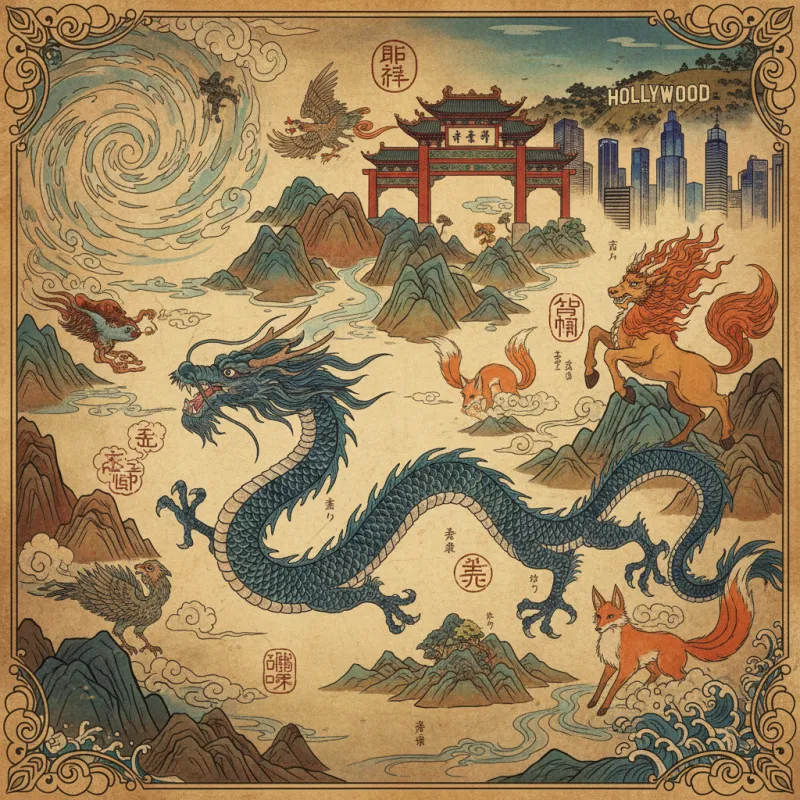
When Disney's Shang-Chi and the Legend of the Ten Rings premiered in 2021, Chinese-American audiences experienced something unprecedented: a Marvel superhero film where the protagonist's father kept a menagerie of creatures straight out of the Shanhaijing. The Hundun (混沌 Hùndùn), that faceless chaos beast from the Classic of Mountains and Seas, appeared on screen as a CGI marvel. The Dijiang (帝江 Dìjiāng), the six-legged, four-winged emperor-bird, soared through Ta Lo's mystical realm. For the first time, Hollywood wasn't just borrowing Chinese aesthetics — it was actually reading the source material.
This represents a seismic shift from where we started. For decades, Western studios treated Chinese mythology like a buffet where you could grab whatever looked exotic, mix it with some kung fu, add a dragon, and call it authentic. The journey from Disney's 1998 Mulan to Marvel's Shang-Chi reveals not just Hollywood's evolving relationship with Chinese culture, but also how the Shanhaijing itself — that ancient compendium of mythical geography and creatures — is finally getting its moment in the global spotlight.
The Mulan Problem: When Cultural Consultants Get Ignored
Disney's animated Mulan was groundbreaking for 1998, but it also established a troubling template: take a Chinese story, strip away its cultural specificity, and rebuild it with Western narrative beats. The original Ballad of Mulan (木兰辞 Mùlán Cí) is a spare, elegant poem about duty and family. Disney added a wisecracking dragon sidekick named Mushu, a cricket for comic relief, and ancestors who behave like Greek chorus members.
The 2020 live-action remake tried to course-correct by removing Mushu and adding a phoenix — a creature actually from Chinese mythology. But then it introduced qi (气 qì) as a superpower that only special people possess, fundamentally misunderstanding a concept that traditional Chinese philosophy considers universal life energy. The film also invented a shapeshifting witch named Xianniang, seemingly inspired by the fox spirits (狐狸精 húlijīng) from Chinese folklore, but stripped of all the moral complexity that makes those creatures interesting in stories like Strange Tales from a Chinese Studio.
What Mulan 2020 missed was the Shanhaijing's actual shapeshifters. The Classic describes the Qinyuan (钦原 Qīnyuán), a bird whose appearance brings drought and whose cry sounds like a phoenix. It mentions the Lushu (鹿蜀 Lùshǔ), a horse-bodied creature with a white head and tiger stripes. These aren't just monsters — they're geographical markers, omens, creatures tied to specific mountains and rivers. Hollywood's version of Chinese mythology tends to float free of this geographical anchoring, which is precisely what makes the Shanhaijing unique.
Kung Fu Panda: Accidentally Getting It Right
DreamWorks' Kung Fu Panda trilogy (2008-2016) shouldn't work. It's about an overweight panda who becomes a martial arts master through the power of believing in himself — pure American individualism wrapped in Chinese aesthetics. Yet Chinese audiences loved it, and the films grossed more in China than in the United States.
Why? Because the filmmakers actually studied Chinese visual culture, philosophy, and yes, mythology. The Spirit Realm in Kung Fu Panda 3 draws heavily from Daoist concepts of the afterlife, but also from the Shanhaijing's descriptions of otherworldly realms. When Po meets his biological father in a hidden panda village, the landscape echoes the Classic's accounts of remote valleys where unusual creatures live in isolation.
More importantly, the films understand that Chinese mythology isn't just about individual heroes — it's about balance, harmony, and the relationship between the earthly and spiritual realms. Master Oogway's ascension to the Spirit Realm, trailing cherry blossoms and golden light, captures something essential about Chinese cosmology that Mulan 2020's wire-fu battles completely missed. The philosophical concepts embedded in these films resonate because they're not just decoration.
The Monkey King's Hollywood Curse
Sun Wukong (孙悟空 Sūn Wùkōng), the Monkey King from Journey to the West, should be as recognizable globally as Superman. He's been adapted countless times in Chinese cinema, television, and animation. Yet every Hollywood attempt to bring him to Western audiences has failed spectacularly.
The 2008 film The Forbidden Kingdom, starring Jackie Chan and Jet Li, reduced the Monkey King to a supporting character in a white teenager's hero journey. The 2014 film The Monkey King, despite being a Chinese production with international ambitions, flopped in Western markets. Netflix's 2021 animated film The Monkey King simplified the character into a generic trickster hero, losing all the Buddhist philosophical depth that makes the original story resonate.
Here's what Hollywood keeps missing: Sun Wukong isn't just powerful — he's a creature of transformation who embodies the Shanhaijing's fundamental principle that boundaries between categories (animal/human, mortal/immortal, earth/heaven) are permeable. The Classic of Mountains and Seas describes dozens of hybrid creatures: human-faced birds, snake-bodied gods, fish that walk on land. Sun Wukong, born from a stone and capable of seventy-two transformations, is the ultimate expression of this mythological fluidity.
The Monkey King also represents something Hollywood struggles with: a protagonist who's genuinely alien in his thinking. He doesn't want to save the world or find true love — he wants to be recognized as equal to the gods, to have his name written in the registers of immortality. That's a very different kind of heroism than Western narratives typically allow.
Shang-Chi: Finally Reading the Source Material
Marvel's Shang-Chi and the Legend of the Ten Rings (2021) represents the first time a major Hollywood production actually treated the Shanhaijing as source material rather than aesthetic inspiration. The film's production designer, Sue Chan, and VFX supervisor, Christopher Townsend, worked with cultural consultants to bring specific creatures from the Classic to life.
The village of Ta Lo, hidden behind a shifting bamboo forest, echoes the Shanhaijing's descriptions of remote realms accessible only through specific geographical features. The Great Protector, a massive dragon that guards the village, draws from the Classic's numerous dragon descriptions — not the European fire-breathing kind, but the Chinese long (龙 lóng) associated with water, wisdom, and cosmic power.
Most impressively, the film features the Dweller-in-Darkness, a soul-consuming entity sealed behind a gate. While not directly from the Shanhaijing, it captures the Classic's frequent mentions of dangerous creatures that must be contained or avoided. The text describes the Taowu (梼杌 Táowù), a stubborn, unteachable beast that represents chaos. It mentions the Qiongqi (穷奇 Qióngqí), a winged tiger that eats people starting from their heads. These aren't villains with complex motivations — they're forces of nature that must be respected and managed.
The film also understands that Chinese mythology is deeply tied to family and lineage. Shang-Chi's conflict with his father, Wenwu, isn't just personal drama — it's about inheritance, duty, and the weight of history. The Ten Rings themselves, ancient artifacts of unknown origin, function like the magical objects throughout the Shanhaijing: powerful, dangerous, and tied to specific bloodlines or locations.
What Hollywood Still Gets Wrong
Despite Shang-Chi's success, Hollywood's engagement with Chinese mythology remains superficial in key ways. The biggest problem? The Shanhaijing isn't just a monster manual — it's a geographical text. Every creature, every strange plant, every magical mountain is located somewhere specific. The Classic tells you which direction to travel, how many li (里 lǐ, ancient Chinese miles) to go, what rivers you'll cross.
This geographical specificity matters because Chinese mythology is fundamentally about place. The dragon isn't just a dragon — it's the dragon of the Eastern Sea, or the dragon that lives in this particular mountain range. Western fantasy, from Tolkien onward, creates imaginary geographies. Chinese mythology maps the real world, then populates it with wonders. Hollywood films set in "mystical China" tend to create vague, orientalist landscapes that could be anywhere, missing this crucial connection between myth and geography.
There's also the problem of moral complexity. The Shanhaijing's creatures aren't good or evil — they're omens, warnings, or simply strange beings that exist. A creature that brings drought isn't villainous; it's dangerous, like a volcano or a flood. Hollywood's need for clear heroes and villains often flattens this moral ambiguity. Even Shang-Chi, for all its strengths, turns the Dweller-in-Darkness into a straightforward monster to defeat rather than a force to be managed or appeased.
The Future: Beyond Martial Arts and Dragons
The success of Shang-Chi and the global popularity of Chinese fantasy novels like The Untamed (based on Mo Dao Zu Shi) suggest that Western audiences are ready for Chinese mythology on its own terms. But Hollywood needs to move beyond its comfort zone of martial arts, dragons, and wise old masters.
The Shanhaijing alone offers countless untapped stories. What about the Kuafu (夸父 Kuāfù), the giant who chased the sun until he died of thirst, his staff transforming into a peach grove? That's a tragedy about ambition and mortality that could rival any Greek myth. Or the Jingwei (精卫 Jīngwèi), the bird that tries to fill the ocean with pebbles after drowning as a human girl? That's a story about persistence and grief that needs no cultural translation.
The Classic describes the Queen Mother of the West (西王母 Xīwángmǔ), who lives in the Kunlun Mountains and guards the peaches of immortality. She's not a villain or a love interest — she's a cosmic power, both nurturing and terrifying. A film that took her seriously, that explored the Shanhaijing's vision of a world where divine beings live in specific mountains and interact with humans according to complex protocols, could be genuinely revolutionary.
Why This Matters Beyond Representation
The push for better representation of Chinese mythology in Hollywood isn't just about fairness or seeing yourself on screen — though those matter. It's about expanding the global imagination. For too long, Western audiences have assumed that Greek and Norse myths represent universal human stories, while Chinese myths are exotic curiosities.
The Shanhaijing offers a fundamentally different way of thinking about the relationship between humans and nature, between the known and unknown. Its creatures aren't monsters to be slain but parts of a complex ecosystem. Its geography isn't a backdrop but an active participant in the story. Its transformations and hybridities suggest that categories we take for granted — human/animal, living/dead, real/imaginary — are more fluid than we think.
When Hollywood finally learns to adapt Chinese mythology without stripping away its strangeness, without making it conform to Western narrative expectations, we'll all benefit. We'll get stories that surprise us, creatures we've never imagined, and heroes who want things we didn't know we could want. The Shanhaijing has been waiting for over two thousand years. It can wait a little longer for Hollywood to catch up.
Until then, we have Shang-Chi's Hundun, that faceless chaos beast, reminding us that the world is stranger and more wonderful than any studio executive's market research could predict. And maybe that's enough to start with — one properly adapted creature from the Classic of Mountains and Seas, proving that audiences everywhere are hungry for myths they haven't heard a thousand times before. The ancient creatures are ready for their close-up. Hollywood just needs to learn their names.
Related Reading
- Shanhai Jing in Modern Art: Contemporary Illustrations of Ancient Beasts — Shanhai Perspective
- Shanhai Jing Creatures in Modern Video Games — Shanhai Perspective
- Shanhaijing in Video Games and Anime
- Modern Artists Reimagining the Classic of Mountains and Seas
- Mystical Beasts of the Shanhaijing: A Journey Through Myth and Geography
- The Complete Guide to Shanhai Jing: China's Book of Mythical Creatures
- Unraveling the Mysteries of Shanhaijing: Myths, Creatures, and Fantastic Realms