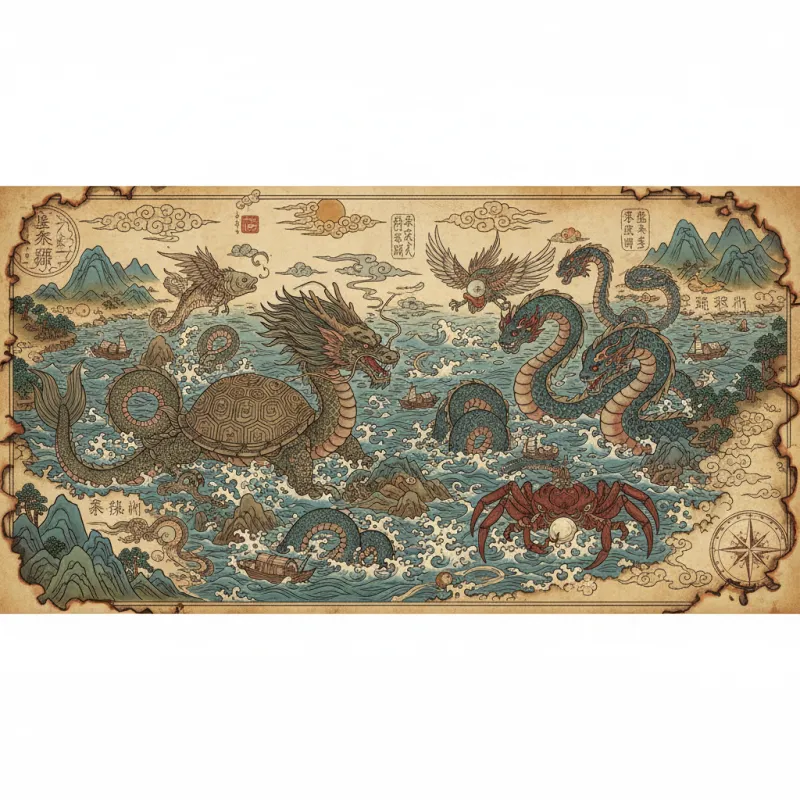
The Kun (鯤) is a fish so large that no one knows how many thousands of li it measures. When it transforms into the Peng (鵬) bird, its back stretches like a mountain range across the sky, and when it beats its wings, the ocean churns into whirlpools that could swallow entire fleets. This isn't hyperbole — this is how the philosopher Zhuangzi opens his most famous work, the Zhuangzi (莊子), written around 300 BCE. He's not describing a creature. He's describing the inadequacy of human perspective itself.
The giant sea creatures of Chinese mythology operate on a scale that makes Western sea monsters look quaint. The Kraken might sink a ship. The Kun-Peng cycle represents the transformation of matter itself, the fluidity between elements, the idea that what we call "ocean" and what we call "sky" are just different states of the same cosmic substance. This is mythology as philosophy, and the Eastern Sea — that vast, mysterious expanse beyond the coastal provinces — was the perfect canvas for it.
The Kun: A Fish Beyond Measurement
The Kun appears in the opening lines of the Zhuangzi, and Zhuangzi makes a point of its immeasurability. "In the Northern Ocean there is a fish, named Kun, whose size I do not know how many thousand li." The li (里) is a Chinese unit of distance, roughly a third of a mile, but the vagueness is intentional. The Kun isn't just big — it's beyond the scale of human measurement, beyond the capacity of language to capture.
What's fascinating is that Zhuangzi doesn't describe the Kun doing anything particularly monstrous. It doesn't attack sailors or guard treasure. It simply exists, and then it transforms. When the sea churns and the seasons change, the Kun becomes the Peng, a bird so massive that its wings are "like clouds hanging from the sky." The transformation takes six months. The journey from ocean to sky requires a typhoon's worth of wind.
This is Daoist philosophy in creature form. The Kun-Peng represents hua (化), transformation, the fundamental mutability of existence. It's the same principle that governs the I Ching (易經, Yijing), the Book of Changes — nothing is fixed, everything flows into something else. The ocean and the sky aren't separate realms. They're just different phases of the same cosmic process, and the Kun-Peng is the being that embodies that transition.
The Ao: Turtles That Carry Mountains
If the Kun represents transformation, the Ao (鰲) represents stability — or rather, the illusion of it. These are cosmic turtles, creatures so large that they carry entire mountains on their backs. According to the Liezi (列子), a Daoist text from around the 4th century BCE, there were originally five sacred mountains in the Eastern Sea, floating freely on the water. The Celestial Emperor, concerned that they might drift away, commanded fifteen giant Ao turtles to take turns supporting them, three turtles per mountain, rotating shifts every 60,000 years.
Then a giant from the Longbo (龍伯) kingdom came fishing. He caught six of the turtles. Two mountains — Daiyu (岱輿) and Yuanqiao (員嶠) — drifted to the North Pole and sank. The remaining three mountains — Penglai (蓬萊), Fangzhang (方丈), and Yingzhou (瀛洲) — stayed in place, still supported by their Ao guardians.
This story does several things at once. It explains why there are only three sacred mountains instead of five. It establishes the Ao as beings of cosmic importance, literally holding up the geography of the immortal realm. And it introduces a note of cosmic precariousness — even mountains supported by giant turtles can be lost if someone gets careless with a fishing rod.
The Ao became a symbol of stability and endurance in Chinese culture. The phrase "Ao tou" (鰲頭), literally "turtle head," came to mean the top position in the imperial examinations, because successful candidates would stand on a stone carved with an Ao during the ceremony. To "stand on the Ao's head" meant to achieve the highest honor. The creature that holds up mountains became a metaphor for holding up civilization itself.
The Jiao: Dragons That Never Left the Water
Western dragons fly. Chinese dragons — long (龍) — can fly, but many of them don't. The Jiao (蛟) is a dragon that stays in the water, a serpentine creature that lives in rivers, lakes, and coastal waters, and it's far more dangerous than its airborne cousins.
The Shuowen Jiezi (說文解字), the Han dynasty dictionary compiled around 100 CE, defines the Jiao as a "scaled dragon" that can cause floods. The Shanhaijing (山海經, Classic of Mountains and Seas) mentions them repeatedly, usually in the context of dangerous waters. "The river has many Jiao" is a warning, not a tourist attraction.
What makes the Jiao terrifying isn't just its size — though it could grow to enormous lengths — but its temperament. Unlike the benevolent dragons associated with emperors and rain, the Jiao was aggressive, territorial, and prone to capsizing boats. The Shiji (史記, Records of the Grand Historian) records that in 219 BCE, the First Emperor of Qin went to the sea to hunt a great fish or Jiao that was blocking his path. He shot it with a repeating crossbow. Whether he actually killed it is unclear, but the story establishes the Jiao as something even emperors had to contend with.
The Jiao also appears in the story of Zhou Chu (周處), a troublemaker from the Three Kingdoms period who redeemed himself by killing three "evils" — a man-eating tiger, a bridge-destroying Jiao, and himself (by reforming his behavior). The Jiao in that story had been terrorizing a local river for years, dragging swimmers underwater and destroying fishing boats. Zhou Chu dove in, fought it for three days and nights, and finally killed it. The story became a parable about confronting one's own destructive nature, but it also reinforced the Jiao's reputation as a genuine threat, not just a mythological abstraction.
For more on water-dwelling dragons and their relationship to Chinese cosmology, see Dragon Kings and Ocean Palaces.
The Hai Heshang: Monk-Fish of Apocalyptic Proportions
The Hai Heshang (海和尚), or "Sea Monk," is a creature that appears in later Chinese folklore, particularly in coastal regions during the Ming and Qing dynasties. It's described as a massive fish with a head resembling a Buddhist monk — bald, round, with a serene expression — and a body that could be as large as a small island.
What's unsettling about the Hai Heshang isn't its size but its behavior. According to coastal legends, when a Hai Heshang appeared, it was an omen of disaster — usually a tsunami or a catastrophic storm. Fishermen who saw one would immediately return to shore and warn their villages. The creature itself didn't attack; it simply appeared, floated on the surface for a while, and then disappeared. Days later, the disaster would strike.
This is a different kind of sea monster — not a predator but a harbinger. The Hai Heshang represents the ocean's inscrutability, the way it can seem calm and then suddenly turn deadly. The monk-like appearance adds an eerie layer: this is a creature that looks peaceful, even holy, but its presence means death is coming. It's the ocean wearing a mask of serenity.
The Hai Heshang also appears in Japanese folklore as the Umibōzu (海坊主), suggesting a shared coastal mythology across East Asia. Both cultures developed the same basic idea: sometimes the ocean sends a warning, and it looks like a monk.
The Whale That Became a Mountain
Chinese sources don't always distinguish clearly between whales and mythological sea creatures. The character jing (鯨) refers to whales, but in classical texts, whales are often described in terms that blur the line between natural history and mythology.
The Shanhaijing mentions whales in several passages, usually in the context of their enormous size. One entry describes a creature called the Jing Yu (鯨魚), a whale-fish so large that when it died and washed ashore, its body formed a small mountain. Local people would harvest its bones for years, using them to build houses and tools.
This isn't entirely mythological. Whale falls — the phenomenon of dead whales sinking to the ocean floor and creating entire ecosystems — were observed by coastal communities, and the bones of large whales could indeed be used for construction. But the Chinese mythological imagination took this natural phenomenon and scaled it up. A whale that becomes a mountain isn't just a big animal; it's a creature that literally reshapes the landscape.
The Bencao Gangmu (本草綱目), Li Shizhen's comprehensive materia medica from 1596, includes an entry on whale products — oil, bones, ambergris — but also notes that "the largest whales are said to be as large as mountains, and when they spout water, it rises like a waterspout and can sink ships." This is natural history shading into mythology, the way all pre-modern natural history did. The line between "very large whale" and "cosmic sea creature" was porous.
For more on how Chinese mythology categorizes sea life, see Fish-Dragons and Transformation Myths.
The Eastern Sea as Cosmic Boundary
All of these creatures — the Kun, the Ao, the Jiao, the Hai Heshang, the mountain-sized whales — inhabit the Eastern Sea, the Donghai (東海). This wasn't just a geographic location. It was a cosmological concept, the edge of the known world, the boundary between the human realm and the realm of immortals.
The Eastern Sea was where the sun rose. It was where the sacred mountains floated. It was where the Queen Mother of the West kept her peach garden (in some versions). It was the direction associated with spring, with beginnings, with the color green-blue (qing, 青). And it was populated by creatures that defied normal categories of existence.
What's striking about Chinese sea monsters is that they're rarely evil. The Kun doesn't attack anyone. The Ao are dutiful guardians. Even the Jiao, for all its aggression, is just defending its territory. These aren't demons or fallen angels. They're expressions of the ocean's fundamental otherness, its refusal to operate on human scales or follow human logic.
The ocean in Chinese mythology is a place of transformation, not conquest. You don't sail across it to find new lands (though some did). You don't map it or tame it. You acknowledge its vastness, respect its creatures, and understand that some things are simply beyond human measure. The leviathans of the Eastern Sea aren't obstacles to be overcome. They're reminders of how small we are, how limited our perspective, how much of the world operates on scales we can barely imagine.
Why Size Matters in Chinese Mythology
There's a reason Chinese sea creatures are so impossibly large. It's not just for dramatic effect. Size, in Chinese philosophical thought, is often a metaphor for perspective. The Kun is so large that it can't be measured because human measurement is inadequate. The Peng flies so high that it looks down on everything, seeing patterns that ground-level observers miss.
Zhuangzi makes this explicit in his text. After describing the Kun-Peng transformation, he tells a story about a cicada and a dove laughing at the Peng. "Why does it need to fly so high?" they ask. "We can hop from tree to tree just fine." The point is that the cicada and the dove can't comprehend the Peng's perspective. They're trapped in their own scale of existence.
This is what the giant sea creatures represent: the inadequacy of human perspective, the existence of scales and modes of being that we can't fully grasp. The ocean is the perfect setting for this because it's already beyond human scale. We can't see to the bottom. We can't cross it without technology. We can't breathe in it. It's fundamentally alien to us, and the creatures that live in it are even more so.
The leviathans of the Eastern Sea aren't just big fish. They're philosophical propositions in creature form, arguments about the nature of reality, the limits of knowledge, and the relationship between the human and the cosmic. They're what happens when you take the ocean seriously — not as a resource or a highway, but as a realm unto itself, governed by its own logic, populated by beings that operate on scales we can barely imagine.
And they're still out there, in the texts, waiting for readers who are willing to adjust their perspective and see the world from the back of a cosmic turtle or the wings of a bird the size of clouds.
Related Reading
- Sea Monsters of the Shanhai Jing: Terrors of the Deep
- Sea Creatures of the Shanhaijing: Monsters from the Deep
- Merfolk in Chinese Mythology: The Shark People and Sea Maidens
- The Four Dragon Kings: Rulers of China's Mythological Oceans
- The Illustrated Shanhaijing: How Artists Have Imagined the Unimaginable
- Mythical Lands of the Shanhaijing: Places That Should Not Exist
- Strange Creatures of the Shanhaijing: A Field Guide to the Impossible