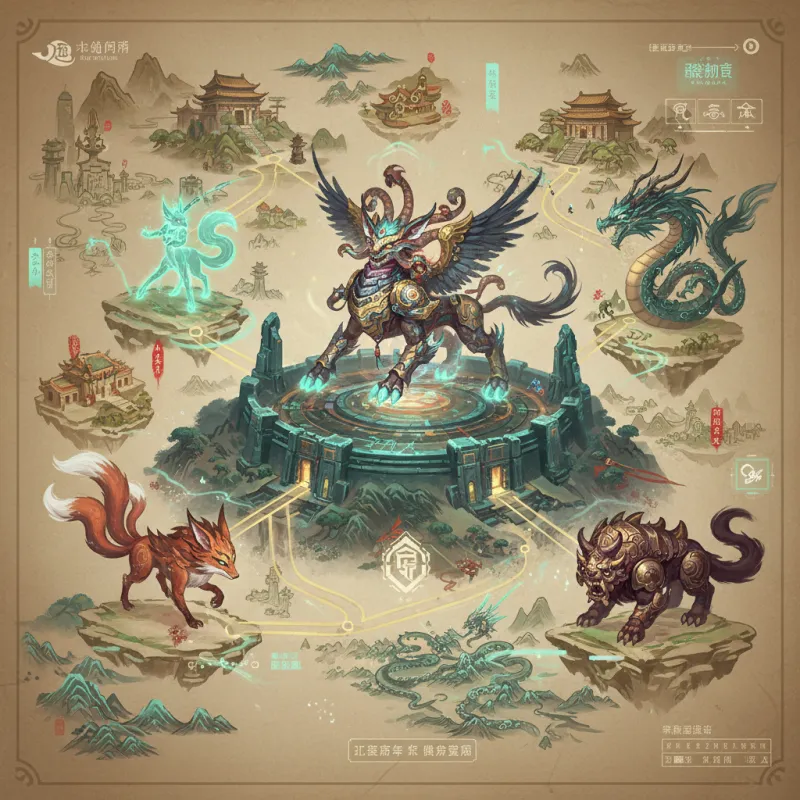
The first time you fight a Bifang (毕方 Bìfāng) in a video game, you might not realize you're facing a creature that's been terrorizing Chinese imaginations for over two millennia. This one-legged fire bird, described in the Shanhaijing as an omen of drought and destruction, has made the leap from ancient text to digital battleground—and it's brought hundreds of its mythological siblings along for the ride.
The Original Monster Manual
The Shanhaijing (山海经 Shānhǎi Jīng, Classic of Mountains and Seas) reads like it was written by a game designer who time-traveled from the future. Compiled between the 4th century BCE and the 2nd century CE, it catalogs over 400 creatures with the systematic precision of a bestiary: habitat zones, physical attributes, behavioral patterns, and most importantly, what happens when humans interact with them. Eat the flesh of a Lushu (驴鼠 Lǘshǔ, donkey-rat) and you'll never have tumors. Wear the hide of a Qiongqi (穷奇 Qióngqí) and you'll gain courage. The text even assigns creatures to specific mountains and regions, creating what amounts to a level-based encounter system.
This wasn't accidental. The Shanhaijing served practical purposes—it was a geographical guide, a pharmacological reference, and a survival manual for travelers navigating unknown territories. But it also established a template that modern game designers have been unconsciously following for decades: creatures as interactive systems with predictable rules and tangible rewards.
Black Myth: Wukong Changes Everything
When Black Myth: Wukong (黑神话:悟空 Hēi Shénhuà: Wùkōng) launched in 2024, it didn't just break sales records—it proved that Chinese mythology could anchor a AAA game without compromise or westernization. Game Science's action RPG draws primarily from Journey to the West, but the Shanhaijing's influence permeates every corner of its world design. The game's environmental storytelling, where each region hosts creatures appropriate to its terrain and climate, mirrors the geographical organization of the ancient text.
More significantly, Black Myth treats its mythological creatures as complex beings with their own motivations and histories, not just exotic enemies to defeat. The Lingxuzi (灵虚子 Língxūzǐ) boss fight, for instance, incorporates the creature's traditional association with transformation and deception into its actual combat mechanics. This represents a maturation in how games handle Chinese mythology—moving beyond surface-level aesthetics to engage with the philosophical and narrative depth of the source material.
The game's global success (over 10 million copies sold in the first week) has created what industry analysts are calling the "Wukong effect"—a sudden surge in Western interest in Chinese mythological games and a validation for Chinese developers who've been told their cultural references are "too niche" for international markets.
From Pokémon to Genshin: The Shanhaijing's Quiet Influence
Long before Black Myth made Chinese mythology mainstream, the Shanhaijing was already shaping game design in subtle ways. Pokémon, despite being Japanese, owes a conceptual debt to the creature-cataloging tradition the Shanhaijing pioneered. The idea of a world populated by hundreds of collectible creatures, each with specific habitats and abilities, echoes the ancient text's organizational logic.
Genshin Impact (原神 Yuánshén) takes a more direct approach, populating its Liyue region with creatures explicitly drawn from Chinese mythology. The Geovishaps reference the dragon-serpent hybrids common in Shanhaijing descriptions, while the Primo Geovishap's territorial behavior and elemental associations mirror how the text assigns creatures to specific mountains and attributes them with control over natural phenomena.
Even Western games have borrowed from the Shanhaijing's playbook without realizing it. The Monster Hunter series, with its ecological approach to creature design—where monsters are treated as animals with specific habitats, diets, and behaviors rather than pure antagonists—reflects the same naturalistic observation that characterizes the ancient text. The difference is that Monster Hunter's developers studied real-world biology, while the Shanhaijing's authors were documenting a mythological ecosystem with equal seriousness.
Mobile Games and the Gacha Bestiary
China's mobile gaming market has embraced Shanhaijing creatures with particular enthusiasm, though not always with scholarly rigor. Games like Onmyoji (阴阳师 Yīnyángshī) and Honor of Kings (王者荣耀 Wángzhě Róngyào) feature dozens of creatures from the text, reimagined as collectible characters with anime-inspired designs. The Taotie (饕餮 Tāotiè), traditionally depicted as a gluttonous monster face, becomes a handsome warrior with demonic features. The Jiuwei Hu (九尾狐 Jiǔwěi Hú, nine-tailed fox) transforms into an elegant female character, playing into established genre conventions.
This represents both an opportunity and a risk. On one hand, these games introduce millions of players to creatures they'd never encounter otherwise. On the other hand, the gacha model's demand for attractive, marketable characters often strips away the creatures' original strangeness and symbolic meaning. The Shanhaijing's creatures were meant to be unsettling, liminal beings that challenged human understanding of the natural world. When they're reduced to collectible waifus and husbandos, something essential is lost.
Yet there's an argument that this popularization serves a purpose. The Shanhaijing itself was never a static text—it was compiled over centuries, with different authors adding and modifying entries. Perhaps these modern reinterpretations are simply the latest chapter in an ongoing process of cultural adaptation and transmission.
Indie Games and Authentic Representation
Some of the most thoughtful engagements with Shanhaijing mythology come from smaller studios willing to prioritize authenticity over mass appeal. Tale of Immortal (鬼谷八荒 Guǐgǔ Bāhuāng), a Chinese cultivation RPG, treats mythological creatures as part of a coherent cosmological system rather than random encounters. The game's creatures behave according to traditional associations—fire creatures appear in volcanic regions, water creatures near rivers and lakes—and their interactions with the player character reflect classical Chinese concepts of harmony and balance.
Similarly, The Wandering Village, while not explicitly based on Chinese mythology, demonstrates how the Shanhaijing's approach to creature design—treating massive beings as ecosystems unto themselves—can inspire innovative gameplay. The game's premise, where players build a settlement on the back of a wandering giant creature, echoes the Shanhaijing's descriptions of impossibly large beings like the Kun (鲲 Kūn), a fish so vast it transforms into the equally massive Peng (鹏 Péng) bird.
These games suggest that the Shanhaijing's real contribution to game design isn't just its catalog of creatures, but its underlying philosophy: that the world is populated by beings that exist according to their own logic, and that understanding and working with that logic is more important than simply conquering it.
The Future: Beyond the Bestiary
As Chinese game development continues to mature and global audiences become more receptive to non-Western mythologies, we're likely to see more sophisticated engagements with the Shanhaijing. The text offers more than just creature designs—it provides a framework for thinking about how fantastical beings relate to geography, how humans interact with the non-human, and how knowledge itself is organized and transmitted.
The next generation of games might move beyond using Shanhaijing creatures as enemies or collectibles and instead explore the text's deeper themes: the relationship between civilization and wilderness, the cataloging impulse as a form of control, the way mythology encodes practical knowledge about the natural world. Imagine a game where you play as a Shanhaijing compiler, traveling through dangerous territories to document creatures, or a survival game where understanding mythological creatures' traditional behaviors is key to staying alive.
The Shanhaijing has been influencing game design for decades, often without designers realizing it. As that influence becomes more conscious and intentional, we're entering an era where ancient Chinese mythology isn't just aesthetic flavor—it's foundational to how games are conceived and constructed. The two-thousand-year-old monster manual is finally getting the adaptation it deserves, one pixel at a time.
For more on how Chinese mythology shapes modern entertainment, explore Shanhaijing Creatures in Modern Animation and The Influence of Chinese Mythology on Western Fantasy.
Related Reading
- Modern Artists Reimagining the Classic of Mountains and Seas
- Chinese Mythology in Hollywood: From Mulan to Shang-Chi — Shanhai Perspective
- Shanhaijing in Video Games and Anime
- Shanhai Jing in Modern Art: Contemporary Illustrations of Ancient Beasts — Shanhai Perspective
- Pangu and the Cosmic Egg: Chinese Creation Story
- The Nine-Tailed Fox: From Divine Beast to Demonic Seductress
- Unraveling the Mysteries of Shanhaijing: Myths, Creatures, and Fantastic Realms