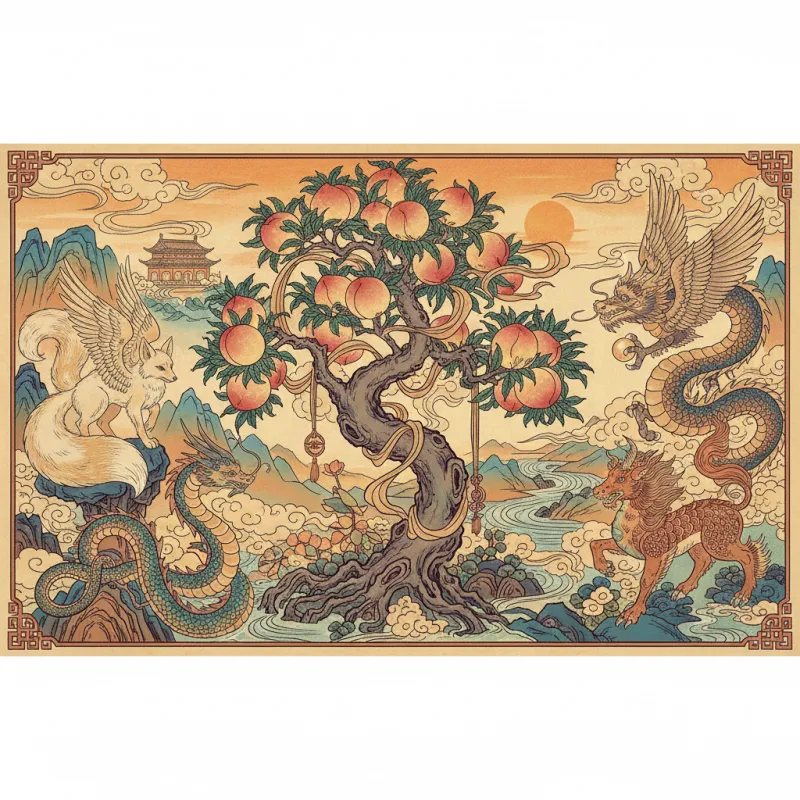
Every three thousand years, the Queen Mother of the West throws a party that makes every other celestial gathering look like a disappointing potluck. The centerpiece? Peaches that grant immortality—but only if you're lucky enough to score an invitation. These aren't your farmer's market peaches. We're talking about fruit so powerful that a single bite can transform you from mortal to eternal, so rare that even the gods mark their calendars millennia in advance.
The Original Source: What the Shanhaijing Actually Says
The Shanhaijing (山海经, Shānhǎi Jīng), or Classic of Mountains and Seas, doesn't waste words on flowery descriptions. Compiled between the 4th century BCE and the early Han dynasty, this text treats magical geography like a field guide. When it mentions the peaches of immortality, it does so with the same matter-of-fact tone it uses for three-headed birds and mountains that float.
The peaches grow in the Kunlun Mountains (昆仑山, Kūnlún Shān), the axis mundi of Chinese cosmology—a place so remote that it exists somewhere between the physical and spiritual realms. The Shanhaijing describes Kunlun as a tiered paradise, with the Queen Mother of the West (西王母, Xī Wángmǔ) presiding over its highest peaks. Her garden contains the peach trees, which bloom once every three thousand years and take another three thousand to bear fruit. That's a six-thousand-year wait for a single harvest.
The text doesn't explain why these peaches grant immortality—it simply states it as fact, the way you'd note that water is wet. This casual certainty is what makes the Shanhaijing so compelling. It's not trying to convince you; it's documenting what it considers observable reality.
The Queen Mother's Legendary Banquets
The Peach Banquet (蟠桃会, Pántáo Huì) became one of Chinese mythology's most enduring set pieces, though its full elaboration came centuries after the Shanhaijing. By the time Journey to the West (西游记, Xīyóu Jì) was published in the 16th century during the Ming dynasty, the banquet had evolved into a complex social hierarchy of the divine.
Sun Wukong's (孙悟空, Sūn Wùkōng) infamous raid on the peach garden remains one of literature's great heist scenes. The Monkey King, appointed as the garden's guardian—essentially hiring a pyromaniac as a fire marshal—discovers that the peaches are classified by ripening time. The trees with pale green fruit ripen every three thousand years and grant basic immortality. The trees with pink blossoms ripen every six thousand years and offer eternal youth. The deepest purple peaches, ripening every nine thousand years, grant immortality equal to Heaven and Earth themselves.
Sun Wukong, characteristically, eats them all. Then he crashes the banquet, drinks the immortality wine, and raids Laozi's alchemy lab for good measure, achieving what the novel calls "five levels of immortality"—a redundancy that would be comical if it weren't so effective at establishing his unkillable nature.
Why Peaches? The Symbolism Runs Deep
China's association between peaches and longevity predates the Shanhaijing by centuries. Archaeological evidence from the Shang dynasty (1600-1046 BCE) shows peach wood used in protective rituals. The fruit's natural symbolism—its shape suggesting a heart, its pit containing the seed of new life—made it a natural candidate for immortality myths.
But there's a practical dimension too. Peach trees were among the earliest domesticated fruit trees in China, cultivated along the Yellow River valley for over four thousand years. They were familiar, beloved, and productive. When ancient mythmakers needed a fruit to represent the ultimate prize, they chose something people already treasured, then elevated it to cosmic significance.
The peach also appears in Daoist alchemy texts as a symbol of the perfected self. The Baopuzi (抱朴子), written by Ge Hong in the 4th century CE, discusses various methods of achieving immortality, including consuming certain fruits and herbs. While Ge Hong was more interested in practical alchemy than mythology, his work shows how the peach had become shorthand for the transformation from mortal to immortal.
The Peaches in Popular Culture and Religious Practice
Walk into any Chinese household during the Lunar New Year, and you'll likely see peach imagery everywhere—on decorations, in paintings, as offerings. The God of Longevity (寿星, Shòuxīng) is invariably depicted holding a peach, sometimes one so large it requires both hands. These aren't the Queen Mother's actual immortality peaches, but they're symbolic descendants, carrying wishes for long life.
Daoist temples often feature paintings of the Queen Mother's garden, with the peach trees rendered in meticulous detail. The Eight Immortals (八仙, Bāxiān), that rowdy crew of enlightened beings, are frequently shown attending the Peach Banquet, each bringing their own chaotic energy to the proceedings. These images serve as both religious art and narrative shorthand—everyone knows what the peaches mean.
Modern Chinese fantasy literature and film have run wild with the concept. The peaches appear in everything from wuxia novels to video games, often with creative variations. Some stories give them different colors corresponding to different powers. Others place them in hidden realms accessible only through specific portals. The 2014 film "The Monkey King" features a visually stunning peach garden sequence that owes as much to CGI as to the Shanhaijing.
The Immortality Paradox: What the Myths Really Tell Us
Here's what strikes me about the peach mythology: immortality in Chinese tradition isn't always portrayed as desirable. The Shanhaijing and later texts are filled with immortals who seem bored, bureaucratic, or bound by celestial rules even more restrictive than mortal laws. The Queen Mother's banquet operates on a strict hierarchy—your seating position reflects your cosmic status, and not everyone gets the nine-thousand-year peaches.
Sun Wukong's theft of the peaches is often read as comic mischief, but it's also a rebellion against this hierarchy. He's rejecting the idea that immortality should be rationed according to rank. His punishment—five hundred years under a mountain—suggests that the celestial establishment takes its peach distribution very seriously.
The peaches also raise questions about what immortality means. Physical immortality? Spiritual transcendence? The Zhuangzi (庄子), written around the same time as parts of the Shanhaijing, suggests that true immortality might be about transcending the fear of death rather than avoiding death itself. The peaches, in this reading, become a kind of cosmic MacGuffin—everyone wants them, but their pursuit reveals more about the pursuers than about the fruit itself.
Connections to Other Mythological Traditions
The immortality fruit appears across world mythologies with striking consistency. The Greek golden apples of the Hesperides, the Norse apples of Iðunn, the Mesopotamian plant of immortality that Gilgamesh loses to a serpent—all share the basic structure of a rare fruit that grants eternal life, guarded by divine beings, and difficult or impossible for mortals to obtain.
What distinguishes the Chinese peaches is their integration into a bureaucratic cosmos. The Queen Mother isn't just guarding the peaches; she's administering them according to celestial protocol. This reflects the Chinese conception of heaven as an organized hierarchy, mirroring earthly imperial administration. Even immortality requires paperwork, apparently.
The peaches also connect to the broader tradition of sacred plants and herbs in Chinese mythology, from the lingzhi mushroom to the ginseng root. These plants occupy a space between the mundane and the magical, growing in the physical world but possessing supernatural properties. The peaches represent the apex of this tradition—the ultimate transformative plant.
The Enduring Appeal: Why We Still Care About Magical Peaches
Three thousand years after the Shanhaijing was compiled, we're still telling stories about these peaches. Why? Partly because the imagery is so vivid—those trees blooming once every three millennia, the Queen Mother's garden at the top of the world, the hierarchical banquet where gods jostle for position. It's mythology that works on multiple levels: as adventure story, as social satire, as spiritual allegory.
But I think the deeper appeal lies in what the peaches represent: the human desire to transcend limitations, to escape the one fate that awaits everyone. The peaches are unattainable for most beings, divine or mortal, which makes them perfect symbols for any impossible dream. They're not just about living forever; they're about the gap between what we want and what we can have.
The Shanhaijing understood this. It catalogued the peaches alongside all the other wonders of the world—the strange beasts, the impossible geography, the mythical creatures that defy natural law. These aren't just stories; they're maps of human longing, charting the territories where reality ends and imagination begins. The peaches grow at that border, forever ripening, forever just out of reach.
Related Reading
- Magical Artifacts of the Shanhaijing
- Hetu and Luoshu: The Cosmic Diagrams
- The Jade Palace of Kunlun: Home of the Queen Mother of the West — Shanhai Perspective
- Weapons of the Gods in Chinese Mythology
- Sacred Objects of Chinese Mythology: Seals, Mirrors, and Cauldrons — Shanhai Perspective
- Unraveling the Mysteries of Shanhaijing: Mythical Creatures and Enigmatic Lands
- Unraveling the Mysteries of Shanhaijing: Myths, Creatures, and Fantastic Realms
- Exploring the Enigmatic Creatures and Lands of Shanhaijing: A Cultural Journey