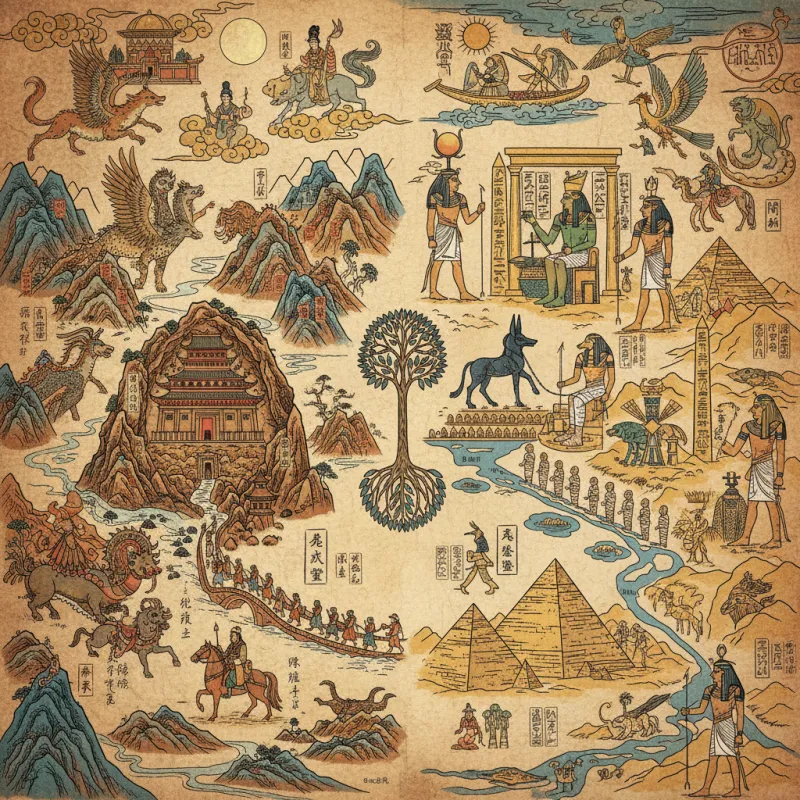
Two ancient civilizations built their entire cosmologies around a single question: what happens when we die? But while Egyptian mythology turned death into an epic journey across celestial waters, Chinese tradition transformed the afterlife into something far more mundane—a bureaucracy with filing systems, judges, and endless paperwork. The difference reveals something profound about how these cultures understood justice, morality, and the human soul.
The Underworld as Government Office
When a Chinese soul dies, it doesn't board a solar barque or face a single dramatic judgment. Instead, it reports to Diyu (地狱 dìyù), the underworld, which operates exactly like an imperial government office—because that's what the living knew best. The system features ten courts, each presided over by a Yanluo Wang (阎罗王 Yánluó Wáng), or King of Hell, who reviews your case file with the thoroughness of a tax auditor.
The first court, ruled by Qin Guang Wang (秦广王 Qín Guǎng Wáng), serves as intake. Your entire life gets reviewed—not against a single moral standard, but against a complex ledger of good and bad deeds. Helped an elderly neighbor? Credit. Disrespected your parents? Major debit. The accounting is meticulous. From there, you're assigned to one of the remaining nine courts based on your specific transgressions. Court Two handles corrupt officials. Court Five deals with murderers. Court Eight processes those who showed filial impiety, perhaps the worst crime in the Chinese moral universe.
This isn't the dramatic weighing of hearts we see in Egyptian mythology. It's administrative processing. The Shanhaijing (山海经 Shānhǎi Jīng) itself doesn't detail Diyu extensively—that comes from later Buddhist-influenced texts—but it establishes the principle that the cosmos operates through hierarchical order, even in death.
The Egyptian Soul's Odyssey
Egyptian afterlife mythology tells a completely different story. Death triggers an immediate journey through the Duat, a dangerous realm filled with serpents, lakes of fire, and hostile demons. The deceased needs spells from the Book of the Dead just to navigate safely. This isn't bureaucracy—it's adventure, with your eternal soul as the prize.
The climax comes in the Hall of Two Truths, where Osiris presides over the Weighing of the Heart ceremony. Your heart gets placed on a scale opposite the feather of Ma'at, goddess of truth and justice. The judgment is binary and immediate: if your heart weighs more than the feather—corrupted by sin and lies—the demon Ammit devours it, and you cease to exist. No appeals process. No second court. Just oblivion.
But if you pass? You enter the Field of Reeds, an idealized version of Egypt where crops grow effortlessly and the Nile floods perfectly on schedule. It's paradise as the Egyptians understood it: eternal agricultural abundance without the backbreaking labor.
The contrast is stark. Chinese afterlife is about processing and punishment, with eventual reincarnation as the goal. Egyptian afterlife is about transformation and reward, with eternal existence as the prize. One system assumes you'll return to the mortal world; the other assumes you'll transcend it entirely.
Animal Gods: Transformation vs. Embodiment
Both mythologies are packed with animal deities, but they conceptualize them in fundamentally different ways. Egyptian gods like Anubis, Horus, and Thoth appear with animal heads on human bodies—they embody animal qualities while maintaining divine humanoid form. Anubis has a jackal's head because jackals scavenged in cemeteries; he's the god of mummification and death. Thoth has an ibis head because ibises were associated with wisdom and writing. The animal features are symbolic, representing divine attributes.
Chinese mythology takes a different approach. The creatures in the Shanhaijing aren't gods wearing animal masks—they're actual beings that blur the boundary between categories. The Jiuwei Hu (九尾狐 jiǔwěi hú), or nine-tailed fox, can transform into a beautiful woman to seduce scholars. The Nian (年 nián) is a beast that terrorized villages until people discovered it feared the color red and loud noises. These aren't deities embodying animal traits; they're liminal beings that can shift between forms entirely.
Consider the Dragon Kings (龙王 lóng wáng) who control weather and water. They're not human-shaped gods with dragon heads. They ARE dragons who can assume human form when they need to interact with mortals. The transformation goes both ways, and the dragon form is primary, not symbolic. This reflects a Chinese cosmological view where boundaries between categories—human, animal, spirit, god—are permeable and constantly shifting.
Egyptian animal gods maintain clear categorical boundaries even as they combine features. Sobek is a crocodile god, but he's depicted as fundamentally divine, not as an actual crocodile that might transform into something else. The form is fixed, eternal, and symbolic of unchanging divine nature.
The Role of Moral Judgment
Both systems judge the dead, but they're judging different things. The Egyptian weighing of the heart measures your fundamental moral character—were you truthful, just, and in harmony with Ma'at? It's a holistic assessment of who you were as a person. The 42 Negative Confessions you recite ("I have not killed," "I have not stolen," "I have not caused pain") are broad moral principles.
Diyu's ten courts judge specific actions and social violations. Did you waste food? Court Three. Did you fail to repay debts? Court Six. The Chinese system cares intensely about social harmony and hierarchical relationships. Crimes against parents, teachers, and rulers receive especially harsh punishment because they threaten the cosmic order that mirrors earthly social structure.
This difference reflects deeper cultural values. Egyptian mythology emphasizes personal moral purity and cosmic balance. Chinese mythology emphasizes social duty and proper relationships. One asks "Were you good?" The other asks "Did you fulfill your role?"
The punishments differ accordingly. Egyptian failure means annihilation—you're erased from existence. Chinese failure means targeted torture followed by reincarnation into a lower form. You might be reborn as an animal or insect, but you get another chance to work your way back up. The Egyptian system is more absolute; the Chinese system is more cyclical, reflecting Buddhist and Daoist influences on later Chinese cosmology.
Sacred Animals and Divine Messengers
Beyond the gods themselves, both cultures elevated certain animals to sacred status, but for different reasons. Egyptians mummified millions of ibises, cats, and crocodiles as offerings to gods or as vessels for divine presence. The animals were sacred because they connected to specific deities—cats to Bastet, ibises to Thoth, crocodiles to Sobek.
Chinese tradition treats certain animals as auspicious or inauspicious based on their symbolic associations and their appearance in texts like the Shanhaijing. The Qilin (麒麟 qílín), often called a "Chinese unicorn," appears only during the reign of a wise and benevolent ruler. The Fenghuang (凤凰 fènghuáng), or phoenix, symbolizes virtue and grace. These creatures aren't worshipped as gods but respected as omens and symbols of cosmic harmony.
The practical implications differed too. Egyptians built temples where sacred animals lived as earthly representatives of gods. The Apis bull, for instance, was carefully selected based on specific markings and housed in luxury at Memphis. When it died, Egypt mourned and mummified it with royal honors.
Chinese tradition rarely institutionalized animal worship this way. Instead, animals appear in stories as teachers, tricksters, and tests of character. The white snake in the Legend of the White Snake (白蛇传 Bái Shé Zhuàn) isn't worshipped but becomes a complex character who falls in love with a human, challenging Buddhist monks and social conventions. Animals in Chinese mythology have agency and personality; they're not vessels for divine will but actors in their own right.
Immortality: Earned vs. Prepared
Both civilizations obsessed over immortality, but pursued it through opposite means. Egyptians believed immortality required elaborate physical preparation—mummification, tomb goods, magical spells. Your body needed to be preserved because your ka (life force) and ba (personality) would need it in the afterlife. Wealthy Egyptians spent fortunes on tomb construction and grave goods, essentially trying to buy their way into eternity.
Chinese immortality traditions, particularly in Daoism, focused on internal cultivation. The Xian (仙 xiān), or immortals, achieved eternal life through meditation, breathing exercises, alchemy, and moral refinement. They didn't need tombs because they transcended physical death entirely, sometimes ascending to heaven in broad daylight. The Eight Immortals (八仙 bā xiān) each achieved immortality through different paths—one through drunkenness and poetry, another through military virtue, a third through pure scholarship.
This reflects a fundamental difference in how the cultures understood the relationship between body and soul. Egyptians saw them as inseparable—destroy the body, and the soul suffers. Chinese philosophy, influenced by Daoism and Buddhism, increasingly viewed the body as a temporary vessel. True immortality meant transcending physical form entirely, not preserving it forever.
The Shanhaijing describes various substances and creatures that grant longevity or immortality—certain mushrooms, the meat of specific animals, water from particular springs. But these are scattered observations, not a systematic theology. Later Daoist texts would systematize these ideas into complex practices of internal alchemy, but the seeds appear in these early geographical and mythological records.
Why These Differences Matter
Comparing Chinese and Egyptian afterlife beliefs isn't just academic curiosity—it reveals how cultures construct meaning around death, justice, and the cosmos. Egypt's dramatic journey and binary judgment reflect a culture that valued individual moral character and saw death as transformation into a perfected state. China's bureaucratic underworld and cyclical reincarnation reflect a culture that valued social harmony and saw death as one phase in an endless cycle of existence.
The animal gods tell a similar story. Egyptian deities with fixed animal features represent eternal, unchanging divine principles. Chinese creatures that shift between forms represent a cosmos where boundaries are fluid and transformation is constant. One mythology seeks to establish order through clear categories; the other finds wisdom in the spaces between categories.
Modern readers often find Chinese mythology more "relatable" because its underworld resembles earthly institutions—courts, judges, paperwork. Egyptian mythology feels more exotic with its animal-headed gods and magical spells. But both systems were trying to answer the same fundamental questions: What happens when we die? How is justice served? What do we owe to the cosmos and each other?
The answers they developed—one bureaucratic and cyclical, one dramatic and eternal—continue to influence how billions of people think about death, morality, and the possibility of something beyond this life. Whether you prefer the adventure of the Duat or the orderly processing of Diyu probably says something about your own values: do you want your afterlife to be an epic journey or a fair trial?
For more on Chinese mythological creatures and their symbolic meanings, explore The Symbolic Language of Shanhaijing Creatures. And if you're curious about how Chinese mythology influenced other Asian traditions, check out Chinese Mythology's Influence on Japanese Folklore.
Related Reading
- Flood Myths: Noah vs Gun-Yu
- Chinese vs. Norse Mythology: Dragons, Giants, and World Trees
- Chinese Dragons vs European Dragons
- The Great Flood: Why Every Civilization Has a Flood Myth
- Unraveling the Mysteries of Shanhaijing: Mythical Creatures and Enigmatic Lands
- Exploring the Enigmatic Mountains and Creatures of the Shanhaijing
- Discovering the Guardians of Shanhaijing: Mythical Creatures and Legendary Lands