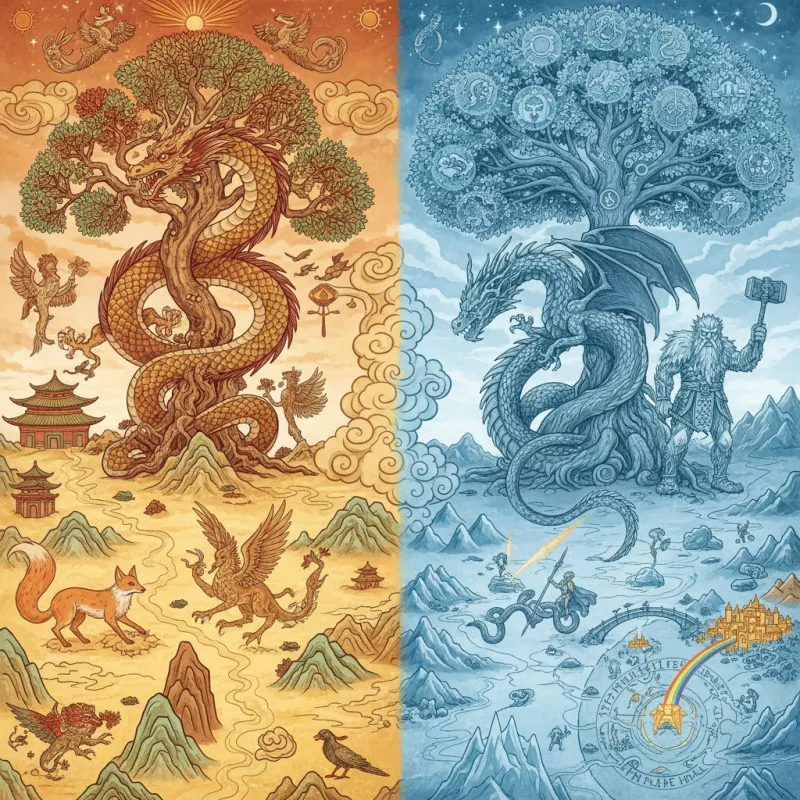
Dragons in Norse mythology get slain. Dragons in Chinese mythology get promoted to middle management. That single difference tells you almost everything you need to know about how these two mythological traditions imagine power, chaos, and the relationship between heaven and earth. But scratch beneath that surface contrast, and you'll find both traditions built their cosmos on remarkably similar foundations: world trees connecting realms, serpents coiled around the edges of existence, and an apocalyptic reset button that wipes the slate clean.
World Trees: Bureaucratic Ladder vs. Cosmic Highway
Both Norse and Chinese mythology anchor their universe with a massive tree, but they use it for completely different purposes.
Yggdrasil, the Norse world tree, is an ash that connects nine realms vertically. Its roots reach down to the wells of fate and wisdom, its trunk supports Midgard (the human world), and its branches stretch up to Asgard where the gods live. It's constantly under attack — a dragon named Níðhöggr gnaws at its roots, four stags eat its leaves, and it's slowly dying. The tree is a cosmic highway, yes, but also a cosmic victim. It suffers. When Ragnarök comes, Yggdrasil will shake but survive, sheltering the two humans who will repopulate the world.
Jianmu 建木 (literally "Erect Wood"), described in the Shanhaijing 山海经 (Classic of Mountains and Seas), stands at the center of the world in a place called Duguang 都广. Unlike Yggdrasil's suffering, Jianmu is a bureaucratic ladder. Gods and shamans climb it to travel between heaven and earth. The Huainanzi 淮南子 (2nd century BCE) describes it as having no branches for a thousand ren 仞 (about 2,400 meters), then suddenly sprouting nine branches that curve upward and nine roots that curve downward, creating a perfect symmetry. This isn't a tree that suffers — it's a tree that organizes.
The difference is philosophical. Yggdrasil embodies the Norse view that even the cosmic order is fragile and under constant assault. Jianmu embodies the Chinese view that the universe is fundamentally hierarchical, with clear pathways between levels of authority. When the legendary emperor Zhuanxu 颛顼 wanted to separate heaven from earth (to stop random humans from bothering the gods), he didn't destroy Jianmu — he just posted guards. Very Chinese solution: don't eliminate the bureaucratic channel, just add more bureaucracy.
Dragons: Chaos Monsters vs. Weather Managers
The Norse dragon Níðhöggr chews on Yggdrasil's roots in the realm of the dead, gnawing away at the foundations of reality itself. Fáfnir, another famous Norse dragon, was originally a dwarf who murdered his father for gold and transformed into a dragon through greed and curse. Sigurd kills him, bathes in his blood, and becomes a hero. The pattern is clear: dragons are problems to be solved with swords.
Chinese dragons — long 龙 — are problems to be solved with ritual offerings and proper respect. The Dragon Kings (Longwang 龙王) of the Four Seas run the weather department. They live in crystal palaces underwater, command armies of shrimp soldiers and crab generals, and report to the Jade Emperor 玉皇大帝. When they get angry, they cause floods and droughts. When they're properly honored, they bring rain at the right time. The Journey to the West 西游记 (16th century) features multiple dragon kings who are basically middle managers dealing with bureaucratic headaches — one gets executed for causing unauthorized rainfall, another's son gets into trouble for eating a monk's horse.
But here's where it gets interesting: both traditions have a world-serpent that encircles everything. The Norse Jörmungandr is so large it wraps around Midgard and bites its own tail. Thor fights it twice — once when he goes fishing and nearly catches it (the line breaks), and finally at Ragnarök when they kill each other. Chinese mythology has Zhulong 烛龙 (Torch Dragon), described in the Shanhaijing as a creature with a human face and snake body that's thousands of li 里 long. When it opens its eyes, it's day; when it closes them, it's night. When it breathes out, it's summer; when it breathes in, it's winter. It doesn't move, doesn't eat, doesn't drink — it just is, regulating the cosmos through its mere existence.
Same structural role (cosmic serpent), completely different personality. Jörmungandr is destined to destroy the world. Zhulong is the world's operating system.
Giants: Enemies vs. Ancestors
Norse giants (jötnar) are the gods' eternal enemies, but also their relatives, lovers, and occasionally their parents. The first being in Norse mythology was Ymir, a giant whose body became the world when Odin and his brothers killed him — his flesh became earth, his blood became oceans, his bones became mountains, his skull became the sky. The gods live in constant tension with the giants, stealing from them (Odin steals the mead of poetry), marrying them (Freyr falls in love with the giantess Gerðr), and preparing to fight them at Ragnarök.
Chinese mythology has giants too, but they're usually culture heroes, not enemies. Pangu 盘古 is the Chinese creation giant whose story parallels Ymir's — when he dies, his body becomes the world. But Pangu isn't killed by gods; he works himself to death separating heaven and earth, then voluntarily transforms. His breath becomes wind, his voice becomes thunder, his left eye becomes the sun, his right eye becomes the moon. It's a sacrifice, not a murder.
The giant Kuafu 夸父 chases the sun to try to catch it, drinks entire rivers dry from thirst, and dies of dehydration. His walking stick transforms into a peach grove to provide shade for future travelers. Even in failure, he's helping humanity. The giant Xingtian 刑天 gets his head cut off by the Yellow Emperor 黄帝, so he uses his nipples as eyes and his belly button as a mouth and keeps fighting. He's not trying to destroy the world — he's just really committed to his principles.
The Norse giants want to tear down the cosmic order. The Chinese giants helped build it, then got demoted or killed by the gods who took over. It's the difference between external threat and internal power struggle.
Apocalypse: Ragnarök vs. The Flood Cycles
Ragnarök is the Norse end-times: Fimbulwinter (three years of winter with no summer), the breaking of all bonds, wolves swallowing the sun and moon, Loki leading an army of the dead, giants attacking from every direction, Yggdrasil shaking, gods dying in single combat with their destined enemies. Thor kills Jörmungandr but dies from its poison. Odin gets eaten by the wolf Fenrir. The world burns, then sinks into the sea.
But then — and this is crucial — it rises again. A new earth emerges from the water, green and fertile. Two humans who hid in Yggdrasil repopulate the world. Some gods survive. It's not an ending; it's a reset button. The Norse cosmos is cyclical, not linear.
Chinese mythology has multiple apocalyptic floods, but they're not cosmic resets — they're management crises. The most famous is Gun 鲧 and Yu 禹's flood, which lasted for decades during the reign of Emperor Yao 尧. Gun tried to stop it by stealing the gods' self-expanding soil (xirang 息壤) without permission. He failed and was executed. His son Yu succeeded by dredging channels and organizing the water rather than trying to block it. Yu became emperor as a reward. The flood wasn't the end of the world; it was a test of administrative competence.
The Shanhaijing mentions another flood where the water god Gonggong 共工 got angry after losing a fight and smashed his head into Buzhou Mountain 不周山, one of the pillars holding up the sky. The sky tilted, rivers flowed southeast, and the goddess Nüwa 女娲 had to smelt five-colored stones to patch the hole. Again, not an apocalypse — just infrastructure damage that required divine repair work.
The Norse expect the world to end and restart. The Chinese expect the world to occasionally break and need fixing. One is cyclical cosmology; the other is maintenance culture.
The Underworld: Warrior Paradise vs. Bureaucratic Hell
Norse warriors who die in battle go to Valhalla, where they fight all day (dying repeatedly), then feast and drink all night (resurrecting for dinner). They're training for Ragnarök, when they'll march out with Odin for the final battle. It's an eternal boot camp disguised as paradise. Warriors who don't die in battle go to Hel, a cold, misty realm that's not exactly torture but definitely not fun.
Chinese hell — Diyu 地狱 — is a bureaucracy with eighteen levels, each specializing in punishing specific sins. There are courts, judges, record-keepers, and appeal processes. The Yama Kings 阎罗王 run it like a government agency. You get punished according to your deeds, serve your sentence, then get reincarnated. The Journey to the West has a scene where the Monkey King breaks into hell's administrative offices and erases his name (and all other monkeys' names) from the death registry. Hell's response isn't divine wrath — it's filing a complaint with heaven's HR department.
Some Chinese hells are creative: the Mountain of Knives, the Forest of Swords, the Pool of Blood, the Ice Hell, the Cauldron Hell where sinners get boiled. But they're all temporary and proportional. Norse Hel is eternal and based on how you died, not how you lived. Chinese Diyu is temporary and based on your moral record. One is fate; the other is justice.
Why These Parallels Matter
Chinese and Norse mythology developed independently, separated by thousands of miles and completely different environments. Yet both traditions built their cosmos around world trees, cosmic serpents, giants who shaped the world, and apocalyptic floods. Why?
Maybe because these are the fundamental questions any mythology has to answer: How is the world organized vertically? (World tree.) What defines the boundary of existence? (World serpent.) Where did the physical world come from? (Giant's body.) What happens when everything goes wrong? (Flood/apocalypse.)
The answers reveal the cultures. Norse mythology is tragic and heroic — even the gods are doomed, so you might as well fight well and die memorably. Chinese mythology is administrative and cyclical — the cosmos is a system that needs maintenance, and if you do your job properly, you might get promoted to immortal bureaucrat.
But both traditions understood something modern mythology often forgets: the world is held together by fragile threads, constantly under assault, always one disaster away from collapse. The difference is whether you think that collapse is inevitable (Norse) or preventable with proper management (Chinese).
For more on Chinese cosmic geography, see The Geography of Shanhaijing: Real Places or Pure Fantasy?. And if you're curious about other mythological bureaucracies, check out The Jade Emperor's Celestial Administration: Heaven's Government Structure.
The dragons are still watching. Some are sharpening their teeth on the roots of reality. Others are filing reports about rainfall quotas. Both are doing exactly what dragons are supposed to do — it just depends which mythology you're reading.
Related Reading
- The Great Flood: Why Every Civilization Has a Flood Myth
- Chinese vs. Egyptian Mythology: Afterlives and Animal Gods
- Flood Myths: Noah vs Gun-Yu
- Chinese Dragons vs European Dragons
- The Four Symbols: Azure Dragon, White Tiger, Vermillion Bird & Black Tortoise
- Bifang: The Fire Bird That Brings Disaster
- Exploring the Enigmatic Seas of the Shanhaijing: Mythical Creatures and Realms