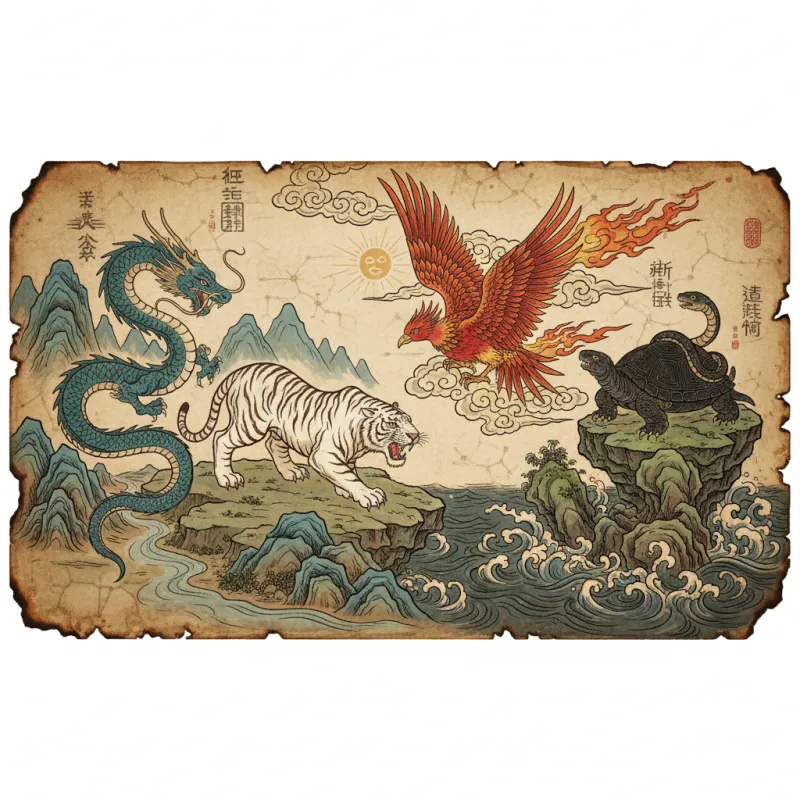
Picture this: it's 168 BCE, and workers are sealing the tomb of the Marquis of Dai in Changsha. On the coffin's sides, they've painted four creatures so powerful that their images alone will guard the deceased through eternity. An azure dragon coils to the east. A white tiger prowls the west. A vermillion bird spreads its wings southward. A black tortoise-and-snake hybrid faces north. These aren't just decorative motifs—they're the Four Symbols (四象, Sì Xiàng), cosmic guardians whose influence shaped everything from palace architecture to military strategy for over two millennia.
More Than Mythology: The Astronomical Origins
Here's what most people miss: the Four Symbols weren't invented by poets or priests. They're star maps. Ancient Chinese astronomers divided the night sky into 28 lunar mansions (二十八宿, Èrshíbā Xiù), then grouped these into four quadrants. Each quadrant's constellation pattern vaguely resembled an animal, and those animals became divine protectors.
The Azure Dragon (青龙, Qīng Lóng) comprises seven eastern mansions: Horn, Neck, Root, Room, Heart, Tail, and Winnowing Basket. If you squint at these stars on a spring evening, you might see a serpentine form stretching across the sky. The White Tiger (白虎, Bái Hǔ) claims seven western mansions. The Vermillion Bird (朱雀, Zhū Què)—not a phoenix, despite what video games tell you—rules the south with its seven mansions. And the Black Tortoise (玄武, Xuán Wǔ), that bizarre turtle-snake chimera, guards the north.
This astronomical foundation explains why the Four Symbols appear in contexts that seem random to modern readers. They're not just mythical beasts—they're a coordinate system, a calendar, and a cosmological framework rolled into one.
The Azure Dragon: Spring's Awakening
The Azure Dragon represents the east, spring, wood element, and the color cyan (that blue-green shade that's neither quite blue nor quite green). In the Shanhai Jing, dragons appear in dozens of entries, usually as serpentine creatures associated with water and weather control. The Azure Dragon inherited these associations but elevated them to cosmic significance.
During the Han Dynasty, military commanders painted Azure Dragons on their eastern battle standards. Why? Because east symbolized new beginnings, and what general doesn't want the energy of spring's renewal on their side? The Tang Dynasty took this further—their capital Chang'an had an Azure Dragon Gate on the eastern wall, and the eastern district became the fashionable neighborhood where aristocrats built their mansions.
The Azure Dragon's connection to wood element isn't arbitrary. Spring is when trees bud and plants push through soil. Wood represents growth, flexibility, and upward movement—all spring qualities. This is wuxing (五行) theory in action, where elements aren't just materials but dynamic processes.
The White Tiger: Autumn's Fierce Protector
If the Azure Dragon is spring's gentle awakening, the White Tiger is autumn's brutal honesty. West, autumn, metal element, white color—the White Tiger embodies everything sharp, decisive, and unforgiving. Metal cuts. Autumn harvests. The White Tiger kills.
This isn't a cuddly tiger. In Han Dynasty tomb art, the White Tiger often appears mid-pounce, claws extended, teeth bared. It's the guardian that doesn't just protect—it destroys threats. Military strategists associated the White Tiger with the right flank of armies (since you face south in Chinese directional orientation, west is to your right). The right flank was the aggressive, attacking side.
The metal element connection runs deep. Autumn is harvest time, when metal sickles cut grain. It's also when leaves fall and plants die back—the cutting away of excess. The White Tiger represents this necessary destruction, the pruning that allows new growth. Compare this to The Qilin: China's Sacred Unicorn and Divine Messenger, which represents benevolence and appears only during peaceful times—the White Tiger has no such qualms about violence.
The Vermillion Bird: Not a Phoenix
Let's clear this up: the Vermillion Bird (朱雀, Zhū Què) is NOT a phoenix (凤凰, Fènghuáng). They're different creatures with different roles. The phoenix is an auspicious bird associated with empresses and marital harmony. The Vermillion Bird is a cosmic guardian associated with fire, summer, and the southern sky.
The confusion comes from both being fire birds, but their symbolism diverges sharply. The Vermillion Bird represents the peak of yang energy—summer's blazing heat, the fire element at its strongest, the color red in its most intense form. It's not about rebirth (that's the phoenix's thing) but about maximum energy and illumination.
In the Huainanzi, a Han Dynasty philosophical text, the Vermillion Bird is described as governing the southern regions where it's perpetually hot. This makes geographical sense—China's south is tropical, and ancient Chinese associated southern expeditions with heat, exotic creatures, and danger. The Vermillion Bird embodied that fierce, untamed southern energy.
Interestingly, the Vermillion Bird appears less frequently in tomb art than the other three symbols. Some scholars think this is because fire symbolism was considered too yang, too active, for the yin realm of death. Or maybe people just didn't want to paint fire imagery inside sealed tombs. Practical concerns sometimes trump symbolism.
The Black Tortoise: The Strangest Guardian
The Black Tortoise (玄武, Xuán Wǔ) is genuinely weird. It's not just a tortoise—it's a tortoise with a snake coiled around it, sometimes shown as a tortoise-snake hybrid, sometimes as two separate creatures in eternal embrace. This oddity has a reason.
The northern sky's seven mansions don't form a clear animal shape. Ancient astronomers saw something vaguely tortoise-like, but also serpentine elements. Rather than choose, they combined both. The result is a creature that perfectly embodies the north's associations: water, winter, the color black (or dark blue), and the mysterious depths.
Water element and winter season make the Black Tortoise the most yin of the Four Symbols. It represents stillness, depth, endurance, and hidden knowledge. Tortoises live for centuries. Snakes hibernate and shed their skin, symbolizing transformation through withdrawal. Together, they're the guardian of the north—the direction associated with death, cold, and the unknown.
During the Song Dynasty, the Black Tortoise became associated with Daoist immortality practices. The tortoise-snake combination was seen as a symbol of yin-yang harmony, and Daoist alchemists used Black Tortoise imagery in their texts about cultivating internal energy. The creature that started as a star pattern became a meditation symbol.
The Four Symbols in Practice
Walk through Beijing's Forbidden City and you'll see the Four Symbols everywhere, though you might not recognize them. The palace complex faces south (the emperor always faced south), putting the Vermillion Bird in front, the Black Tortoise behind, the Azure Dragon to the left, and the White Tiger to the right. This wasn't decorative—it was cosmic alignment made architectural.
Military formations followed the same pattern. The Wujing Zongyao (武经总要), an 11th-century military encyclopedia, describes battle formations named after the Four Symbols. The Azure Dragon formation emphasized flexible, flowing movements. The White Tiger formation was aggressive and direct. The Vermillion Bird formation used fire weapons and rapid attacks. The Black Tortoise formation was defensive, with soldiers forming a shell-like protective barrier.
Even feng shui (风水) relies on the Four Symbols. The ideal building site has a mountain behind (Black Tortoise), a river in front (Vermillion Bird), a hill to the left (Azure Dragon), and a road to the right (White Tiger). This creates what feng shui practitioners call the "Armchair Formation"—a site protected on all sides by the cosmic guardians.
From Ancient Tombs to Modern Games
The Four Symbols never disappeared. They're in the Romance of the Three Kingdoms (三国演义), where generals invoke their power. They're in Journey to the West (西游记), where they appear as actual characters. They're in countless wuxia novels, anime series, and video games.
But here's what modern adaptations often miss: the Four Symbols aren't just powerful monsters to fight or summon. They're a worldview. They represent the idea that the universe has structure, that directions have meaning, that time and space are interconnected. When ancient Chinese looked at the night sky and saw these four creatures, they saw evidence that the cosmos was ordered, comprehensible, and—most importantly—protective.
The Mawangdui tomb paintings from 168 BCE show the Four Symbols guarding the Marquis of Dai. Over 2,000 years later, we're still drawing them, still invoking them, still finding meaning in their cosmic dance. That's not just cultural persistence—that's proof that some symbols touch something fundamental in how humans understand our place in the universe. The Four Symbols endure because they answer a question every culture asks: what guards us from the chaos beyond? For ancient China, the answer was written in the stars: a dragon, a tiger, a bird, and a very strange tortoise.
Related Reading
- Chinese Dragons: Everything You Need to Know
- The Nine-Tailed Fox: From Divine Messenger to Demonic Seductress
- Fenghuang: The Chinese Phoenix and Its True Meaning
- Divine Beasts of the Shanhaijing: The Four Guardians and Beyond
- Kunlun Mountain: The Axis of the Chinese Cosmos
- Modern Artists Reimagining the Classic of Mountains and Seas
- Chinese Dragons vs European Dragons