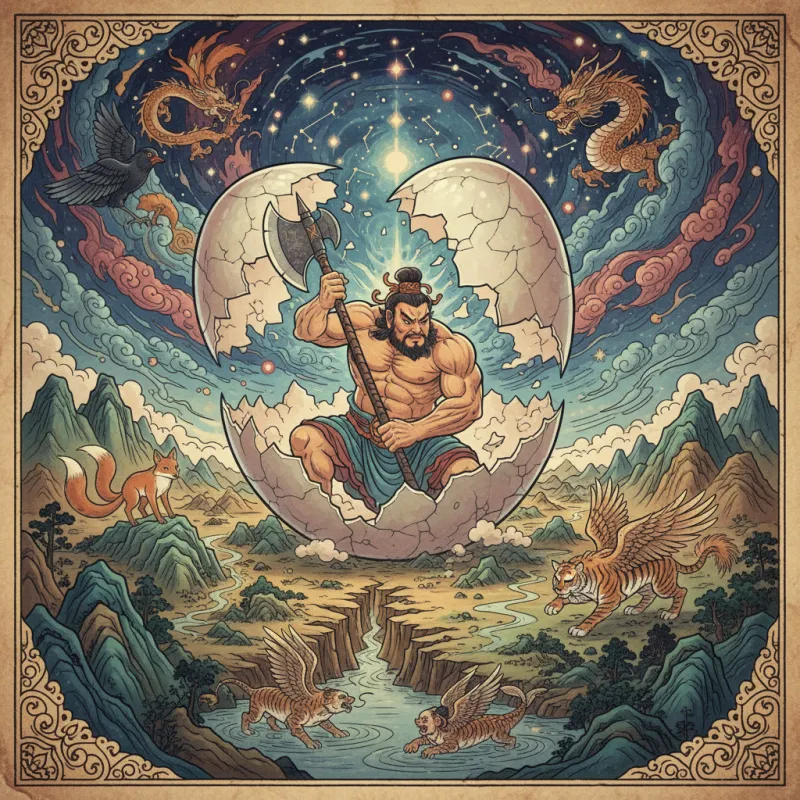
A cosmic egg floats in absolute darkness. No stars, no earth, no sky — just void and this single shell containing everything that will ever exist. Inside, compressed into impossible density, sleeps a giant named Pangu (盘古, Pángǔ). He's been asleep for eighteen thousand years. When he finally wakes up, cramped and furious in the suffocating dark, he grabs an axe and splits the egg wide open.
That single crack becomes the birth of the universe.
The Late Arrival of China's Creation Story
Here's something that surprises most people: the Pangu myth is not ancient. While other cultures were carving creation stories into temple walls and weaving them into their oldest texts, China went without a proper cosmogonic myth for millennia. The Shanhaijing (山海经, Shānhǎijīng, Classic of Mountains and Seas), compiled between the 4th century BCE and 2nd century CE, catalogs hundreds of strange creatures and distant lands but never explains how the world began. The Shijing (诗经, Shījīng, Book of Songs) and early Confucian texts? Silent on the matter.
The Pangu story first appears in writing during the Three Kingdoms period (220-280 CE) in a text called Sanwu Liji (三五历记, Sānwǔ Lìjì, Historical Records of the Three Sovereigns and Five Emperors) by Xu Zheng (徐整, Xú Zhěng). That's roughly two thousand years after the Shanhaijing began taking shape. By the time Pangu showed up in literature, the Han Dynasty had already risen and fallen.
Why so late? Some scholars argue China's philosophical traditions — particularly Daoism's concept of spontaneous generation from the Dao (道, Dào) — made a creator figure unnecessary. Others suggest the myth existed in oral tradition long before Xu Zheng wrote it down, possibly originating from southern minority groups like the Miao or Yao peoples, who still tell Pangu stories today. The truth is probably both: China had philosophical explanations for cosmic origins, and when a narrative version finally emerged, it came from the margins rather than the center of Chinese civilization.
The Cosmic Egg Cracks Open
The myth itself is brutally simple. In the beginning, there was hundun (混沌, hùndùn) — primordial chaos, often described as a cosmic egg. Everything existed in this egg, but nothing was differentiated. Light and dark, hot and cold, heavy and light — all mixed together in an undifferentiated mass.
Pangu slept inside this egg for eighteen thousand years. Some versions say he grew inside it, forming from the chaos itself. When he woke, the egg was too small, too dark, too confining. He couldn't see. He couldn't move. So he took an axe (some versions say he used his bare hands, which is even more impressive) and split the egg apart.
The lighter, purer elements — yang (阳, yáng) — rose up to become the sky. The heavier, murkier elements — yin (阴, yīn) — sank down to become the earth. And Pangu stood between them, holding them apart.
This is where the story gets interesting. The sky and earth wanted to close back together, to return to their original chaotic unity. So Pangu had to keep them separated. He grew taller — ten feet per day, according to most versions. The sky rose ten feet. The earth thickened ten feet. And Pangu grew ten feet taller to keep them apart.
He did this for another eighteen thousand years.
The Giant Becomes the World
After eighteen thousand years of holding up the sky, Pangu died. And here's where Chinese cosmology reveals its fundamental difference from Western creation myths: Pangu doesn't retire to some celestial realm to receive worship. He doesn't become a distant god. Instead, he transforms completely into the physical world.
His breath became the wind and clouds. His voice became thunder. His left eye became the sun; his right eye became the moon. His four limbs and five extremities became the four cardinal directions and five sacred mountains. His blood became rivers. His muscles became fertile soil. His hair and beard became the stars in the sky. His skin and body hair became plants and trees. His teeth and bones became metal and stone. His marrow became jade and pearls. His sweat became rain and dew.
And his parasites — the fleas and lice living on his body — became human beings.
Yes, you read that correctly. In the earliest versions of this myth, humanity originates from Pangu's body parasites. Later, more flattering versions emerged (we came from his tears, or from clay shaped by the goddess Nüwa), but the original story is refreshingly honest about humanity's place in the cosmic order. We're not the pinnacle of creation. We're not made in the image of the divine. We're the fleas on a dead giant's corpse.
The Philosophy Hidden in the Myth
The Pangu story encodes several core concepts of Chinese cosmology. First, there's the idea of transformation rather than creation ex nihilo. Pangu doesn't create the world from nothing — he transforms chaos into order, and then transforms himself into the material world. Nothing is truly created or destroyed; everything changes form.
Second, there's the fundamental unity of all things. The world isn't separate from its creator. The creator is the world. When you walk on earth, you're walking on Pangu's flesh. When you look at the sun, you're looking into Pangu's eye. This isn't pantheism exactly — it's more like cosmic recycling. The divine and the material are the same substance in different configurations.
Third, there's the concept of sacrifice and effort. Pangu doesn't speak the world into existence with a casual word. He works for it. He holds up the sky for eighteen thousand years, growing taller every single day, until the separation is permanent. Then he dies from the effort. Creation requires sacrifice, labor, exhaustion. It's not effortless divine will — it's grinding, physical work.
This resonates with Daoist philosophy, particularly the Daodejing's (道德经, Dàodéjīng) emphasis on transformation and the Dao's role in generating the ten thousand things through natural process rather than conscious design. It also connects to the concept of qi (气, qì) — the vital energy that flows through all things. Pangu's breath becomes wind, his voice becomes thunder — these aren't metaphors but literal transformations of his qi into different forms.
Regional Variations and Minority Traditions
The Pangu myth shows significant variation across different regions and ethnic groups in China. The Han Chinese version, recorded by Xu Zheng, is the most widely known, but it's not the only one.
Among the Yao people of southern China, Pangu is called "King Pan" (盘王, Pán Wáng) and is considered their direct ancestor. Their version includes a dog-headed Pangu who marries a princess and fathers the Yao people. The Miao people have similar stories, and some scholars argue these southern minority traditions preserve older versions of the myth that predate the Han Chinese literary version.
In some Daoist texts from the Tang Dynasty (618-907 CE), Pangu becomes identified with Laozi (老子, Lǎozǐ), the legendary founder of Daoism, creating a syncretic figure that bridges creation mythology and philosophical tradition. Other versions merge Pangu with the Three Sovereigns (三皇, Sānhuáng), the legendary rulers who taught humanity essential skills like agriculture and medicine.
The myth also traveled beyond China. Korean and Vietnamese creation stories show Pangu's influence, though adapted to local traditions. In Vietnam, he's sometimes called Bàn Cổ and credited with creating the Vietnamese people specifically. These variations demonstrate how the myth functioned as a flexible framework that different cultures could adapt to their own origin stories.
Why China Needed Pangu
The late emergence of the Pangu myth suggests it filled a specific cultural need. By the Three Kingdoms period, China had been in contact with Buddhist missionaries for centuries. Buddhism brought with it elaborate cosmologies and creation stories from India. Confucianism and Daoism, for all their philosophical sophistication, didn't offer a simple narrative answer to the question: "How did the world begin?"
Pangu provided that answer. He gave China a creation story that could compete with Buddhist and foreign narratives while remaining distinctly Chinese in character. Unlike the Abrahamic God or the Hindu Brahma, Pangu doesn't transcend the material world — he becomes it. Unlike the Greek Titans or Norse giants, he doesn't fight other gods for supremacy — he simply works, grows, and transforms.
The myth also served a political function. During periods of fragmentation and chaos (like the Three Kingdoms period when it first appeared in writing), the image of Pangu holding heaven and earth apart resonated as a metaphor for the emperor's role in maintaining cosmic and social order. Just as Pangu prevented the world from collapsing back into chaos, the emperor prevented society from dissolving into disorder.
The Cosmic Egg in Comparative Mythology
The cosmic egg motif appears in creation myths worldwide, from the Hindu Hiranyagarbha (golden womb) to the Finnish Kalevala to the Orphic egg of ancient Greece. But the Chinese version has distinctive features.
Unlike many cosmic egg myths where a god creates the egg or exists before it, the Chinese version offers no explanation for the egg's origin. It simply exists, floating in primordial chaos. This aligns with Daoist philosophy's resistance to ultimate origins — the Dao that can be named is not the eternal Dao. Asking what came before the cosmic egg is like asking what's north of the North Pole.
The egg's contents are also unique. In many traditions, the cosmic egg contains a creator god who then makes the world. In the Chinese version, the egg is the world, just in compressed form. Pangu doesn't create anything new — he separates what already exists, organizing chaos into cosmos. This distinction matters. It's the difference between creation and differentiation, between making something from nothing and revealing the structure hidden in chaos.
Living with Pangu Today
Walk through any Chinese temple or cultural site, and you'll likely encounter Pangu. He appears in statues, paintings, and murals, usually depicted as a giant holding up the sky, often with an axe in hand. The image has become so iconic that it's easy to forget how relatively recent the myth is in Chinese literary tradition.
Modern Chinese culture has embraced Pangu enthusiastically. He appears in video games, novels, films, and television shows. The myth has been adapted, expanded, and reimagined countless times. Some versions give him a personality, motivations, even dialogue. Others keep him as an impersonal cosmic force, more process than person.
The myth also influences how Chinese culture thinks about creation and creativity. The idea that creation requires sacrifice, that the creator must become the creation, that nothing truly new exists but only transformations of what already is — these concepts shape artistic and philosophical discourse in ways both obvious and subtle.
Perhaps most importantly, the Pangu myth offers an alternative to creation stories that emphasize divine command or intelligent design. The world isn't made according to a plan. It's not shaped by conscious will. It emerges from chaos through physical effort and ultimate sacrifice. The creator doesn't stand apart from creation, judging it good or bad. The creator is the creation, inseparable from it, transformed into every mountain, river, and living thing.
In a sense, we're all still living inside Pangu's body, walking on his flesh, breathing his breath, looking up at his eyes in the sky. The cosmic egg cracked open eighteen thousand years after Pangu fell asleep, and we're still dealing with the consequences of that first, violent separation of heaven and earth. The myth reminds us that creation isn't a distant event that happened once and finished. It's an ongoing process, a constant effort to keep chaos at bay, to maintain the separation between sky and earth, order and disorder.
And maybe, like Pangu, we're all growing a little taller every day, holding up our own small piece of the sky.
Related Reading
- The Ten Suns: When the Sky Caught Fire
- Gonggong Breaks the Pillar of Heaven
- Creation Myths of the Shanhaijing: How the World Was Made (Multiple Times)
- The Enigmatic Fish of Shanhaijing: Mythical Creatures of Chinese Lore
- Unearthing the Cursed Beings of Shanhaijing: Myths, Creatures, and Lands
- Exploring the Myths of Serpents in the Shanhaijing: Creatures of Power and Mystery