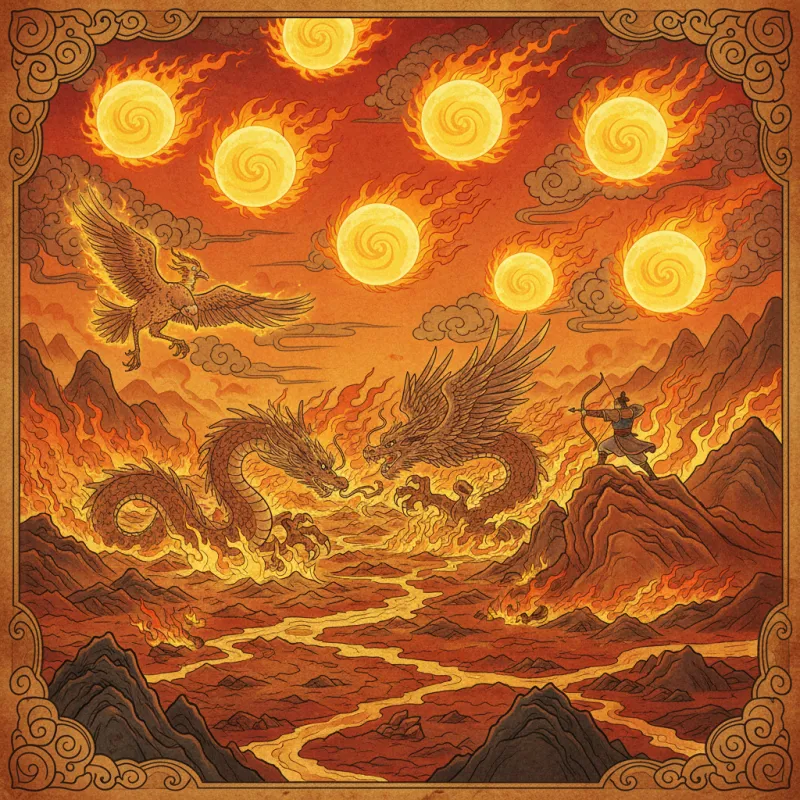
Imagine waking up one morning to find ten suns blazing in the sky. Not a poetic exaggeration—ten actual suns, each burning with the fury of a star, turning the heavens into a furnace of white-hot light. The earth cracks open. Rivers boil away into steam. Forests ignite spontaneously. Even the stones begin to melt. This is the catastrophe at the heart of one of China's most visceral creation myths: the story of the ten suns (十日, shí rì), a tale that has haunted Chinese imagination for over two millennia.
The Divine Family Behind the Suns
The ten suns weren't celestial accidents—they were children. Specifically, they were the sons of Xihe (羲和, Xī Hé), the goddess of the sun, and Di Jun (帝俊, Dì Jùn), one of the supreme deities in early Chinese mythology. This family structure is crucial because it transforms what could have been a simple astronomical disaster into a domestic tragedy with cosmic consequences.
According to the Shanhaijing (山海经, Shānhǎijīng, Classic of Mountains and Seas), Xihe lived beyond the eastern edge of the world in a place called the Valley of the Sun (旸谷, Yángǔ). There stood an enormous fusang tree (扶桑, fúsāng)—a mythical mulberry so vast that its branches could hold ten suns. Each morning, Xihe would bathe one of her sons in the Sweet Springs (甘渊, Gānyuān) and carry him across the sky in her chariot, while the other nine waited in the fusang tree's branches, glowing like roosting phoenixes.
This was the original order of the cosmos: one sun per day, a perfect rotation, a system as reliable as breathing. The suns were not just light sources—they were divine princes performing a sacred duty, maintaining the rhythm that allowed life to exist.
The Day Everything Broke
Then came the day when all ten suns decided to rise together.
The texts don't fully explain why. Some versions suggest youthful rebellion—the divine princes grew tired of their solitary daily journeys and wanted to play together in the sky. Others hint at something darker: perhaps they were testing their power, or maybe the cosmic order had simply worn thin after eons of repetition. The Huainanzi (淮南子, Huáinánzǐ), compiled in the 2nd century BCE, describes the event with chilling simplicity: "In the time of Yao, the ten suns came out together."
The effect was apocalyptic. With ten times the normal solar radiation hammering the earth, the world began to die. The heat was so intense that it didn't just kill—it transformed. Crops didn't wither; they combusted. Water didn't evaporate slowly; it exploded into steam. The Huainanzi records that "the grasses and trees scorched and died, and the people had nothing to eat." But it was worse than famine. The text continues: "Yayu, Zaochi, Jiuying, Dafeng, Fengxi, and Xiushe all came forth to harm the people."
These weren't just poetic names. They were monsters—specific creatures that emerged from the chaos. Yayu (猰貐, yàyǔ) was a man-eating beast with a human face. Zaochi (凿齿, záochǐ) had tusks so long they could pierce through a person like skewers. Jiuying (九婴, jiǔyīng) was a nine-headed serpent that could breathe both fire and water. The ecological collapse triggered by the ten suns didn't just kill the world—it unleashed the nightmares that had been sleeping in its margins.
Enter the Archer
This is where Yi (羿, Yì) enters the story, and he's not what you'd expect from a hero. He wasn't a king or a sage. He was an archer—specifically, the greatest archer who ever lived, a figure so skilled that his name became synonymous with archery itself. The legendary emperor Yao (尧, Yáo), desperate to save his people, called upon Yi to restore order.
Di Jun, the father of the ten suns, gave Yi a red bow and ten white arrows. The symbolism here is profound: the supreme deity was authorizing the execution of his own children. This wasn't a battle between good and evil—it was a father choosing humanity over his sons, order over family.
Yi climbed to the top of a mountain and began to shoot. The first arrow flew true, and one of the suns exploded in the sky, falling to earth as a three-legged crow (三足乌, sānzú wū). This detail—that each sun contained a divine crow—appears consistently across multiple texts. The Shanhaijing and later sources describe these solar crows as golden or red, with three legs instead of two, marking them as creatures beyond natural law.
One by one, Yi shot down the suns. Each arrow found its mark. Each sun fell as a burning crow. The sky grew darker—not with night, but with the absence of excess light, a return to the proper balance. By the time Yi had nine arrows left in his quiver, nine suns had fallen.
The Last Sun
Here the story takes a crucial turn. As Yi reached for his tenth arrow, Emperor Yao stopped him. Some versions say Yao physically grabbed the arrow; others say he simply spoke a command. The reason was practical: humanity needed one sun to survive. Total darkness would be as deadly as the inferno.
But there's a deeper layer to this intervention. By stopping Yi, Yao transformed the archer's mission from complete destruction to calibrated restoration. Yi wasn't just a killer of gods—he was an agent of balance, someone who could wield ultimate power and then choose not to use it. This restraint is what separates the hero from the monster in Chinese mythology.
The surviving sun—the youngest brother, according to some tellings—was traumatized. He had watched his nine siblings die, shot from the sky by an archer with divine sanction. From that day forward, he traveled his appointed path across the sky with perfect obedience, never deviating, never rebelling. The regularity of the sun's movement, which we take for granted, is in this myth a product of terror and grief.
The Aftermath and Yi's Fate
Yi's story doesn't end with his triumph. In fact, his greatest achievement becomes the source of his downfall—a pattern that echoes through Chinese literature and philosophy. After saving the world, Yi became arrogant. He had killed nine divine princes; what couldn't he do?
Different texts offer different versions of his decline. In some, he becomes a tyrant, drunk on his own power. In others, he's betrayed by his wife Chang'e (嫦娥, Cháng'é), who steals the elixir of immortality he had obtained and flees to the moon—a story that forms the basis of the Mid-Autumn Festival and connects to broader themes of lunar mythology and celestial exile. The Huainanzi suggests that Yi was eventually killed by his own disciple, Feng Meng (逢蒙, Féng Méng), who struck him down with a peach wood club.
The irony is deliberate: the man who could shoot down the sun couldn't dodge a wooden club. The archer who restored cosmic order couldn't maintain order in his own life. This is not a flaw in the storytelling—it's the point. Chinese mythology rarely offers simple heroism. Even the greatest deeds carry consequences, and power without wisdom leads to destruction.
What the Myth Reveals
The ten suns story operates on multiple levels simultaneously. On the surface, it's an explanation for why we have one sun instead of many—a creation myth that establishes the current order of the cosmos. But dig deeper and you find a meditation on authority, family, sacrifice, and the terrible choices required to maintain civilization.
Consider Di Jun's position: he must give the weapon that will kill his children to the man who will use it. He chooses the survival of the world over his own bloodline. This is the ultimate expression of the Confucian ideal that public duty supersedes private loyalty—but the myth predates Confucius by centuries, suggesting this tension is fundamental to Chinese thought.
Or consider Xihe, the mother who bathed her sons each morning and carried them across the sky. The texts barely mention her after the catastrophe. What does a mother do when nine of her ten children are executed for the crime of playing together? The silence around her grief is itself a kind of commentary—some losses are too vast for words.
The myth also reveals ancient Chinese anxieties about cosmic instability. Unlike mythologies that present the universe as fundamentally ordered (with chaos as an external threat), Chinese cosmology often suggests that order is fragile, maintained through constant effort and occasional violence. The ten suns didn't rise together because of some external evil—they did it because they were young and bored and didn't understand the consequences. The threat comes from within the system, not outside it.
Echoes Through Time
The ten suns myth has reverberated through Chinese culture for millennia. It appears in the Shanhaijing, the Huainanzi, the Chu Ci (楚辞, Chǔ Cí, Songs of Chu), and countless later texts. Poets invoke it as a metaphor for tyranny—multiple suns representing multiple rulers, each claiming supreme authority, together creating unbearable conditions. The Tang dynasty poet Li Bai (李白, Lǐ Bái) references Yi's arrows in his political poetry, using the myth to critique imperial excess.
The image of the three-legged crow became a symbol of the sun itself in Chinese art and iconography, appearing on bronze mirrors, silk paintings, and architectural decorations. Even today, China's lunar exploration program uses the name "Yutu" (玉兔, Yùtù, Jade Rabbit)—a reference to the rabbit that lives on the moon with Chang'e, Yi's wife, connecting modern space exploration to ancient mythology.
The myth also connects to broader patterns in Chinese creation stories, particularly the theme of cosmic repair and restoration. Like Nüwa mending the broken sky, Yi's shooting of the suns is an act of emergency maintenance on a damaged cosmos. The universe in these stories is not perfect and eternal—it breaks, it overheats, it floods. And it requires heroes willing to make terrible choices to fix it.
The Question That Remains
Here's what haunts me about this myth: the surviving sun. Every morning, he rises and crosses the sky, performing his duty with perfect precision. But he does it alone, forever, knowing that his brothers fell from the heavens as burning crows. He does it because the alternative—joining them in rebellion or grief—would mean the end of everything.
Is that obedience? Or is it a kind of ongoing sacrifice, a choice made new each dawn to continue despite loss? The myth doesn't say. It just shows us the sun, rising again, as it always has, as it always will—until perhaps one day it doesn't, and we'll understand too late what that daily journey cost.
Related Reading
- Nuwa Creates Humanity from Clay
- Pangu and the Cosmic Egg: Chinese Creation Story
- Gonggong Breaks the Pillar of Heaven
- Creation Myths of the Shanhaijing: How the World Was Made (Multiple Times)
- The Nine-Tailed Fox: From Divine Messenger to Demonic Seductress
- Peaches of Immortality: The Most Coveted Fruit
- Sea Creatures of the Shanhaijing: Monsters from the Deep