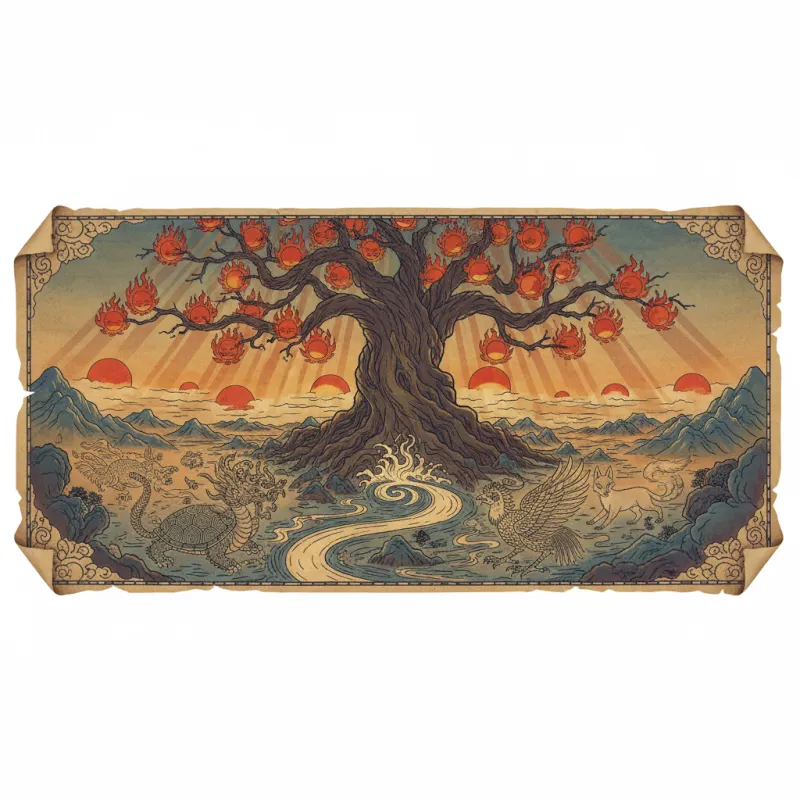
Every mythology needs a place where the light goes to die. For the ancient Chinese, that place had a name: Ruomu (若木 Ruòmù), the tree at the edge of the western wilderness where the ten suns came to rest after their long journey across the sky. If the Fusang Tree in the east was the cosmic alarm clock, Ruomu was the bed — drooping, warm, glowing faintly with the last heat of a day well spent.
The Western Counterpart Nobody Talks About
Most people who dip into Chinese mythology hear about Fusang pretty quickly. Ten suns, a giant mulberry tree in the east, the whole dramatic setup. But Ruomu? It gets maybe a paragraph in most English-language sources, which is a shame, because without it the entire cosmological framework falls apart.
The Shanhai Jing (山海经 Shānhǎi Jīng), our primary source for this stuff, is pretty clear about the arrangement. In the "Overseas Western Classic" (海外西经 Hǎiwài Xī Jīng) section, it describes Ruomu as standing in the far west, beyond the Flowing Sands (流沙 Liúshā), in a place where normal geography gives up and mythical space takes over. The text says the tree has a "bent form" (屈形 qū xíng) — not standing proud like Fusang, but curved, almost bowing under the weight of its celestial cargo.
This isn't just poetic imagery. The ancient Chinese were mapping out a complete solar cycle, and they needed both endpoints. Fusang was where the sun-birds bathed and prepared for their daily flight. Ruomu was where they landed, exhausted, their light dimming as they settled into the branches. One tree for dawn, one for dusk. The symmetry is almost too perfect.
What the Texts Actually Say
The Shanhai Jing gives us the bare bones: "Beyond the Flowing Sands, west of the Black River, north of the Red River, there is a great mountain named Kunlun. There is a tree called Ruomu, where the sun sets." That's it. No elaborate descriptions of golden leaves or divine gardeners. Just a tree, doing its job, day after day.
But later commentators couldn't leave it alone. Guo Pu (郭璞 Guō Pú), the 4th-century scholar who annotated the Shanhai Jing, added that Ruomu was a type of red-flowered tree, possibly related to the hibiscus family. Whether he had any textual basis for this or was just making educated guesses, we'll never know. Medieval Chinese scholars loved filling in gaps.
The Huainanzi (淮南子 Huáinánzǐ), compiled around 139 BCE, gives us a bit more context. It describes the sun's journey in mechanical terms: rising from the Valley of Yang (暘谷 Yánggǔ) near Fusang, traveling across the sky in a chariot, and finally descending to Ruomu in the west. The text treats this as straightforward cosmography, not metaphor. This was how educated Han dynasty readers understood the structure of their world.
The Geography of Sunset
Here's where it gets interesting. Ruomu wasn't just floating in abstract mythical space — it had neighbors. The Shanhai Jing places it near several other western landmarks: the Kunlun Mountains (昆仑山 Kūnlún Shān), the home of the Queen Mother of the West (西王母 Xī Wángmǔ), and various rivers that flowed with strange substances instead of water.
This western region was the Chinese mythological equivalent of the edge of the world. It's where Xi Wangmu held court in her jade palace, where the three-legged crow (三足乌 sānzú wū) that lived inside the sun would finally rest, where immortals gathered and normal rules stopped applying. Ruomu fit perfectly into this landscape of extremes.
The association with Kunlun is particularly significant. Kunlun was the axis mundi of Chinese cosmology, the mountain that connected heaven and earth. Having the sunset tree nearby reinforced its status as a liminal space — a place where celestial and terrestrial realms overlapped. When the suns descended to Ruomu, they were crossing a boundary, moving from the sky-realm back toward the earth-realm, preparing for their nightly journey through the underworld before emerging again at Fusang.
The Ten Suns Problem
You can't talk about Ruomu without addressing the elephant in the room: why ten suns? The myth goes that originally, all ten sun-birds took turns crossing the sky, one per day, creating a perfect ten-day week. But one day they all decided to fly out together, nearly incinerating the earth until the archer Yi (羿 Yì) shot down nine of them, leaving only one to make the daily journey.
This story is usually told with Fusang as the setting — that's where the suns lived, where they bathed, where Yi found them. But logically, Ruomu should have been just as crowded. If ten suns were taking turns, then nine would be resting at Ruomu while one was in the sky. The tree must have been quite a sight at sunset: nine glowing orbs already nestled in the branches, waiting for their sibling to return.
After Yi's intervention, Ruomu became a lonelier place. Just one sun, every evening, settling into the same spot. The tree that was designed to hold ten now held one. I wonder if the ancient Chinese thought about that — whether the myth of the archer was also a story about emptiness, about a cosmic infrastructure suddenly rendered obsolete.
Ruomu in Later Tradition
By the Tang dynasty (618-907 CE), Ruomu had become a standard literary reference for sunset and the western regions. Poets used it as shorthand for the end of the day, the passage of time, the inevitability of decline. Li Bai (李白 Lǐ Bái), never one to resist a good mythological allusion, mentioned it in several poems, usually in the context of lamenting how quickly the sun sets and how short life is.
But the tree also took on new meanings. Some Daoist texts incorporated Ruomu into their cosmological schemes, treating it as one of several cosmic trees that structured space and time. It became associated with the element of metal (金 jīn) and the direction west, fitting into the five-phase (五行 wǔxíng) system that organized so much of Chinese philosophical thought.
There's even a tradition that identifies Ruomu with actual trees in the western regions of China. Some scholars have suggested it might refer to a species of desert tree that turns red at sunset, creating the illusion of holding the sun's light. Whether this is the origin of the myth or just a later rationalization is impossible to say, but it's a reminder that mythology and geography were never entirely separate in the Chinese imagination.
The Symbolism of the Bent Tree
That detail about Ruomu's "bent form" has always stuck with me. Fusang is described as tall and straight, two trees intertwined, reaching upward. Ruomu bends, curves, droops. It's the difference between morning and evening, between ambition and rest, between the energy of beginning and the relief of ending.
There's something almost tender about the image. The sun doesn't crash into Ruomu or get trapped there — it settles, gently, into branches that curve to receive it. The tree bends not from weakness but from accommodation, from the accumulated weight of countless sunsets. It's a tree that knows its purpose and has shaped itself accordingly.
This is the kind of detail that makes me think the Ruomu myth was more than just cosmological bookkeeping. It's a meditation on cycles, on the necessity of rest, on the idea that even the sun — the most powerful, constant force in the sky — needs a place to stop. The bent tree is an acknowledgment that sustainability requires receptivity, that the cosmic order depends on spaces of rest as much as spaces of action.
Why Ruomu Matters
In the grand scheme of Chinese mythology, Ruomu is a supporting character. It doesn't have the dramatic narrative of Jianmu, the cosmic ladder that connected heaven and earth. It doesn't have the agricultural significance of the various grain-giving deities. It's just a tree where the sun sets.
But that's exactly why it matters. Ruomu represents the parts of mythology that aren't about heroes or monsters or cosmic battles — the infrastructure, the daily operations, the quiet necessities that make the spectacular stuff possible. Every mythology needs its Ruomu: the unglamorous, essential places where cycles complete and begin again.
The ancient Chinese understood something important when they imagined this tree. They understood that endings need space, that transitions require landmarks, that even celestial mechanics need a sense of place. Ruomu is where the light goes to die, yes, but also where it goes to rest, to prepare, to gather itself for another dawn at Fusang. It's the pause between breaths, the moment of stillness before motion resumes.
And maybe that's the real lesson of Ruomu: that every journey needs not just a starting point but an ending point, not just a launch but a landing. The sun doesn't just rise — it also sets. And somewhere in the western wilderness, there's a bent tree waiting to catch it, day after day, sunset after sunset, for as long as the world keeps turning.
Related Reading
- Mythical Lands of the Shanhaijing: Places That Should Not Exist
- The Fusang Tree: Where the Suns Rise and the World Begins — Shanhai Perspective
- Exploring the Enigmatic Mythical Creatures and Lands of Shanhaijing
- Kunlun Mountain: The Paradise at the Center of the World — Shanhai Perspective
- Penglai Island: The Legendary Isle of Immortals — Shanhai Perspective
- The Enigmatic Fish of Shanhaijing: Mythical Creatures of Chinese Lore
- Unraveling the Mysteries of Shanhaijing: Myths, Creatures, and Fantastic Realms
- Giants and Gods: The Titans of the Shanhai Jing