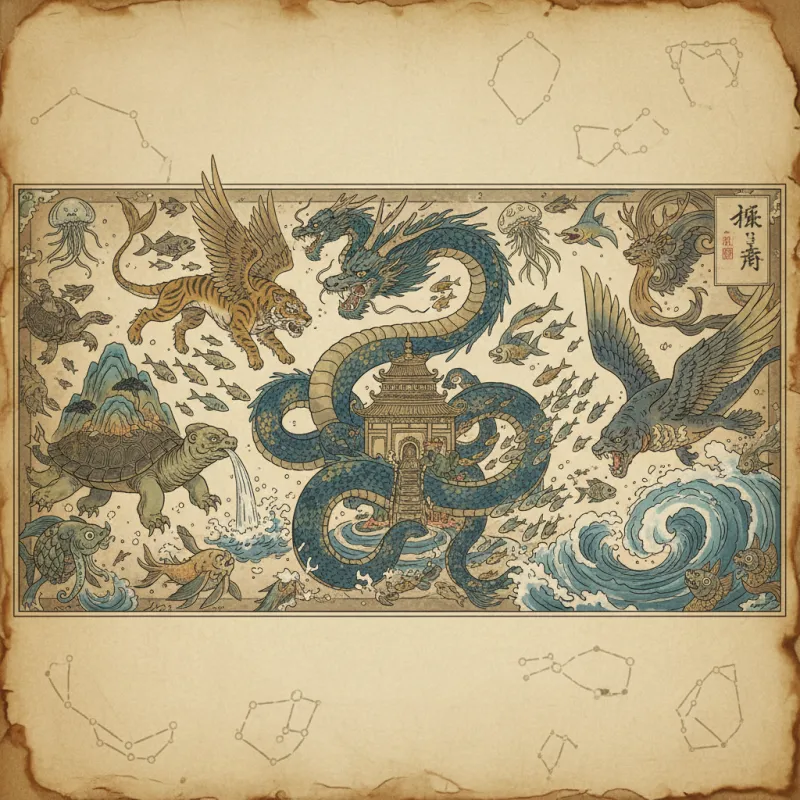
The ocean floor of the Shanhaijing (山海经, Shānhǎi Jīng) is not a place for the faint of heart. While land-based creatures might have the head of a bird and the body of a snake, the deep-sea monsters of this ancient text abandon all pretense of biological logic. They are vast, they are hungry, and they exist in a realm where the usual rules — gravity, proportion, the need for functional anatomy — simply don't apply.
Why the Ocean Breeds Monsters
Ancient Chinese cartographers could measure mountains, trace rivers, and catalog the creatures of the interior. But the ocean? The ocean was a void that swallowed ships and returned nothing. The Shanhaijing, compiled between the 4th and 1st centuries BCE, treats the sea as a space of pure possibility — and pure terror. If you can't verify what lives there, then anything might live there.
This wasn't just superstition. It was practical epistemology. The text's land creatures, however strange, follow patterns: they appear in specific mountains, eat specific things, make specific sounds. The sea creatures are different. They're described with a kind of nervous vagueness, as if the authors themselves weren't quite sure what they were dealing with. The ocean sections of the Shanhaijing read less like a bestiary and more like a collection of sailors' nightmares.
The Kun (鲲) — When a Fish Becomes Geography
The Kun (鲲, kūn) appears in the Zhuangzi rather than the Shanhaijing proper, but it belongs to the same mythological universe. Zhuangzi describes it as a fish "thousands of li in size" — a measurement so absurd it stops being a measurement and becomes a philosophical statement. The li (里) was roughly half a kilometer, which means the Kun is not a creature but a moving landmass.
What makes the Kun truly unsettling is its transformation. It becomes the Peng (鹏, péng), a bird equally massive, which flies from the northern ocean to the southern sea. The journey takes six months. The text specifies that when the Peng beats its wings, the sound is like clouds hanging from the sky. This is not a creature that exists in the same world as humans. It exists in a different scale of reality entirely.
The Kun-Peng transformation suggests something important about how the Shanhaijing understands the ocean: it's a place where identity is fluid, where a fish can become a bird because the categories themselves break down in the deep. Compare this to the more stable land-based creatures, which maintain their forms across the text.
The Jiao (蛟) — The Dragon That Isn't Quite
The Jiao (蛟, jiāo) is often translated as "flood dragon," which undersells how genuinely disturbing this creature is. It's described as a scaled serpent that lives in rivers and coastal waters, capable of causing floods and capsizing boats. Unlike the celestial dragons (龙, lóng) that control weather and symbolize imperial power, the Jiao is a creature of pure appetite.
The Shanhaijing places Jiao in specific locations — the waters near Mount Tai, certain rivers in the south — but always with a warning. These are not creatures you negotiate with. They are obstacles, hazards, things to be avoided or, if you're particularly brave or foolish, killed. The text records several instances of heroes slaying Jiao, and the descriptions are visceral: the water turns red, the creature thrashes for hours, its death throes create whirlpools.
What's interesting is that the Jiao occupies a middle space between the mundane and the mythological. It's not as cosmically vast as the Kun, but it's far more dangerous to actual humans. It exists at the scale where myth and daily life intersect — where a fishing trip can become a life-or-death encounter with something that shouldn't exist but does.
The Yu-Qiang (禺强) — The Ocean's Bureaucrat
Yu-Qiang (禺强, Yú Qiáng) is described as the god of the northern ocean, and his appearance is magnificently bizarre: a human face, a bird's body, two green snakes hanging from his ears, and two more snakes under his feet. He's not a monster in the sense of being hostile — he's more like a cosmic administrator, managing the winds and tides.
What makes Yu-Qiang significant is that he represents an attempt to impose order on the ocean's chaos. The Shanhaijing is fundamentally a text about classification, about putting the world into categories. Yu-Qiang is the ocean's category, its representative in the bureaucracy of the cosmos. But even he looks like a nightmare. Even the official in charge of the sea is a hybrid creature that defies normal biology.
This tells us something about how the text views the ocean: it can be governed, but only by something as strange as the ocean itself. You can't send a normal god to manage the deep. You need something that's already half-monster.
The Hai-Ren (海人) — Humans Who Aren't
The Hai-Ren (海人, hǎi rén), or "sea people," appear in several passages, and they're deeply unsettling precisely because they're almost human. They're described as having human faces and fish bodies, living in underwater kingdoms, occasionally surfacing to interact with coastal communities. Some versions say they weep pearls. Others say their fat can be burned as an eternal flame.
The Hai-Ren occupy the uncanny valley of the Shanhaijing. They're close enough to human to be recognizable, but different enough to be alien. They suggest that the ocean doesn't just contain monsters — it contains alternative versions of humanity, people who adapted to the deep and became something else in the process.
This is a recurring anxiety in Chinese mythology: the fear that the boundaries of humanity are more permeable than we'd like to believe. The Hai-Ren are what happens when humans cross into the ocean's territory and don't come back unchanged. They're a warning and a possibility, a reminder that the ocean can claim you not just physically but ontologically.
The Pattern Behind the Chaos
If you read the ocean sections of the Shanhaijing carefully, a pattern emerges. The creatures get stranger the farther you go from shore. Coastal waters have Jiao — dangerous, but comprehensible. The open ocean has Kun — vast beyond measurement. The deepest waters have things that aren't even named, just described as "strange fish" or "unusual serpents," as if the authors gave up trying to categorize them.
This is a map of epistemological confidence. The text knows the land. It's uncertain about the coast. It's completely lost in the deep ocean. And rather than pretend otherwise, it populates that uncertainty with creatures that embody it — things too big to measure, too strange to classify, too dangerous to approach.
The mythical geography of the Shanhaijing is ultimately about the limits of knowledge. The ocean monsters aren't just scary stories. They're markers of where the known world ends and the unknowable begins. They're what lives in the spaces between certainty and chaos, and they're still there, waiting, in every map's blank margins.
Related Reading
- The Four Dragon Kings: Rulers of China's Mythological Oceans
- Leviathans of the Eastern Sea: Giant Sea Creatures in Chinese Myth
- Sea Monsters of the Shanhai Jing: Terrors of the Deep
- Merfolk in Chinese Mythology: The Shark People and Sea Maidens
- Pangu and the Cosmic Egg: The Chinese Creation Myth
- Exploring the Enigmatic Creatures and Lands of Shanhaijing: A Cultural Journey
- Exploring Shanhaijing’s Most Enigmatic Mythical Creatures and Mysterious Lands