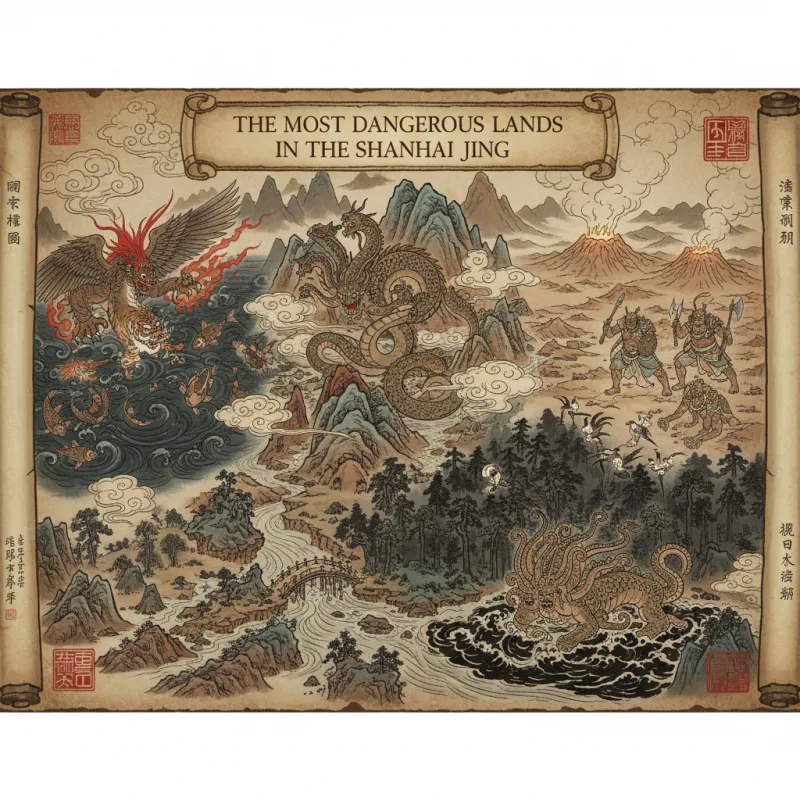
The ancient cartographers who compiled the Shanhai Jing weren't trying to sell you on exotic travel destinations. They were warning you about places where the landscape itself wants you dead. These weren't metaphorical dangers or spiritual tests — the text describes actual geographic features that would kill an unprepared traveler within hours. Fire mountains that melt bronze. Rivers whose water dissolves flesh. Forests where the trees scream. The further you traveled from the Central Plains, the more the world stopped playing by normal rules.
The Flaming Mountains: Where Metal Runs Like Water
The southern wilderness (大荒南经 Dàhuāng Nán Jīng) contains mountains that are perpetually on fire. Not volcanic eruptions — just mountains made of rock that burns. The Shanhai Jing describes the Yanshan (炎山 Yán Shān, literally "Flame Mountain") where the heat is so intense that bronze and iron melt on contact. Trees don't grow there. Animals don't live there. The text suggests that even birds flying overhead would fall from the sky, cooked mid-flight.
This wasn't poetic exaggeration. The compilers of the Shanhai Jing were documenting real geographic knowledge, however distorted by distance and retelling. These flaming mountains likely referred to regions of intense geothermal activity, possibly in what is now Yunnan or further south into Southeast Asia. The detail about melting metal suggests someone actually tried to bring metal tools into these regions and watched them become useless.
The guardian creature of these mountains is the Zhurong (祝融 Zhùróng), a fire deity with the body of a beast and the face of a human. Unlike the benevolent fire-bringers of other mythologies, Zhurong doesn't share fire with humanity — he keeps it contained in these deadly mountains, where it belongs. The message is clear: some natural forces aren't meant to be tamed.
The Weak Water: The River That Drowns Everything
In the western wilderness lies the Ruoshui (弱水 Ruòshuǐ, "Weak Water"), a river so named because nothing can float on its surface. Not wood. Not feathers. Not even a goose feather, the text specifies, as if anticipating skepticism. Drop anything into the Weak Water and it sinks immediately, pulled down by forces that defy normal physics.
The Weak Water serves as a natural moat around several sacred locations, including approaches to Kunlun Mountain: Where Heaven Meets Earth in Chinese Mythology. It's not just a physical barrier — it's a test of worthiness. Only beings with supernatural abilities can cross it. The Queen Mother of the West (西王母 Xī Wángmǔ) lives beyond it precisely because the Weak Water keeps mortals away.
Modern scholars have proposed various explanations: quicksand rivers, waters with unusual mineral content that increase density, or simply very fast-moving currents that overwhelm buoyancy. But the Shanhai Jing's description suggests something stranger. The text emphasizes that the water itself is "weak" — lacking the normal properties that allow things to float. It's water that has forgotten how to be water.
The Land of Perpetual Darkness
The northern wilderness (大荒北经 Dàhuāng Běi Jīng) contains regions where the sun never rises. Not because of polar night cycles, but because these lands exist in permanent shadow. The Shanhai Jing describes the Youdu (幽都 Yōudū, "Dark Capital"), a territory shrouded in eternal darkness where the living cannot survive for long.
This isn't the comfortable darkness of night. The text describes it as a thick, oppressive darkness that disorients travelers and causes madness. People who enter Youdu lose their sense of direction within hours. They wander in circles, unable to find their way out, until they collapse from exhaustion or terror. The darkness is described as having weight and substance, pressing down on intruders like a physical force.
The guardian of Youdu is Zhulong (烛龙 Zhúlóng, "Torch Dragon"), a creature so massive that when it opens its eyes, day comes to the world, and when it closes them, night falls. But Zhulong doesn't open its eyes in Youdu itself. That land remains dark by design, a place where the normal cycle of day and night doesn't apply. It's a geographic anomaly, a pocket of the world that operates under different rules.
The Poison Valleys of the East
The eastern wilderness contains valleys filled with toxic vapors that kill on contact. The Shanhai Jing describes the Duze (毒泽 Dú Zé, "Poison Marsh"), where the very air is lethal. Plants that grow there are poisonous. Water that flows through it becomes undrinkable. Animals that live in the region have adapted to the toxins, making them equally dangerous to eat.
What makes these valleys particularly treacherous is that the poison isn't always visible. The text warns of "invisible miasmas" (瘴气 zhàngqì) that drift through the valleys, killing travelers who don't realize they've entered a contaminated zone until symptoms appear. Victims experience dizziness, difficulty breathing, and eventual paralysis. The Shanhai Jing recommends carrying specific herbs as antidotes, but notes that some poisons work too quickly for treatment.
These descriptions align remarkably well with modern understanding of naturally occurring toxic gases in certain geological formations. Volcanic regions can produce carbon dioxide pockets that displace oxygen. Decomposing organic matter in swamps releases methane and hydrogen sulfide. The ancient Chinese clearly encountered these phenomena and documented them as best they could, framing them as geographic features to avoid rather than chemical processes to understand.
The Screaming Forest
In the western regions, the Shanhai Jing describes a forest where the trees themselves are hostile. The Kuafu Forest (夸父林 Kuāfù Lín) is named after the giant Kuafu who died chasing the sun and whose walking staff transformed into this grove. But these aren't normal trees. The text describes them as producing sounds like human screaming, particularly at night.
Travelers who enter the Screaming Forest report overwhelming feelings of dread and paranoia. The trees seem to move when not directly observed. Paths that were clear become blocked. The forest actively resists navigation, as if it doesn't want anyone to pass through. Those who camp within its boundaries report nightmares so vivid they wake up unable to distinguish dream from reality.
The scientific explanation might involve wind patterns creating unusual acoustic effects through hollow trees, or perhaps infrasound frequencies that induce psychological distress. But the Shanhai Jing treats the forest as genuinely malevolent, a living entity that remembers its origin as a giant's weapon and continues to serve as a barrier against intrusion.
The Magnetic Mountains
The Shanhai Jing describes mountains in the far north that pull metal objects toward them with irresistible force. Warriors who approach these mountains wearing armor find themselves dragged forward, unable to retreat. Metal weapons fly from their hands. Even metal coins in pouches are pulled free, leaving travelers impoverished and defenseless.
This description of magnetic mountains appears in multiple ancient Chinese texts, suggesting it was based on real observations of lodestone deposits. But the Shanhai Jing characterizes these mountains as deliberately dangerous, as if the magnetic force exists specifically to disarm and disable travelers. The text recommends approaching these regions without any metal objects whatsoever — advice that would leave travelers vulnerable to the many dangerous creatures that inhabit the area.
The strategic implications are fascinating. These magnetic mountains create zones where conventional military force becomes useless. An army equipped with bronze weapons and armor would be helpless. The geography itself serves as a defense system, protecting whatever lies beyond from invasion by technologically advanced civilizations.
Why These Lands Exist
The Shanhai Jing doesn't present these dangerous territories as random natural hazards. They're positioned deliberately, forming a ring of hostile geography around the civilized center of the world. The flaming mountains to the south, the weak water to the west, the perpetual darkness to the north, the poison valleys to the east — together they create a natural barrier that keeps the known world separate from whatever lies beyond.
This geographic arrangement reflects a deeper cosmological principle in ancient Chinese thought. The center is safe, ordered, and governed by human civilization. The periphery is wild, chaotic, and governed by forces that predate human existence. The dangerous lands aren't aberrations — they're the natural state of the world before human intervention. Civilization exists as a small island of safety in an ocean of hostility.
The creatures that guard these regions — the fire deities, the torch dragons, the poison spirits — aren't villains. They're custodians, maintaining the boundaries between different types of existence. They prevent humans from wandering into territories where human life cannot be sustained. In this sense, the dangerous lands of the Shanhai Jing serve a protective function, even as they threaten anyone foolish enough to ignore the warnings.
Modern readers might see these descriptions as primitive superstition, but they represent sophisticated geographic knowledge encoded in mythological language. The compilers of the Shanhai Jing were documenting real dangers — geothermal activity, toxic gases, magnetic anomalies, extreme weather — using the conceptual framework available to them. They weren't wrong about the dangers. They just explained them differently than we would today. And their core message remains valid: the world contains places where humans don't belong, and ignoring that fact has consequences.
Related Reading
- The Four Seas and the Shape of the Ancient Chinese World
- Kunlun Mountain: The Paradise of Immortals
- Sacred Rivers in Chinese Mythology: The Yellow River and the Yangtze
- The Geography of the Shanhaijing: Mapping a World That Does Not Exist
- Pangu and the Cosmic Egg: Chinese Creation Story
- The Hetu and Luoshu: Magical Diagrams from the Rivers — Shanhai Perspective
- The Illustrated Shanhaijing: How Artists Have Imagined the Unimaginable for Two Thousand Years