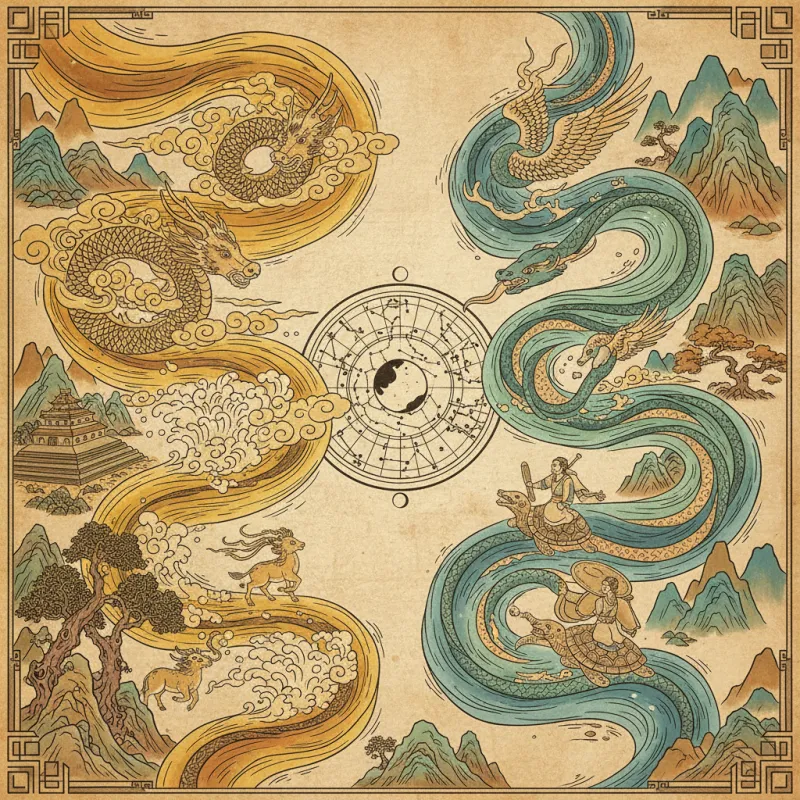
The Yellow River has killed more people than any other river in human history. Floods in 1887 claimed between 900,000 and 2 million lives. The 1931 flood killed up to 4 million. Yet for three thousand years, the Chinese have called it 黄河 (Huánghé), the "Mother River," and built their entire civilization along its banks. This paradox — a river that both nurtures and destroys — sits at the heart of Chinese mythology. The sacred rivers of China aren't gentle. They're gods with tempers.
The Yellow River: Where Civilization Learned to Negotiate with Chaos
The Yellow River earned its name from loess, the fine yellow silt it carries from the plateaus of northwestern China. It transports more sediment than any river on earth — roughly 1.6 billion tons annually. This isn't just a geological fact. It's the reason Chinese mythology is obsessed with flood control, why the first legendary emperors are hydraulic engineers, why the river appears in myths as both creator and destroyer.
The river's mythology begins with 鲧 (Gǔn), the father of Yu the Great. Around 2200 BCE, according to legend, China faced a catastrophic flood that lasted for decades. The Yellow River had breached its banks and refused to return. Emperor Yao appointed Gǔn to solve the problem. Gǔn's approach was simple: build walls, dam the water, force it back. He worked for nine years. He failed completely. The floods worsened. Yao had him executed — some versions say he was banished to Feather Mountain, others that he was killed outright.
Then came Gǔn's son, 禹 (Yǔ), later known as Yu the Great or Da Yu. Yu understood what his father didn't: you can't fight the Yellow River. You negotiate with it. Instead of building walls to block the water, Yu dredged channels to guide it. He spent thirteen years traveling the river system, supposedly passing his own house three times without stopping to visit his family. The Shanhaijing describes him measuring the land with a jade ruler, marking mountains, creating the first maps of China's geography. Yu didn't just control the flood — he organized the entire landscape into nine provinces, establishing the geographical framework that would define China for millennia.
This myth matters because it's not really about water. It's about the fundamental Chinese approach to chaos: you don't eliminate it, you channel it. The Yellow River became the model for understanding everything from political power to personal cultivation. The river is 黄河之水天上来 (Huánghé zhī shuǐ tiānshàng lái) — "the Yellow River's waters come from heaven," as Li Bai wrote in the Tang Dynasty. It's divine, but divinity in Chinese thought isn't separate from nature. It's nature at its most powerful.
The Dragon Kings and the River's Temper
By the Han Dynasty (206 BCE - 220 CE), the Yellow River had acquired a divine bureaucracy. The 龙王 (Lóngwáng), or Dragon Kings, ruled the waters. Four Dragon Kings governed the four seas, but countless lesser dragons controlled rivers, lakes, and wells. The Yellow River Dragon King was particularly important — and particularly temperamental.
These weren't the dragons of European mythology. Chinese dragons are water deities, controllers of rain and flood, fundamentally connected to agriculture and survival. The Dragon King of the Yellow River appears throughout Chinese literature as a figure who must be appeased, negotiated with, sometimes tricked. In Journey to the West, the Dragon King of the Jing River (a Yellow River tributary) is executed for causing the wrong amount of rain — a bureaucratic error with cosmic consequences.
The mythology reflects reality. The Yellow River changes course dramatically. Between 602 BCE and 1938 CE, it shifted its mouth from north of the Shandong Peninsula to south of it at least five times, each shift creating new deltas, destroying cities, killing thousands. You can't build a stable civilization on an unstable river without developing myths that explain why the river behaves this way. The Dragon Kings provided that explanation: the river has a will, a personality, moods that must be managed.
Local communities along the Yellow River performed elaborate rituals to appease the Dragon King. During droughts, they'd parade dragon effigies and pray for rain. During floods, they'd offer sacrifices — sometimes animals, sometimes precious objects, and in desperate times, human lives. The practice of 河伯娶妇 (Hébó qǔ fù), "the River God takes a wife," involved drowning young women as brides for the river deity. The practice was supposedly ended by 西门豹 (Xīmén Bào), a magistrate during the Warring States period who exposed it as a scam run by corrupt shamans, but the myth persisted in folklore for centuries.
The Yangtze: The River That Connects Worlds
If the Yellow River is the mother, the Yangtze (长江 Chángjiāng, literally "Long River") is the artery. At 6,300 kilometers, it's the longest river in Asia and the third-longest in the world. It divides China into north and south, connects the Tibetan Plateau to the East China Sea, and appears in mythology as a boundary between realms.
The Yangtze's mythology is different from the Yellow River's. It's less about flood control and more about transformation, boundaries, and the supernatural. The river appears in the Shanhaijing as the habitat of strange creatures: the 鱼妇 (yúfù), fish-women who live in the water and come to shore to seduce men; the 江豚 (jiāngtún), river dolphins that were considered sacred and whose appearance predicted weather changes.
The Three Gorges region, where the Yangtze cuts through mountains, is particularly rich in mythology. This is where 巫山 (Wū Shān), the "Shamanic Mountains," rise from the river. The goddess of Wushan appears in the Gaotang Fu by Song Yu (3rd century BCE) as a divine woman who visits the King of Chu in a dream, then transforms into morning clouds and evening rain. The phrase 巫山云雨 (Wū Shān yún yǔ), "clouds and rain of Wushan," became a poetic euphemism for sexual intimacy, but the original myth is about the boundary between human and divine, waking and dreaming, earth and sky — all mediated by the river.
The Yangtze also marks the southern boundary of the Central Plains culture that produced most classical Chinese mythology. South of the Yangtze, you enter the territory of 楚 (Chǔ) culture, which had its own mythological traditions. The Chuci (Songs of Chu), compiled around the 2nd century BCE, contains river deities and water spirits that don't appear in northern texts. The 湘君 (Xiāng Jūn) and 湘夫人 (Xiāng Fūrén), the Lord and Lady of the Xiang River (a Yangtze tributary), are lovers separated by death, their story told through shamanic songs that invoke the river as a path between the living and the dead.
Rivers as Cosmic Infrastructure
Here's what makes Chinese river mythology distinctive: the rivers aren't just settings for myths. They're infrastructure. They're how the cosmos is organized.
The Shanhaijing describes rivers with the same systematic attention it gives to mountains, minerals, and monsters. Rivers connect regions, define territories, mark boundaries between the known and unknown. When the text describes a mountain, it almost always mentions which river flows from it, where that river goes, what creatures live in it. Geography and mythology are inseparable.
This makes sense when you remember that the Shanhaijing was probably compiled between the 4th and 1st centuries BCE, during the Warring States period and early Han Dynasty. This was when China was being unified, when the concept of "China" as a single geographical and political entity was being invented. Rivers were how you organized that space. The Yellow River and the Yangtze weren't just important rivers — they were the axes around which the entire world was structured.
The mythological geography reflects this. Kunlun Mountain, the cosmic mountain where heaven meets earth, is described as the source of multiple rivers. The 弱水 (Ruò Shuǐ), the "Weak Water" that can't support even a feather, flows from Kunlun's northern slopes. The Yellow River itself was sometimes said to originate from Kunlun, though the Shanhaijing gives it a different source. The point isn't geographical accuracy — it's cosmic organization. Rivers flow from sacred mountains, connect the center to the periphery, bring divine power into the human world.
The Great Flood and the Birth of Civilization
Every major civilization has a flood myth. China's version is unique because it's not about divine punishment or a fresh start. It's about engineering.
The Great Flood myth, centered on Yu the Great's efforts to control the Yellow River, appears in texts from the Shangshu (Book of Documents) to the Shiji (Records of the Grand Historian). The flood lasted for decades. It covered the Central Plains, displaced populations, destroyed agriculture. But it wasn't sent by angry gods. It was a natural disaster that required a human solution.
Yu's success in controlling the flood made him a culture hero. He founded the Xia Dynasty (traditionally dated to around 2070 BCE, though archaeological evidence is debated). He established the nine provinces, created the tribute system, organized the empire. Chinese civilization, in this telling, begins with hydraulic engineering. The first emperor is a water engineer.
This myth has shaped Chinese political thought for millennia. Good government means flood control. Bad government means the rivers overflow. The Mandate of Heaven — the principle that emperors rule because heaven grants them legitimacy — is partly measured by their ability to manage water. When the Yellow River floods catastrophically, it's a sign that the dynasty is losing heaven's favor. The river is both a practical challenge and a cosmic barometer.
The myth also explains why Chinese civilization developed where it did. The Yellow River valley, despite the floods, had the richest agricultural land in East Asia, thanks to all that loess sediment. The Yangtze valley was warmer and wetter, perfect for rice cultivation. These rivers made intensive agriculture possible, which made large populations possible, which made complex civilization possible. The mythology acknowledges this: the rivers are mothers, creators, the source of life. They're just also dangerous.
Rivers in Literature and Popular Religion
By the Tang Dynasty (618-907 CE), river mythology had moved from classical texts into popular religion and literature. The Dragon Kings had temples along every major waterway. Local river gods received offerings. Fishermen and sailors prayed before voyages. The rivers were fully integrated into the religious landscape.
Literature from this period treats rivers as characters. Li Bai's poetry is full of rivers — the Yellow River pouring from heaven, the Yangtze flowing endlessly east, rivers as metaphors for time, change, the passage of life. Du Fu writes about rivers as witnesses to history, flowing past ruined capitals and forgotten dynasties. The rivers outlast everything human.
In Journey to the West (16th century), rivers are obstacles and tests. The pilgrims must cross the 流沙河 (Liúshā Hé), the "Flowing Sands River," where they encounter 沙悟净 (Shā Wùjìng), the Sand Monk, a former celestial general exiled to the river as punishment. They cross the 通天河 (Tōngtiān Hé), the "River to Heaven," where a turtle carries them across in exchange for a promise to ask Buddha a question. Rivers in Journey to the West are boundaries between stages of the journey, between levels of spiritual development. You can't progress without crossing water.
Water Margin (14th century) is set in the marshes and rivers of Shandong, where the Yellow River creates a landscape of waterways and wetlands. The outlaw heroes hide in these marginal spaces, using the rivers' complexity to evade government forces. The rivers provide refuge, but they're also dangerous — characters drown, boats capsize, floods threaten. The rivers are neutral forces that can be used by heroes or villains, depending on who understands them better.
The Modern River and the Ancient Myth
The Yellow River and the Yangtze are still dangerous. The Three Gorges Dam, completed in 2006, is the world's largest hydroelectric project, built partly for flood control on the Yangtze. The Yellow River is so heavily managed — dammed, diverted, depleted — that it sometimes doesn't reach the sea. Climate change is altering rainfall patterns, threatening both floods and droughts.
But the mythology persists. Dragon boat festivals still honor river deities. The phrase "跳进黄河洗不清" (tiào jìn Huánghé xǐ bù qīng), "even jumping into the Yellow River won't wash you clean," means you can't escape blame — the river is still invoked as a cosmic force. When the Yellow River runs clear, it's still considered an omen, a sign that something fundamental has changed in the cosmic order.
The rivers made Chinese civilization possible. They also made it precarious. The mythology reflects this tension: rivers are mothers and destroyers, divine and dangerous, sources of life and death. You can't understand Chinese mythology without understanding that every myth about order, control, and civilization is ultimately a myth about water. The rivers flow through everything, connecting the sacred mountains to the human world, the past to the present, chaos to order. They're still flowing. The myths are still true.
Related Reading
- The Fusang Tree: Where Ten Suns Rest
- The Most Dangerous Lands in the Shanhai Jing
- The Four Seas and the Shape of the Ancient Chinese World
- Kunlun Mountain: Where Heaven Meets Earth in Chinese Mythology
- Kunlun Mountain: The Paradise of Immortals
- Discovering the Guardians of Shanhaijing: Mythical Creatures and Legendary Lands
- Chinese Dragons: Everything You Need to Know
- Kuafu Chases the Sun: The Giant Who Ran After Light