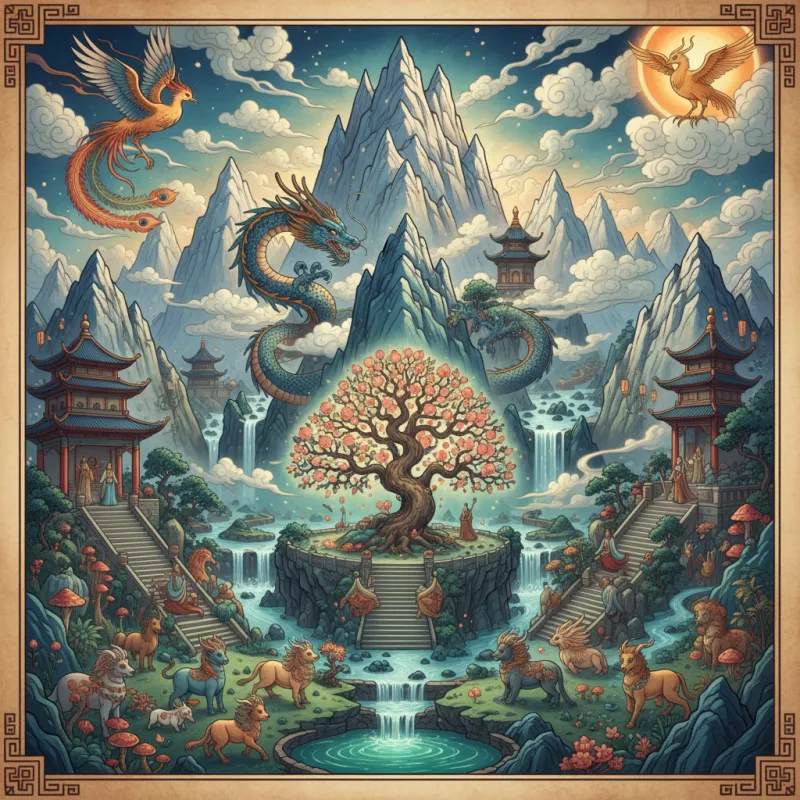
Picture this: a mountain so tall its peaks pierce the celestial realm, where jade palaces shimmer in eternal mist and the Queen Mother of the West tends her peach trees of immortality. This isn't fantasy—it's Kunlun Mountain (昆仑山, Kūnlún Shān), the most sacred peak in Chinese mythology and the axis around which the entire cosmos revolves. While modern tourists flock to the physical Kunlun range in western China, the mythical Kunlun described in the Shanhai Jing exists in a dimension beyond geography, a paradise where gods walk and mortals dare not tread without invitation.
The Cosmic Architecture of Paradise
The Shanhai Jing doesn't mess around when describing Kunlun's structure. This isn't just a mountain—it's a nine-tiered cosmic ladder, each level more magnificent and terrifying than the last. The base spans 800 li (roughly 250 miles), rising 80,000 ren into the sky. At its summit sits the Hanging Garden (悬圃, Xuánpǔ), a plateau where the legendary Jianmu tree (建木, Jiànmù) once grew, allowing divine beings to ascend and descend between heaven and earth.
What strikes me most about Kunlun's architecture is its function as a cosmic filter. The lower slopes are guarded by the Kaiming Beast (开明兽, Kāimíng Shòu), a nine-headed tiger-bodied creature that devours anyone unworthy of ascending. This isn't just mythological window dressing—it reflects a profound Chinese philosophical concept that spiritual elevation requires merit, not just ambition. You can't simply climb your way to enlightenment; the mountain itself judges your worthiness.
The middle tiers house various divine administrators and immortal beings, each managing different aspects of cosmic order. By the time you reach the upper levels, you're in the domain of the Queen Mother of the West (西王母, Xī Wángmǔ), the supreme goddess who rules this paradise with absolute authority.
The Queen Mother's Eternal Garden
If Kunlun is the heart of Chinese mythological geography, then the Queen Mother of the West is its beating pulse. Her palace complex on Kunlun's summit contains the most coveted treasure in all mythology: the Peaches of Immortality (蟠桃, Pántáo). These aren't your grocery store peaches—they ripen once every 3,000 years, and a single bite grants eternal life.
The Shanhai Jing describes the Queen Mother herself in terms that would terrify modern readers: a woman with a leopard's tail, tiger's teeth, and a talent for whistling that could summon storms. Later texts from the Han Dynasty (206 BCE - 220 CE) softened her image into the elegant goddess we recognize today, but I prefer the original version. She's not a benevolent fairy godmother—she's a powerful cosmic force who controls the very essence of immortality.
Her most famous interaction with mortals involves Emperor Mu of Zhou (周穆王, Zhōu Mù Wáng), who supposedly visited Kunlun around 985 BCE. According to the Mu Tianzi Zhuan (穆天子传), he brought lavish gifts and was granted an audience, though notably, he wasn't offered any peaches. The Queen Mother doesn't hand out immortality like party favors—even emperors must prove themselves worthy.
The Sacred Waters and Mystical Flora
Kunlun's geography includes features that would make any fantasy novelist jealous, except these were documented centuries before Tolkien was born. Four major rivers originate from Kunlun's slopes, flowing to the four cardinal directions and nourishing the mortal world below. The most significant is the Weak Water (弱水, Ruòshuǐ), a river so peculiar that nothing can float on its surface—not even a feather. This serves as a natural moat, preventing unauthorized access to the mountain's sacred precincts.
The mountain's flora reads like a pharmacopoeia of immortality. Beyond the famous peaches, Kunlun hosts the Jade Tree (玉树, Yùshù), whose leaves are pure jade and whose fruit grants wisdom, and various species of lingzhi mushrooms (灵芝, língzhī) that extend lifespan when consumed. The Shanhai Jing catalogs dozens of plants found nowhere else, each with specific supernatural properties.
What fascinates me is how these mythical elements mirror real Daoist alchemical practices. The quest for immortality wasn't just mythological fantasy—it drove actual expeditions, scientific experiments, and pharmaceutical developments throughout Chinese history. Kunlun represented the idealized source of all these life-extending substances, the place where the boundary between myth and medicine dissolved.
Kunlun's Role in the Divine Bureaucracy
Here's where Kunlun's significance extends beyond pretty scenery and magic peaches. In Chinese cosmology, heaven operates like an imperial bureaucracy, and Kunlun functions as the administrative capital for earthly affairs. The mountain serves as the meeting point between celestial officials and terrestrial spirits, a cosmic embassy where divine policy gets implemented.
The Shanhai Jing mentions numerous deities stationed at Kunlun, each with specific portfolios. Lu Wu (陆吾, Lùwú), a god with a human face and tiger body, manages the mountain's nine districts and oversees the celestial garden. The Kaiming Beast I mentioned earlier isn't just a guard—it's the chief of security for the entire cosmic order, reporting directly to the Queen Mother.
This bureaucratic structure influenced how Chinese emperors legitimized their rule. By claiming connections to Kunlun—through ritual, lineage, or divine mandate—they positioned themselves as intermediaries between heaven and earth. The mountain became a political symbol as much as a spiritual one, which explains why so many dynasties sponsored expeditions to find the "real" Kunlun.
The Physical Mountain and Mythical Confusion
Now for the awkward part: where exactly is Kunlun? The physical Kunlun Mountains stretch across western China, forming part of the Tibetan Plateau's northern edge. But the mythical Kunlun described in the Shanhai Jing doesn't match this geography at all. The text places it in the northwest, but also describes it as the source of the Yellow River, which actually originates from the Bayan Har Mountains.
This geographical confusion isn't a bug—it's a feature. Ancient Chinese cosmography mixed empirical observation with mythological significance. When the Shanhai Jing describes Kunlun, it's not providing GPS coordinates; it's mapping spiritual topology. The mountain exists in a liminal space between the physical and metaphysical, accessible only to those who understand that not all journeys are measured in miles.
During the Han Dynasty, Emperor Wu (汉武帝, Hàn Wǔdì) became obsessed with finding Kunlun, sending multiple expeditions westward. They never found the paradise described in texts, but they did expand Chinese geographical knowledge significantly. The search for mythical Kunlun inadvertently drove real exploration, proving that even impossible quests can yield practical results.
Kunlun's Literary and Cultural Legacy
Kunlun's influence extends far beyond the Shanhai Jing. The mountain appears in countless literary works, from Qu Yuan's Chu Ci (楚辞) poems to modern wuxia novels. In Journey to the West (西游记), the Monkey King causes chaos at the Queen Mother's peach banquet—a scene that has become iconic in Chinese popular culture. The mountain serves as a narrative shorthand for ultimate spiritual achievement and divine authority.
What I find most compelling is how Kunlun evolved from a specific mythological location into a metaphor for any spiritual peak worth climbing. Daoist practitioners speak of "ascending Kunlun" when describing meditation practices that elevate consciousness. The mountain became internalized, transformed from an external destination into an internal state of being.
This metaphorical flexibility explains Kunlun's enduring relevance. While we no longer believe in a literal nine-tiered mountain guarded by nine-headed beasts, the concept of a sacred space where ordinary rules don't apply—where immortality is possible and divine beings walk freely—remains psychologically powerful. Kunlun represents humanity's eternal hope that somewhere, somehow, transcendence is achievable.
The Paradise We Carry Within
Standing at 1,582 words, I've barely scratched the surface of Kunlun's significance. This mountain connects to nearly every major theme in Chinese mythology: the relationship between heaven and earth, the quest for immortality, the structure of divine authority, and the geography of the sacred. It appears in discussions of mythical creatures and divine beings throughout the Shanhai Jing.
The genius of Kunlun as a mythological construct is its ambiguity. It's simultaneously a real mountain range, a cosmic axis, a divine palace, and a spiritual metaphor. This multiplicity allows each generation to reinterpret Kunlun according to their needs while maintaining continuity with ancient tradition. The paradise of immortals isn't just a place the ancients believed in—it's a concept that continues to shape how we think about transcendence, achievement, and the possibility of surpassing human limitations.
Perhaps the Queen Mother still tends her peach trees on some metaphysical summit, waiting for worthy visitors. Or perhaps Kunlun exists wherever we dare to imagine that the impossible might be possible after all.
Related Reading
- The Fusang Tree: Where Ten Suns Rest
- The Four Seas and the Shape of the Ancient Chinese World
- The Geography of the Shanhaijing: Mapping a World That Does Not Exist
- Kunlun Mountain: Where Heaven Meets Earth in Chinese Mythology
- Weak Water: The River Nothing Can Cross
- East vs. West: Comparing Mythical Creatures Across Cultures
- The Qilin: China's Sacred Unicorn and Divine Messenger
- Exploring the Enigmatic Creatures and Lands of the Shanhaijing