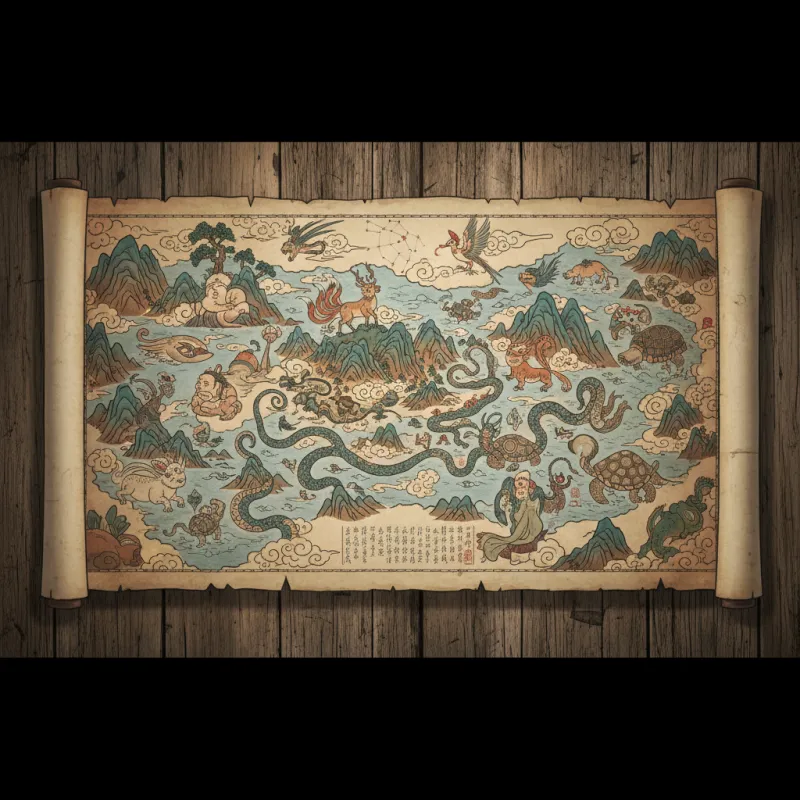
A map that leads nowhere is worse than no map at all. Yet for over two thousand years, Chinese scholars have tried to plot the Shanhaijing (山海经, Shānhǎijīng, "Classic of Mountains and Seas") onto actual terrain, convinced that beneath its catalog of monsters and divine peaks lies a genuine geographic record. They have failed. Every attempt to align the text's mountains with real mountains, its rivers with real rivers, produces a landscape that cannot exist—distances that contradict, directions that reverse, a world that folds in on itself like an Escher drawing.
The question isn't whether the Shanhaijing describes real places. The question is why it pretends to.
The Seduction of Precision
Open the Shanhaijing to almost any page and you'll find numbers. The text measures everything. Mount Zhao (招摇之山, Zhāoyáo zhī shān) lies 300 li (里, a unit roughly equivalent to half a kilometer) from Mount Tang. The Ying River flows northeast for 400 li before joining the Yi. The Southern Mountains stretch 16,380 li from beginning to end. This is not the vague geography of myth. This is surveying.
The precision is intoxicating. When the Wuzang Shanjing (五藏山经, "Classic of the Five Treasuries of Mountains") section describes a chain of mountains, it reads like a hiking guide: "Three hundred li east is Mount Qing. Another 350 li east is Mount Qi. Another 370 li east is Mount Jiwei." You can almost see the ancient cartographer, stylus in hand, marking distances on bamboo strips.
But try to follow these directions and you walk off the edge of the known world. The mountains don't line up. The distances are wrong. The rivers flow backward. Scholars have been trying to solve this puzzle since at least the Han dynasty (206 BCE–220 CE), and the most honest conclusion is the one nobody wants to accept: the geography is impossible because it was never meant to be possible.
The Copyist's Curse
The traditional explanation blames transmission errors. The Shanhaijing we have today is not the Shanhaijing of the Warring States period (475–221 BCE) or even the Han. It's a copy of a copy of a copy, transcribed by hand across centuries, each generation of scribes introducing new mistakes. A character misread here, a number transposed there, and suddenly Mount Zhao is 3,000 li away instead of 300.
Guo Pu (郭璞, Guō Pú, 276–324 CE), the text's most famous commentator, spent years trying to identify the mountains and rivers. He succeeded with some—the Yellow River, the Yangtze, a few major peaks—but most remained stubbornly unidentifiable. He blamed corrupted text. Later scholars blamed Guo Pu for not trying hard enough.
The copyist theory is comforting because it preserves the idea that the Shanhaijing was once accurate. Somewhere in the past, there existed a true version, a real map. We've just lost it. But this theory requires an extraordinary number of errors, all conspiring to make the geography consistently wrong in ways that can't be fixed by changing a few characters. It's not that the text is corrupted. It's that the world it describes never existed.
The Ritual Landscape
Here's a different theory: the Shanhaijing isn't describing physical geography at all. It's describing ritual geography—a map of sacred space organized by religious and cosmological principles rather than actual terrain. The mountains aren't real mountains; they're ritual stations. The distances aren't travel distances; they're symbolic intervals.
This explains why the text is so obsessed with what you find at each mountain: which gods live there, which animals, which minerals, which plants. Mount Zhao has a tree whose leaves cure deafness. Mount Tang has a beast that looks like an ox but has a white head. These aren't naturalist observations. They're ritual inventories, catalogs of what each sacred site provides.
The Shanhaijing might be a liturgical text disguised as a geographic one—a handbook for ritual specialists who needed to know which mountain to visit for which purpose, organized in a sequence that made sense for ceremonial circuits rather than actual journeys. The precision of the distances would then be ritual precision, marking out a sacred landscape that existed in religious imagination rather than physical space. This connects to broader patterns in ancient Chinese cosmology, where the four seas marked the boundaries of civilization in ways that were more symbolic than cartographic.
The Composite World
Or maybe the Shanhaijing is a compilation, stitched together from multiple sources that described different regions using different reference points. The Wuzang Shanjing section alone covers five mountain systems—Eastern, Southern, Western, Northern, and Central—each potentially drawn from separate geographic traditions. When later editors tried to combine these into a single coherent text, they created a Frankenstein's monster of geography, a world assembled from incompatible parts.
This would explain why some sections seem more realistic than others. The Central Mountains section, for instance, contains recognizable features of the Yellow River valley. The Overseas sections, by contrast, describe a fantasy world of giants and immortals. These might have originated as separate texts—one a genuine (if stylized) geographic record, the other pure mythology—that got bound together and treated as a unified whole.
The problem with this theory is that it still doesn't explain why anyone would preserve such an obviously broken text. If the geography didn't work, why not fix it? Why not reorganize the sections, adjust the distances, make the rivers flow in the right directions? The fact that no one did suggests that accuracy wasn't the point.
The Imaginary Empire
The most radical interpretation is that the Shanhaijing describes an imaginary world on purpose. It's not a failed map of reality but a successful map of unreality—a deliberate construction of an alternate geography that served political, philosophical, or literary purposes.
Consider when the text was compiled: the late Warring States period and early Han, an era of imperial consolidation when the concept of "All Under Heaven" (天下, tiānxià) was being actively constructed. The Shanhaijing presents a world that is vast, diverse, and ultimately knowable—a world that can be cataloged, measured, and controlled. It doesn't matter if the mountains are real. What matters is the claim that they can be known.
In this reading, the Shanhaijing is less a map than a manifesto. It asserts that the world has a structure, that it can be comprehended through systematic observation, that even the strangest and most distant regions follow knowable patterns. The precision of the measurements isn't meant to be verified; it's meant to convey authority. This is what imperial knowledge looks like: comprehensive, detailed, confident, and utterly unconcerned with whether you can actually use it to find your way.
Living With Impossibility
Modern readers want the Shanhaijing to be one thing or another: either a genuine geographic record (corrupted but recoverable) or pure mythology (never meant to be real). But the text refuses this binary. It insists on being both and neither—precise but impossible, systematic but incoherent, geographic but unmappable.
Maybe that's the point. Maybe the Shanhaijing is teaching us that the world exceeds our maps, that reality is always stranger and more complex than our attempts to catalog it. The text's impossible geography might be a feature, not a bug—a reminder that knowledge has limits, that some things can't be pinned down, that the world will always escape our grids.
Or maybe I'm giving it too much credit. Maybe it's just a mess, a text that got away from its compilers, a geographic project that failed so thoroughly that it became something else entirely. Either way, we're left with a map that leads nowhere, and two thousand years of scholars who can't stop trying to follow it.
The Shanhaijing doesn't describe a world that exists. It describes a world that insists on being described anyway—a world that demands to be mapped even as it refuses to be found. That might be the most honest kind of geography there is.
Related Reading
- Kunlun Mountain: The Paradise of Immortals
- The Fusang Tree: Where Ten Suns Rest
- Sacred Rivers in Chinese Mythology: The Yellow River and the Yangtze
- Kunlun Mountain: Where Heaven Meets Earth in Chinese Mythology
- Weak Water: The River Nothing Can Cross
- East vs. West: Comparing Mythical Creatures Across Cultures
- The Nine-Headed Bird: Terror of the Skies
- Magical Artifacts of the Shanhaijing