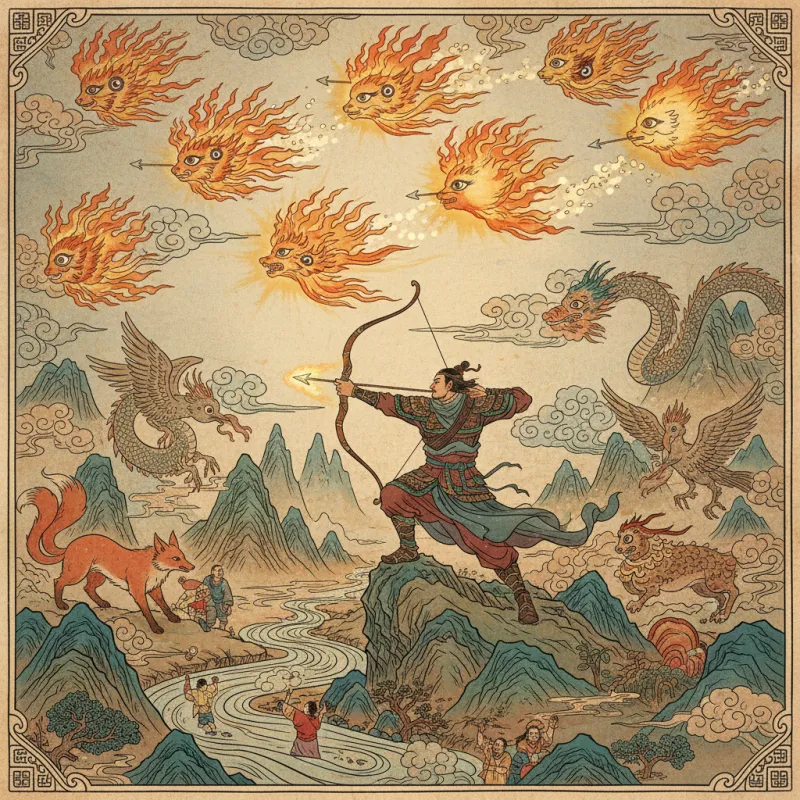
Ten suns blazed in the sky, turning rivers to dust and crops to ash. The people of ancient China cowered in their homes, watching their world burn. This wasn't a distant apocalypse or a metaphorical crisis—according to the Shanhaijing (山海经, Shānhǎi Jīng, Classic of Mountains and Seas), this was reality, and only one man could save humanity from extinction.
The Cosmic Crisis
The myth tells us that the Jade Emperor's ten sons, each embodying a sun, decided one fateful day to abandon their celestial schedule. Instead of taking turns illuminating the earth as they'd done since time immemorial, all ten rose together. The result was catastrophic. The Huainanzi (淮南子), compiled during the Western Han dynasty around 139 BCE, describes the devastation in visceral detail: forests spontaneously combusted, rivers evaporated before people's eyes, and the very rocks began to melt.
This wasn't just environmental disaster—it was cosmic rebellion. The ten suns, young and reckless, ignored their father's commands and the natural order that kept the universe balanced. Their defiance represents a theme that runs deep through Chinese mythology: the consequences when celestial beings forget their responsibilities to the mortal realm.
Enter Houyi: The Divine Archer
Houyi (后羿, Hòuyì) wasn't just any archer—he was a deity himself, sometimes described as a god of archery, other times as a skilled mortal elevated to divine status. The texts aren't entirely consistent, which actually makes him more interesting. What they all agree on: his bow was no ordinary weapon. Forged in the heavens, it could shoot arrows that pierced the fabric between the mortal and divine realms.
The Jade Emperor, desperate to save the earth and restore order, summoned Houyi. The mission was clear but nearly impossible: eliminate the threat without destroying his own sons. It's worth noting the political dimension here—Houyi was being asked to commit an act that would inevitably enrage the most powerful being in the cosmos. He accepted anyway.
The Impossible Shot
Picture Houyi standing on Mount Kunlun (昆仑山, Kūnlún Shān), the mythical axis mundi connecting heaven and earth. He drew his celestial bow, aimed at the first sun, and released. The arrow flew true, and one sun exploded in a shower of golden feathers and flames. A three-legged crow—the jinwu (金乌, jīnwū)—fell from the sky, dead.
Here's what makes this moment fascinating: each sun wasn't just a ball of fire but housed a divine crow, a creature that appears throughout Chinese mythology as a solar symbol. When Houyi shot down the suns, he was killing living beings, not just extinguishing lights. The myth forces us to confront an uncomfortable truth about heroism—sometimes saving the world requires terrible acts.
Houyi shot down eight more suns. Nine divine crows lay dead. The earth began to cool, and humanity emerged from their shelters, praising their savior. But Houyi had one arrow left and one sun remaining in the sky.
The Moment of Mercy
This is where the story gets psychologically complex. According to some versions, the Jade Emperor himself intervened, begging Houyi to spare his last son. Other versions claim Houyi's wife, Chang'e (嫦娥, Cháng'é), hid his final arrow, recognizing that total darkness would be as deadly as ten suns. The most compelling interpretation, found in later Tang dynasty retellings, suggests Houyi made the choice himself—a moment of mercy that would define his character and seal his fate.
He lowered his bow. One sun remained, and humanity was saved. But the cost was immediate and severe.
The Price of Heroism
The Jade Emperor's gratitude lasted exactly as long as it took him to count his dead sons. Nine. Houyi had killed nine divine princes. Grief and rage overwhelmed imperial gratitude, and the archer who saved the world was banished from heaven, stripped of his immortality, and cast down to live as a mortal among those he'd rescued.
This punishment reveals something crucial about the Chinese mythological worldview: even righteous actions have consequences when they disrupt the cosmic hierarchy. Houyi did exactly what he was asked to do, but that didn't protect him from the emotional aftermath of his choices. The myth doesn't present this as unjust—it simply is. The universe operates on principles that transcend simple notions of right and wrong.
Houyi's story intersects with other tragic figures in Chinese mythology, particularly Nüwa's creation and sacrifice, where divine beings pay terrible prices for saving humanity. Both myths explore the loneliness of being the one who must act when everyone else is paralyzed by fear.
Life After Divinity
Stripped of immortality, Houyi became obsessed with reclaiming what he'd lost. He sought the elixir of immortality from the Queen Mother of the West, Xiwangmu (西王母, Xīwángmǔ), who dwelt in the Kunlun Mountains. She gave him enough for two people to become immortal—or one person to become a god again.
But here's where the myth splinters into multiple endings, each revealing different anxieties about power, marriage, and sacrifice. In the most famous version, Chang'e discovered the elixir and, in a moment of panic or ambition (the texts disagree), drank it all. She floated to the moon, where she remains to this day, separated from her husband for eternity. The Mid-Autumn Festival celebrates her, not him—another layer of irony in Houyi's tragic tale.
Other versions paint Houyi's mortal life more darkly. Without divine purpose, he became a tyrant, a cautionary tale about heroes who outlive their heroic moments. Some texts claim he was eventually killed by his own apprentice, Fengmeng (逢蒙, Féngméng), who coveted his master's legendary bow. The archer who saved the world died from an arrow—poetic, brutal, and very Chinese in its circular tragedy.
The Archer's Legacy
Houyi's myth endures because it refuses easy answers. Was he a hero or a killer? A savior or a cosmic criminal? The answer is yes to all of it. He embodies the complexity of necessary violence, the loneliness of leadership, and the bitter truth that gratitude has a short memory.
His story appears in countless forms across Chinese literature, from the ancient Shanhaijing to modern novels and films. Each retelling emphasizes different aspects—some focus on his skill, others on his sacrifice, still others on his fall from grace. The myth's flexibility is its strength, allowing each generation to find new meaning in the archer's choice.
When you see depictions of Houyi in art, he's almost always shown at the moment of drawing his bow, frozen in that instant before the arrow flies. It's the perfect image: a man caught between duty and consequence, between the divine and the mortal, between saving the world and destroying his own future. That's the essence of heroism in Chinese mythology—not the triumph, but the terrible weight of the choice itself.
The next time you feel the sun's warmth on your face, remember: you're experiencing the mercy of an archer who chose to lower his bow, and the tragedy of a hero who paid for that mercy with everything he had.
Related Reading
- Kuafu Chases the Sun: The Giant Who Ran After Light
- Houyi the Archer: The Hero Who Shot Down Nine Suns
- The Shanhaijing's Heroes: Mortals Who Challenged Gods and Won (Mostly)
- Gun and Yu: Father and Son Who Tamed the Great Flood
- Da Yu Controls the Floods: Engineering Meets Mythology
- The Feathered People: Winged Humans of the Shanhai Jing
- Exploring the Enigmatic Creatures and Lands of the Shanhaijing
- Chinese Mythology in Hollywood: From Mulan to Shang-Chi — Shanhai Perspective