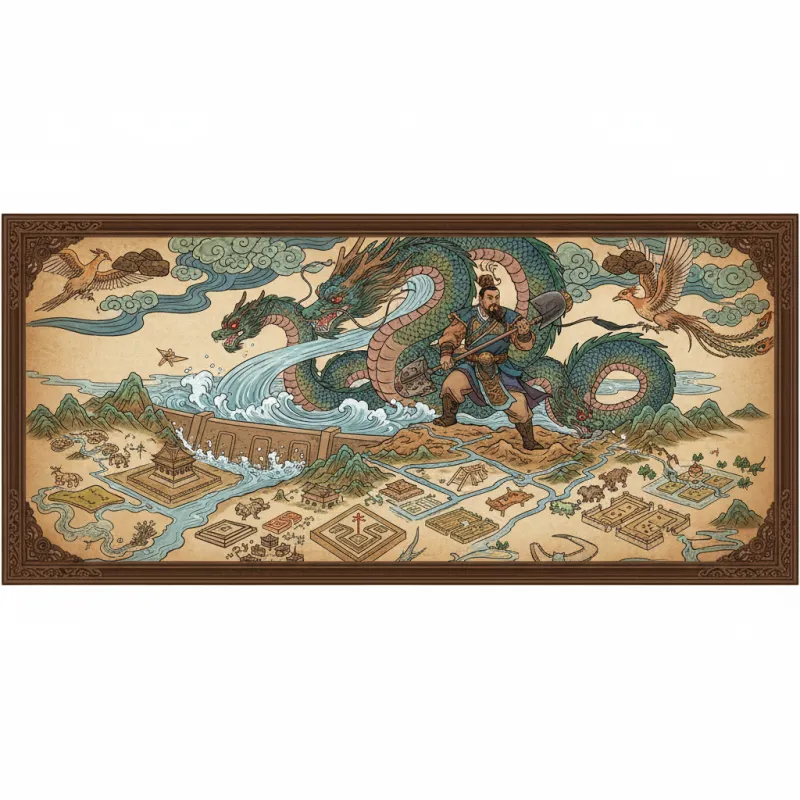
The Yellow River has killed more people than any war in Chinese history. For millennia, it earned the grim nickname "China's Sorrow," drowning entire provinces when it changed course, burying cities under silt, and leaving famine in its wake. But according to the Shanhai Jing (山海经, Shānhǎi Jīng) and other ancient texts, there was one man who looked at this untamable monster and said: I can fix this. His name was Da Yu (大禹, Dà Yǔ), and his story sits at the fascinating intersection where mythology becomes engineering manual.
The Flood That Wouldn't Stop
When Da Yu inherited the flood control project around 2200 BCE, the situation was already desperate. His father, Gun (鲧, Gǔn), had spent nine years trying to contain the floods using the traditional method: build walls, dam the water, force it to submit. The Shanhai Jing tells us Gun stole xirang (息壤, xīrǎng)—a magical self-expanding soil—from the heavenly emperor to build his dams. It didn't work. The floods kept coming, Gun was executed for his failure, and the waters continued to rise.
This wasn't just any flood. Ancient texts describe waters that covered mountains, separated heaven from earth, and persisted for generations. Whether this represents actual catastrophic flooding from the Yellow River, collective memory of post-Ice Age sea level rise, or pure mythology is still debated. What matters is that the Chinese imagination encoded a fundamental truth: water cannot be conquered by force alone.
The Engineer Who Listened to Water
Da Yu's genius was recognizing what his father couldn't: you don't fight water, you guide it. Instead of building higher walls, he dredged channels. Instead of blocking rivers, he deepened their beds. The Shiji (史记, Shǐjì), Sima Qian's historical records from the 1st century BCE, describes Da Yu personally surveying the land, measuring elevations, and mapping water flow patterns across the entire known world.
For thirteen years, Da Yu barely went home. The famous story claims he passed his own house three times and never entered—once hearing his wife in labor, once hearing his son crying, once hearing his son call for him. Each time he kept walking, surveying rod in hand. This detail, repeated across multiple sources, reveals something crucial about how ancient China viewed heroism: not as battlefield glory, but as relentless, unglamorous dedication to public works.
The Shanhai Jing adds mythological flourishes to his engineering feats. It describes how Da Yu commanded dragons to dredge riverbeds with their tails, how he split mountains with divine axes, how he received a jade measuring rod from a river deity. But strip away the magic and you're left with descriptions of actual hydraulic engineering: canal systems, drainage networks, and the principle of working with water's natural tendency to flow downward rather than trying to wall it in.
Mountains, Seas, and the Nine Provinces
Da Yu's flood control project became a geographical survey of the entire known world. The Shanhai Jing itself may have originated partly from records kept during this massive undertaking. Da Yu divided the land into nine provinces (九州, jiǔzhōu), established tribute systems, and created what might be China's first comprehensive geographical database.
This is where Da Yu's story connects directly to the broader mythology of the Shanhai Jing. As he traveled, he encountered the strange creatures and peoples catalogued in that text: the one-legged Kui (夔, Kuí) that helped him move mountains, the Fangfeng (防风, Fángfēng) giant he later executed for arriving late to a meeting, the various river deities and mountain spirits he had to negotiate with or subdue. Whether you read these as literal encounters or as metaphors for dealing with local tribes and natural obstacles, they paint Da Yu as someone who had to master not just engineering but diplomacy, ethnography, and what we'd now call project management on a continental scale.
The Shanhai Jing describes mountains he climbed, rivers he traced to their sources, and strange lands he mapped. Some scholars argue that Da Yu's journey represents early Chinese exploration and colonization, with "controlling the floods" serving as justification for extending political control over diverse regions. Others see it as a mythological framework for understanding China's complex geography and hydrology.
From Engineer to Emperor
Da Yu's success at controlling the floods earned him something unprecedented: the throne itself. Emperor Shun (舜, Shùn), impressed by Da Yu's achievements, abdicated in his favor around 2070 BCE, establishing the Xia Dynasty (夏朝, Xià Cháo)—China's first dynasty, though its historical existence remains debated. This transition from engineer to emperor encodes a powerful political philosophy: legitimate rule comes from serving the people's practical needs, not from divine right or military conquest alone.
The Shanhai Jing and related texts describe Da Yu's transformation during his labors. He walked so much his legs atrophied and he developed a distinctive limping gait called "the Yu step" (禹步, Yǔbù), which later became a ritual dance in Daoist ceremonies. His hands grew callused, his body darkened from sun exposure, and he lost the hair on his shins from constantly wading through water. These aren't the marks of a distant god-king but of someone who literally worked himself into a different physical form.
This bodily transformation matters. Unlike heroes in many mythological traditions who maintain their divine beauty and strength, Da Yu becomes less physically perfect as he becomes more heroic. His power comes from endurance, not from supernatural might. Even when the Shanhai Jing credits him with magical abilities—like transforming into a bear to move boulders—these powers serve practical engineering purposes rather than combat or conquest.
The Legacy in Stone and Story
Da Yu's flood control system supposedly lasted for generations, and his methods influenced Chinese hydraulic engineering for millennia. The Grand Canal, the Dujiangyan irrigation system, and countless other waterworks trace their philosophical lineage back to Da Yu's principle: work with water, not against it. Whether Da Yu was a real person, a composite of multiple engineers, or pure mythology, his story became the template for how China thought about managing its relationship with rivers.
The Shanhai Jing preserves fragments of this legacy in its geographical descriptions. When it mentions mountains Da Yu split, rivers he dredged, or channels he cut, it's creating a mythological map where every landscape feature tells a story about human effort to shape the natural world. This is fundamentally different from mythologies where landscapes are created by gods alone—here, the hero's engineering work literally reshapes geography.
Modern archaeology has found some intriguing correlations. Evidence of massive flooding in the Yellow River valley around 1920 BCE, sophisticated water control systems from the early Bronze Age, and the sudden emergence of more centralized political structures all roughly align with the Da Yu timeline. Whether this proves his existence or simply shows that the myth was built on real historical events remains contentious.
Engineering as Mythology, Mythology as Engineering
What makes Da Yu's story endlessly fascinating is how it refuses to separate the practical from the mythological. He uses both divine assistance and surveying equipment. He commands dragons and digs ditches. He receives magical tools from river spirits and develops innovative dredging techniques. The Shanhai Jing presents this as perfectly natural—of course controlling floods requires both engineering knowledge and negotiating with supernatural forces. The boundary between technology and magic simply doesn't exist in the same way it does in modern thinking.
This integration appears throughout the Shanhai Jing's treatment of geography and natural resources. When it describes mountains rich in jade or rivers full of strange fish, it's simultaneously cataloguing economic resources and mythological wonders. Da Yu's journey through this landscape models how to engage with a world that is both practically manageable and mysteriously alive with spirits and strange creatures.
Compare this to other flood heroes like Noah or Utnapishtim, who survive catastrophe by building arks and floating above the problem. Da Yu doesn't escape the flood—he gets down in the mud and fixes it. His heroism is fundamentally about labor, persistence, and technical skill rather than divine favor or moral righteousness. Even when gods help him, they're providing tools and information, not doing the work for him.
The Hero Who Couldn't Go Home
Return to that image of Da Yu passing his house three times without entering. It's become one of Chinese culture's most powerful symbols of dedication to public service over private life. But there's something almost tragic about it too. Da Yu saves everyone's home by abandoning his own. He becomes the father of a nation by neglecting his son. He masters the external world of rivers and mountains while losing touch with the internal world of family and rest.
The Shanhai Jing doesn't moralize about this choice—it simply records it, along with the strange creatures he met and the mountains he climbed. But the story has resonated for millennia precisely because it captures something true about the cost of great achievements. Da Yu's limping gait, his calloused hands, his sun-darkened skin—these are the physical manifestations of what he gave up to control the floods.
Later traditions tried to soften this. Some versions claim he did visit his family briefly, or that his wife understood and supported his mission. But the earliest texts are starker: thirteen years of walking past his own door, choosing the work over everything else. It's the kind of detail that's too strange, too uncomfortable to be purely invented. Whether it happened or not, someone thought this was what heroism looked like.
In the end, Da Yu's story in the Shanhai Jing and related texts offers a distinctly Chinese vision of heroism: not the warrior who conquers enemies, but the engineer who serves the people; not the god who commands nature, but the human who learns to work with it; not the king who inherits power, but the laborer who earns it through relentless, unglamorous dedication. The floods he controlled have long since returned—the Yellow River still floods, still changes course, still earns its grim nickname. But the story of the man who tried to tame it, armed with nothing but surveying equipment, determination, and perhaps a few helpful dragons, continues to flow through Chinese culture like water finding its course.
Related Reading
- Gun and Yu: Father and Son Who Tamed the Great Flood
- The Shanhaijing's Heroes: Mortals Who Challenged Gods and Won (Mostly)
- Kuafu Chases the Sun: The Giant Who Ran After Light
- Houyi Shoots the Suns: The Archer's Sacrifice
- Yi the Archer: The Man Who Shot Down Nine Suns
- Bifang: The Fire Bird That Brings Disaster
- Exploring the Enigmatic Seas of the Shanhaijing: Mythical Creatures and Realms
- Unraveling the Mysteries of Shanhaijing: Myths, Creatures, and Fantastic Realms