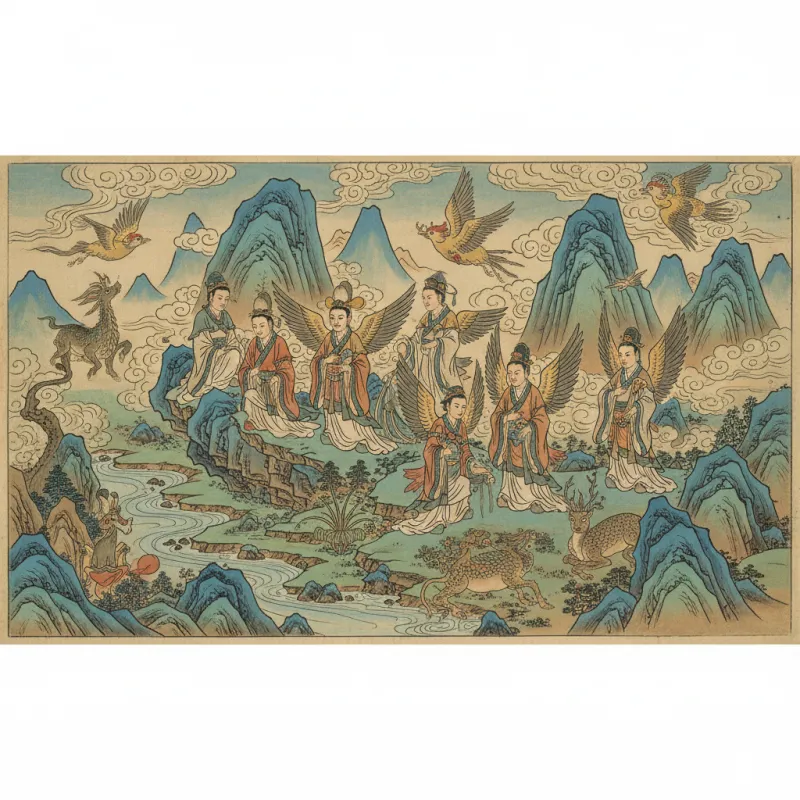
Picture a village perched on a mountain peak so high that clouds drift through its streets like fog. The inhabitants step off cliff edges without fear, their feather-covered arms spreading wide as they catch thermal updrafts and spiral into the sky. This isn't a scene from a fantasy novel — it's a description from one of China's oldest geographical texts, the Shanhaijing (山海经 Shānhǎi Jīng, Classic of Mountains and Seas), written over two thousand years ago. The Yuren (羽人 yǔrén), or Feathered People, weren't imagined as mythical creatures or divine beings. They were cataloged as an actual human population, as real to ancient Chinese geographers as any other distant tribe.
Not Angels, Not Birds — Something In Between
Here's what makes the Yuren genuinely fascinating: they occupy a unique space in the taxonomy of mythical beings. They're not gods descended from heaven. They're not shapeshifters who transform between human and bird forms. They're not spirits or demons. According to the Shanhaijing, they're people — fully human in mind and culture — who simply happen to have feathers instead of skin and wings instead of arms.
The text describes them with the same matter-of-fact tone it uses for any geographical feature: "The Country of the Feathered People is located in the southeast. Its people have human faces and bodies, but their bodies are covered in feathers, and they have wings." No explanation is offered for why they evolved this way. No origin myth explains their transformation. They simply exist, as naturally as the Changgu People exist with their elongated arms or the Junzi People exist with their exceptional virtue.
This casual acceptance is what separates ancient Chinese geographical texts from Western mythology. Greek myths give us Icarus, whose artificial wings melt when he flies too close to the sun — a cautionary tale about hubris. The Yuren need no such warning. They were born to fly.
Where the Feathered People Live
The Shanhaijing places the Yuren in multiple locations, which has led scholars to debate whether these represent different populations or simply confusion in the text's transmission over centuries. The most commonly cited location is in the far southeast, in a mountainous region beyond the known borders of ancient China. Some versions place them near the Eastern Sea, others in the southern wilderness.
What's consistent across descriptions is the elevation. The Yuren live in high places — mountain peaks, cliff faces, regions where the air is thin and the ground far below. This makes practical sense. Why would a flying people choose to live in valleys or plains? Their entire civilization would be oriented around verticality. Their architecture, their agriculture, their social structures — everything would be designed for beings who move through three dimensions rather than two.
I find myself wondering about the details the text doesn't provide. Do the Yuren build their homes on cliff faces, accessible only by flight? Do they farm on terraced mountainsides, tending crops while hovering in midair? When they gather for festivals or ceremonies, do they circle in the sky like flocks of birds, or do they perch in trees like humans sitting in chairs?
The Feather Question
The descriptions consistently mention that the Yuren's bodies are covered in feathers (羽 yǔ), but the texts are frustratingly vague about the specifics. Are these feathers like bird plumage — overlapping, aerodynamic, designed for flight? Or are they more like hair, a covering that happens to be feathered but serves primarily as protection from the elements?
The distinction matters because it tells us how the ancient Chinese imagined these beings. If the feathers are functional for flight, then the Yuren are essentially human-bird hybrids, their entire physiology adapted for aerial life. If the feathers are merely decorative or protective, then they're humans with an unusual skin condition who happen to also have wings — a less integrated transformation.
My reading of the texts suggests the former. The Shanhaijing doesn't waste words on decorative details. When it mentions feathers, it's describing a fundamental characteristic of the species, not an accessory. The Yuren are feathered the way birds are feathered — completely, necessarily, as part of their essential nature.
Flight as Culture
What would it mean to be human but capable of flight? Not just physically, but culturally? The Yuren force us to imagine an entire civilization built around an ability we lack.
Consider warfare. A flying people would have an overwhelming tactical advantage over ground-based enemies. They could attack from above, retreat to unreachable heights, and scout enemy positions from the sky. But they'd also be vulnerable in ways ground-dwellers aren't — storms would be deadly, and any injury that prevented flight would be catastrophic.
Consider courtship. Would the Yuren value aerial acrobatics the way humans value dance? Would young people compete to fly the highest, the fastest, the most gracefully? Would there be sky-based sports, games played in three dimensions that we can barely imagine?
Consider death. Would the Yuren bury their dead in the ground like earthbound humans, or would they practice sky burial, leaving bodies on high peaks for the wind and weather to claim? Would they see death as a return to the earth they left behind, or as a final flight into the heavens?
The Shanhaijing doesn't answer these questions. It simply notes that the Yuren exist and moves on to the next geographical feature. But the questions linger.
The Immortality Connection
Later Chinese texts complicate the simple picture of the Yuren as just another human population. By the Han Dynasty (206 BCE - 220 CE), the Feathered People had become associated with Daoist immortality practices. The term "yuren" began to refer not just to a distant tribe but to humans who had achieved transcendence through cultivation.
Daoist texts describe practitioners who, through meditation, breathing exercises, and alchemical practices, could transform their bodies — growing lighter, more ethereal, eventually sprouting feathers and gaining the ability to fly. The feathers became a symbol of spiritual achievement, a physical manifestation of having transcended ordinary human limitations.
This shift is significant. The Yuren went from being a geographical curiosity — strange people who live far away — to being an aspirational ideal. They represented what humans could become if they dedicated themselves to the right practices. Flight wasn't just a biological trait; it was a spiritual accomplishment.
I'm skeptical of this later interpretation. It feels like a retrofit, a way of incorporating the Shanhaijing's strange peoples into a philosophical framework that didn't exist when the text was written. The original Yuren weren't trying to achieve anything. They were simply living their lives, as naturally feathered and winged as we are naturally smooth-skinned and earthbound.
Why We Keep Returning to This Image
The Feathered People appear in Chinese art, literature, and folklore for over two thousand years after the Shanhaijing was compiled. They show up in Tang Dynasty poetry, Ming Dynasty paintings, and modern fantasy novels. The image of the winged human refuses to fade.
I think it's because the Yuren represent a very specific kind of freedom — not escape from the human condition, but enhancement of it. They're not gods who never knew limitation. They're not spirits who exist outside physical reality. They're people, with all the complexity and messiness that implies, who simply have one additional ability: they can fly.
That's the dream, isn't it? Not to stop being human, but to be human plus something more. To keep our minds, our relationships, our cultures, our identities — and also to step off a cliff and soar.
The Shanhaijing offers no moral lesson about the Yuren. It doesn't warn us that flight comes with a price, or that we should be content with our earthbound existence. It simply says: somewhere out there, in the mountains beyond the known world, there are people who can fly. They exist. They're real.
And for two thousand years, we've been looking up at the sky and wondering what that would feel like.
Related Reading
- Strange Nations of the Shanhai Jing: A Catalog of Impossible Peoples
- The Peoples of the Shanhaijing: Foreign Nations at the Edge of the World
- The Peoples of the Shanhaijing: One-Eyed Nations, Winged Tribes, and the Edges of Humanity
- Giants and Gods: The Titans of the Shanhai Jing
- Exploring the Enigmatic Mountains and Creatures of the Shanhaijing
- Discovering the Enigmatic Hybrid Creatures of Shanhaijing
- The Shanhaijing's Heroes: Mortals Who Challenged Gods and Won (Mostly)