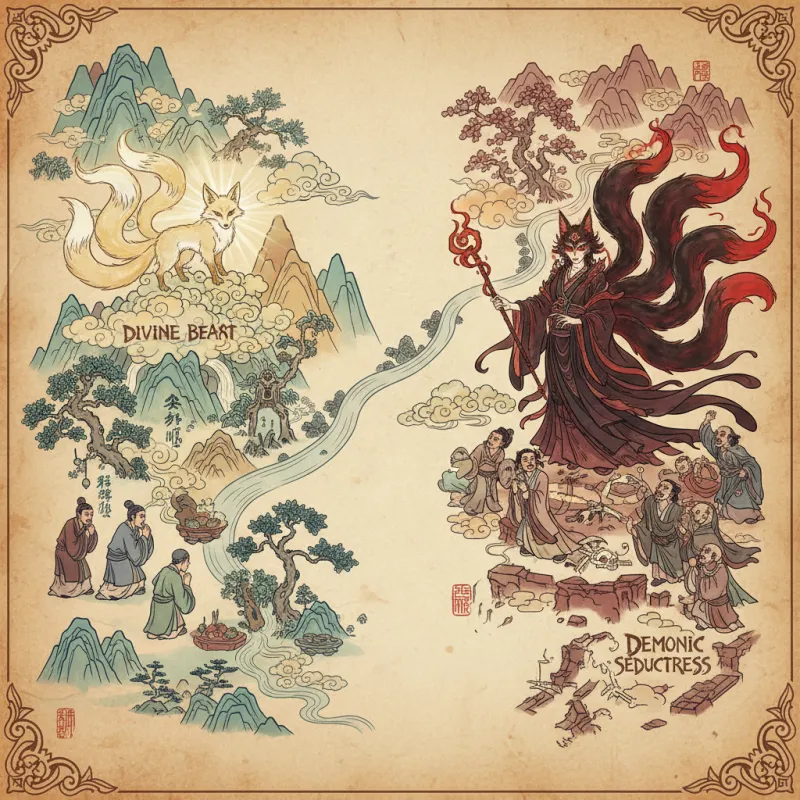
A white fox with nine flowing tails appears in the court of King Yu the Great. The officials don't panic — they bow. This creature, according to the earliest Chinese texts, signals that heaven approves of the ruler. Fast forward two thousand years, and that same nine-tailed fox is now Daji, the concubine who convinced a Shang Dynasty king to create a forest of flesh-hanging torture devices. Same creature, opposite meaning. What happened?
The Auspicious Beast of Ancient Texts
The Shanhaijing (山海经 Shānhǎi Jīng, Classic of Mountains and Seas) presents the Nine-Tailed Fox (九尾狐 jiǔwěihú) without a hint of menace. In the "Nanshan Jing" (南山经, Classic of the Southern Mountains), it appears on Qingqiu Mountain, described matter-of-factly: a fox with nine tails whose cry resembles a baby's wail. The text adds a crucial detail — eating its flesh protects against poisonous insects.
This isn't a monster. It's medicine.
The "Haiwai Dong Jing" (海外东经, Classic of Regions Beyond the Eastern Seas) places the Nine-Tailed Fox in the land of Qingqiu, where it lives among the people who worship it. During the Han Dynasty (206 BCE - 220 CE), scholars interpreted these passages as omens of dynastic legitimacy. The Baihu Tongyi (白虎通义), a Han text systematizing imperial ideology, explicitly states that the Nine-Tailed Fox appears when a sage rules with perfect virtue. Its nine tails represented the nine provinces of China unified under righteous governance.
The Guideways Through Mountains and Seas wasn't describing a threat — it was describing a blessing that rulers desperately wanted to see.
When Politics Needed a Scapegoat
The transformation begins during the Northern and Southern Dynasties period (420-589 CE), when political instability demanded explanations. Dynasties rose and fell with alarming speed. Confucian historians, tasked with explaining why legitimate rulers lost the Mandate of Heaven, needed villains who weren't the emperors themselves.
Enter the seductive fox spirit.
The story of Daji (妲己 Dájǐ) crystallizes this shift. In the Shiji (史记, Records of the Grand Historian) written around 94 BCE, Daji is simply a beautiful woman who encourages King Zhou's cruelty. She's human, and she's terrible, but she's not supernatural. By the time the Fengshen Yanyi (封神演义, Investiture of the Gods) was written in the 16th century Ming Dynasty, Daji has become a thousand-year-old fox spirit sent by the goddess Nüwa to destroy the Shang Dynasty. The fox didn't just influence the king — it possessed Daji's corpse and wore her body like a costume.
This narrative pattern repeats across Chinese history. Whenever a dynasty falls, historians look for the beautiful woman who "confused" the emperor, and increasingly, that woman is revealed to be a fox spirit in disguise. The Tang Dynasty (618-907 CE) produced numerous tales of fox spirits seducing scholars and officials, collected in texts like the Youyang Zazu (酉阳杂俎). These weren't auspicious beasts anymore — they were explicitly demonic.
The Mechanics of Fox Transformation
Chinese folklore developed elaborate rules for how foxes became supernatural. A fox that lived fifty years could transform into a beautiful woman. At one hundred years, it could become a young man or a shaman with prophetic powers. At one thousand years, it became a celestial fox (天狐 tiānhú), capable of communicating with heaven itself.
The transformation required absorbing essence — either from the moon (foxes were said to bow to the moon to absorb its yin energy) or from humans through sexual intercourse. This detail is crucial: it reframes female sexuality as literally vampiric. The fox spirit doesn't just seduce men; it drains their life force, leaving them as withered husks. The Dragon might demand virgin sacrifices, but at least it was honest about it.
Medieval Chinese texts obsess over the signs that reveal a fox spirit's true nature. She casts no shadow at noon. She can't pronounce certain Buddhist sutras. Her reflection in a mirror shows fox ears. She fears dogs, which can see through her disguise. These "tells" gave men a framework for suspecting any woman who seemed too beautiful, too intelligent, or too sexually confident.
The Gender Politics of Fox Mythology
Here's what's rarely discussed: male fox spirits exist in Chinese folklore, but they're fundamentally different. The male fox spirit typically appears as a scholar or official, and his stories focus on trickery and social climbing rather than seduction. He might cheat on the imperial examinations or swindle merchants, but he doesn't destroy dynasties.
Female fox spirits, by contrast, are almost always defined by their sexuality. They seduce, they drain, they destroy through desire. This gendered split reveals the anxiety at the heart of fox mythology: the fear that female sexuality, if not controlled by Confucian family structures, will undermine the entire social order.
The Qing Dynasty (1644-1912) text Liaozhai Zhiyi (聊斋志异, Strange Tales from a Chinese Studio) by Pu Songling complicates this picture. Many of his fox spirit stories feature sympathetic, even heroic fox women who help scholars pass exams or escape danger. But even Pu Songling's progressive fox spirits are defined by their relationships with men — they exist to serve, save, or test male protagonists. The Phoenix might symbolize feminine power, but it does so as an empress, within acceptable hierarchies. The fox spirit represents feminine power outside those structures, which is precisely why it had to be demonized.
Regional Variations and Cultural Export
The Nine-Tailed Fox mythology didn't stay in China. It migrated to Korea, where it became the kumiho (구미호), and to Japan, where it became the kyūbi no kitsune (九尾の狐). Each culture adapted the mythology to its own anxieties.
Korean kumiho stories are uniformly dark — the kumiho must eat human livers to survive, and it can never truly become human, no matter how long it lives. There's a tragic dimension to Korean fox tales; the kumiho often wants to become human and live a normal life, but its nature makes this impossible. The most famous kumiho story involves a fox who falls in love with a human man and tries desperately to suppress her need to eat his liver.
Japanese kitsune mythology is more diverse. While the nine-tailed fox appears as a villain in stories like the Tamamo-no-Mae legend (where a fox spirit nearly destroys the imperial court), Japanese folklore also includes benevolent fox spirits who serve the Inari deity and bring prosperity to households. The Japanese tradition preserved some of the original auspicious associations that Chinese culture had largely abandoned.
The Modern Rehabilitation
Contemporary Chinese, Korean, and Japanese popular culture has embraced the Nine-Tailed Fox with enthusiasm, but often with a revisionist twist. Video games, anime, and web novels frequently feature fox spirits as protagonists rather than antagonists. These modern fox spirits are powerful, independent, and morally complex — more antihero than villain.
The 2020 Korean drama "Tale of the Nine-Tailed" reimagines the kumiho as a guardian deity who protects humans from evil spirits. Chinese web novels like "The Demonic King Chases His Wife" feature fox spirit heroines who are clever, powerful, and unapologetically sexual without being evil. This represents a significant cultural shift: reclaiming the fox spirit from its role as a cautionary tale about dangerous women.
Yet even in these modern retellings, the fox spirit remains defined by transformation and deception. She's still the shapeshifter, still the one whose true nature must be hidden or revealed. The mythology has been inverted — the fox is now the hero — but the underlying framework remains. We're still telling stories about women whose power comes from their ability to transform, to be something other than what they appear.
What the Fox Reveals
The Nine-Tailed Fox's journey from divine omen to demonic seductress isn't really about foxes. It's about how societies project their anxieties onto mythology, and how those mythologies in turn shape social attitudes. When the Han Dynasty needed symbols of legitimate rule, the Nine-Tailed Fox was auspicious. When later dynasties needed explanations for political failure that didn't implicate the emperors themselves, the Nine-Tailed Fox became a seductress who corrupted rulers.
The fox spirit mythology provided a vocabulary for discussing female power, sexuality, and social transgression without directly addressing those topics. It's no coincidence that fox spirit stories proliferated during periods of social change, when traditional gender roles were being questioned or renegotiated.
Today, as East Asian popular culture reimagines the Nine-Tailed Fox as a protagonist, we're witnessing another transformation — one that reflects contemporary attitudes about female agency and power. The fox is still changing its story, because we're still changing ours. And perhaps that's the most fox-like thing about this mythology: its ability to transform, adapt, and survive across millennia, always reflecting the culture that tells its tale.
Related Reading
- The Four Guardian Beasts: Azure Dragon, White Tiger, Vermilion Bird, Black Tortoise
- Half-Human Half-Beast: The Strangest Creatures of Shanhaijing
- Hybrid Beings of the Shanhaijing: When Animals Merge
- Human-Animal Hybrids in the Shanhai Jing: Gods with Beast Features
- Mystical Fish of Shanhaijing: Exploring Legendary Creatures and Enchanted Waters
- Exploring the Enigmatic Seas of the Shanhaijing: Mythical Creatures and Realms
- The Mountain Gods of Ancient China