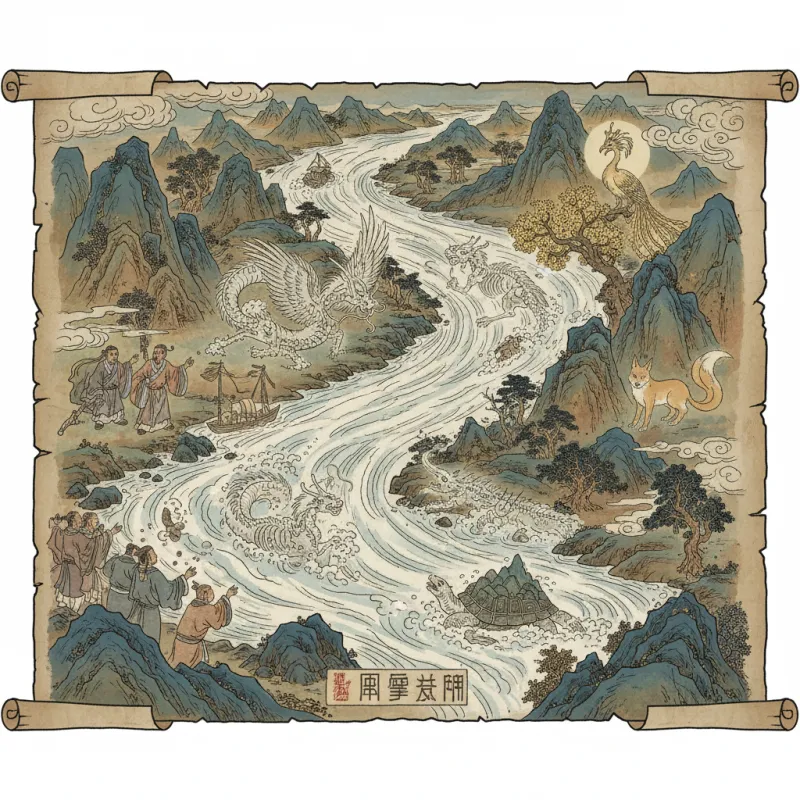
Picture a river so strange that even a feather sinks like stone. No boat floats on its surface. No swimmer reaches the far shore. No bridge can span its width. This is Weak Water—弱水 (ruò shuǐ)—the most paradoxical waterway in Chinese mythology, a river that exists not to connect, but to divide.
The Impossible Physics of Weak Water
The Shanhai Jing describes Weak Water with an almost scientific precision that makes its impossibility all the more haunting. This isn't just deep water or fast water—it's water that fundamentally rejects buoyancy itself. Ancient texts claim that even the lightest goose feather, dropped onto its surface, would plummet straight to the bottom. The Tang Dynasty poet Li Bai referenced this property in his work, using Weak Water as a metaphor for insurmountable obstacles between lovers.
What makes Weak Water "weak" is precisely what makes it unconquerable. The name itself is a paradox—the water is called weak not because it lacks power, but because it lacks the normal properties that make water useful to humans. It cannot bear weight. It cannot sustain life. It cannot be crossed, contained, or controlled. In this sense, Weak Water represents nature at its most alien, a substance that looks familiar but operates by entirely different rules.
Geographic Locations in the Classic
The Shanhai Jing places Weak Water in multiple locations, suggesting it's less a single river and more a recurring phenomenon at the edges of the known world. The most famous location is in the far west, flowing around the mythical Kunlun Mountains, home to the Queen Mother of the West. Here, Weak Water serves as the ultimate moat, protecting the divine realm from mortal intrusion more effectively than any wall or army.
Another account places Weak Water three thousand li north of the Yan Mountains, in territories so remote that even the text's compilers could only speculate about them. The number three thousand appears repeatedly in descriptions of Weak Water—three thousand li wide, three thousand zhang deep—numbers that in ancient Chinese literature often mean "immeasurably vast" rather than literal measurements. This mathematical hyperbole reinforces the river's role as an absolute boundary.
Some scholars argue that Weak Water might have originated from travelers' accounts of salt lakes or quicksand, natural phenomena that could swallow objects and people without the appearance of normal water. The Lop Nur region in Xinjiang, known for its treacherous salt flats, has been proposed as one possible inspiration. But this rational explanation somehow diminishes the mythological power of the concept—Weak Water works precisely because it shouldn't exist.
The River as Cosmic Boundary
Weak Water functions as more than geography; it's a metaphysical border between realms. In Buddhist texts that later incorporated Chinese mythological elements, Weak Water surrounds Mount Sumeru, the cosmic mountain at the center of the universe. This placement transforms the river from a terrestrial feature into a fundamental structure of reality itself.
The Journey to the West, written by Wu Cheng'en during the Ming Dynasty, features Weak Water as one of the obstacles the monk Xuanzang and his disciples must overcome. In Chapter 22, they encounter a river eight hundred li wide where "a goose feather cannot float." Sun Wukong, the Monkey King who can somersault through clouds and battle celestial armies, finds himself powerless against this water. They can only cross by finding a ferryman who knows the secret—suggesting that Weak Water yields not to strength but to knowledge and proper ritual.
This episode reveals something crucial about how Weak Water functions in Chinese cosmology. It's not merely a physical barrier but a test of worthiness and wisdom. The Queen Mother of the West doesn't need guards when Weak Water surrounds her palace—the river itself judges who may approach.
Weak Water in Daoist Philosophy
Daoist texts adopted Weak Water as a symbol for the paradoxical nature of the Dao itself. The Daodejing famously states that "the softest things in the world overcome the hardest," and Weak Water embodies this principle taken to its extreme. Water that cannot bear weight is the ultimate expression of softness, yet it creates an absolute barrier that no amount of hardness can breach.
The Zhuangzi mentions Weak Water in discussions about the relativity of values and the limits of human understanding. What appears weak may be strong; what appears passable may be impassable. The river becomes a meditation on how our assumptions about the natural world can blind us to its true nature. A Daoist sage, the text suggests, would not try to cross Weak Water but would instead question why crossing is necessary.
This philosophical dimension explains why Weak Water persists in Chinese literature long after the Shanhai Jing. It's not just a mythological curiosity but a concept that captures something essential about limits, boundaries, and the relationship between human will and natural law.
Literary Evolution and Modern Interpretations
By the Tang and Song dynasties, "weak water" had become a standard literary reference, often appearing in poetry about separation and longing. The phrase "三千弱水" (sān qiān ruò shuǐ—three thousand [li of] weak water) became shorthand for insurmountable distance between lovers. The poet Liu Yuxi wrote of weak water separating the mortal world from the realm of immortals, a barrier that even the most devoted could not cross.
In the famous Qing Dynasty novel Dream of the Red Chamber, the protagonist Jia Baoyu is said to have been born from a stone left over from when the goddess Nüwa repaired the sky—a stone that fell near Weak Water. This origin story links him to the liminal spaces of mythology, suggesting he belongs neither fully to the mortal world nor to the divine realm.
Contemporary Chinese fantasy literature has revived Weak Water as a plot device, often depicting it as a magical substance that can be weaponized or overcome through cultivation of spiritual power. These modern interpretations sometimes miss the point—Weak Water's power lies precisely in its absolute nature, its refusal to be conquered or controlled. When it becomes just another obstacle for a protagonist to overcome, it loses its philosophical weight.
The Enduring Mystery
What makes Weak Water compelling across millennia is its resistance to explanation. Unlike other mythological elements that can be rationalized or historicized, Weak Water remains stubbornly impossible. It's water that isn't water, a river that cannot be crossed, a boundary that exists not in space but in the nature of reality itself.
The Shanhai Jing never explains why Weak Water exists or what purpose it serves beyond being uncrossable. This absence of explanation is itself significant. Not everything in the cosmos exists for human benefit or understanding. Some boundaries are meant to remain boundaries. Some mysteries are meant to stay mysterious.
In our age of engineering marvels and technological solutions, Weak Water reminds us that some limits are fundamental rather than technical. You cannot build a bridge across it because the problem isn't engineering—it's ontological. The river exists to teach us that not every barrier is meant to be overcome, and that wisdom sometimes means accepting rather than conquering.
Related Reading
- The Four Seas and the Shape of the Ancient Chinese World
- The Fusang Tree: Where Ten Suns Rest
- The Geography of the Shanhaijing: Mapping a World That Does Not Exist
- Kunlun Mountain: The Paradise of Immortals
- The Most Dangerous Lands in the Shanhai Jing
- Exploring the Myths of Serpents in the Shanhaijing: Creatures of Power and Mystery
- The Fusang Tree: Where the Suns Rise and the World Begins — Shanhai Perspective
- Unraveling the Mysteries of Shanhaijing: Myths, Creatures, and Fantastic Realms