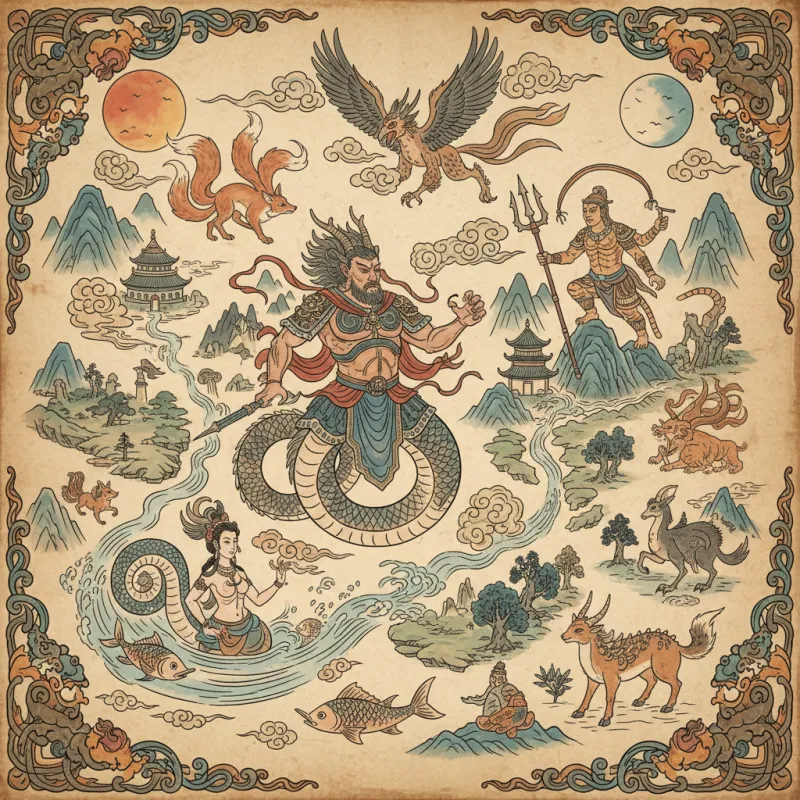
I keep a running list of the weirdest creatures in the Shanhaijing. It's long. It keeps getting longer. Every time I reread the text, I find something I missed — some three-tailed fox or six-legged bird or fish with human hands that I somehow overlooked the last time through.
But the creatures that haunt me most aren't the ones with extra limbs or impossible anatomies. They're the hybrids. The beings that are half-human, half-something-else. Because unlike the purely fantastical monsters, these creatures occupy an uncomfortable middle ground that forces you to ask: where does humanity end and monstrosity begin?
The Shanhaijing (山海经, Shān Hǎi Jīng) — the Classic of Mountains and Seas — contains descriptions of over 550 distinct creatures. Many are ordinary animals described in unfamiliar terms. Some are clearly mythological. And a significant number are hybrids — beings that combine human and animal features in ways that range from beautiful to horrifying. These aren't random assemblages of body parts. They follow patterns. And those patterns reveal something important about how ancient Chinese culture understood the boundaries between civilization and wilderness, between the human and the divine.
The Geography of Transformation
The Shanhaijing organizes its creatures geographically, and that geography matters. The hybrids aren't evenly distributed across the text. They cluster in specific regions, particularly in the distant mountains and the far seas — the edges of the known world where the rules of nature supposedly break down.
In the Western Mountains, you find the Kaiming Beast (开明兽, Kāimíng Shòu), which guards the gates of heaven. It has nine human heads on a tiger's body. Nine faces, all watching in different directions, all presumably capable of speech and thought. The text doesn't tell us if these heads have individual personalities or share a single consciousness, but the image is unsettling either way.
Move to the Eastern Sea, and you encounter the Lingyu (陵鱼, Língyú) — a fish with a human face and hands, and the legs of a snake. It lives in the water but has human appendages that serve no obvious aquatic purpose. What does a fish do with hands? The text doesn't say. It simply records the creature's existence and moves on.
This geographical distribution isn't accidental. The farther you travel from the Central Plains — the heartland of Chinese civilization — the more the boundaries between categories dissolve. Distance from the center equals distance from order. And in that disorder, humans and animals merge.
Faces That Shouldn't Speak
The most common hybrid feature in the Shanhaijing is the human face. Not human bodies with animal heads — that's relatively rare. But animal bodies with human faces. Fish with human faces. Birds with human faces. Snakes with human faces. Even insects with human faces.
The Renmianniao (人面鸟, Rénmiànniǎo) appears multiple times in different regions. It's a bird with a human face, and the text sometimes specifies that it can speak human language. But what would a bird with human intelligence say? Would it still think like a bird, concerned with seeds and nests and migration? Or would the human face bring human consciousness with it?
The Renmianyu (人面鱼, Rénmiànyú) — human-faced fish — appear in several bodies of water throughout the text. Some have four legs in addition to their fish bodies. Some have wings. The variations suggest these aren't descriptions of a single species but rather a category of being: fish that have crossed some threshold into human-adjacent existence.
What disturbs me about these creatures is the implication that a human face equals human awareness. If you give something a human face, you give it the capacity to look back at you, to recognize you, to judge you. These aren't animals you can hunt without moral consequence. They're something else.
The Divine Hybrids
Not all hybrids in the Shanhaijing are monsters. Some are gods.
Xiwangmu (西王母, Xīwángmǔ), the Queen Mother of the West, appears in the text with a human form but the teeth of a tiger and the tail of a leopard. She's one of the most important deities in Chinese mythology, and her hybrid nature isn't a curse — it's a mark of her divine status. She exists beyond human categories because she's more than human, not less.
The same pattern appears with Yanzi (奢比尸, Shēbǐshī), a deity described as having a human face and a beast's body, with ears like a dog. He's a god of the western regions, and his hybrid form signals his role as a mediator between the human and natural worlds.
This creates an interesting hierarchy. At the bottom, you have pure animals — creatures that exist entirely within the natural order. In the middle, you have the disturbing hybrids — beings that combine human and animal features in ways that violate category boundaries. And at the top, you have the divine hybrids — beings whose mixed nature reflects their transcendence of ordinary categories.
The difference isn't in the physical form. It's in the power and purpose. A fish with a human face is a monster. A god with a beast's body is divine. The same hybrid anatomy can signify degradation or elevation depending on context.
Patterns of Combination
After cataloging dozens of these creatures, patterns emerge. The Shanhaijing doesn't combine human and animal features randomly. Certain combinations appear repeatedly, and certain combinations never appear at all.
Human faces on animal bodies: extremely common. Animal heads on human bodies: rare. Human hands and arms: occasional. Human legs and feet: very rare. The text seems to privilege the face as the seat of humanity. You can have a human face on a fish body and still be recognizably human-adjacent. But a fish head on a human body would just be a fish.
The choice of animal matters too. Tigers, snakes, birds, and fish are the most common animal components. These aren't arbitrary choices. Tigers represent power and ferocity. Snakes represent transformation and danger. Birds represent freedom and transcendence. Fish represent the alien world beneath the water's surface. Each animal brings specific symbolic associations to the hybrid.
You rarely see hybrids involving domestic animals. No human-faced pigs. No human-faced chickens. The hybrids draw from wild animals — creatures that exist outside human control. This reinforces the idea that these beings represent the breakdown of civilized order.
The Mechanics of Monstrosity
The Shanhaijing rarely explains how these hybrids came to exist. It simply describes them as inhabitants of specific regions, as if they're natural species rather than the results of transformation or divine intervention.
But other Chinese texts fill in the gaps. The Huainanzi (淮南子, Huáinánzǐ) suggests that hybrids can result from violations of natural law — when humans or animals cross boundaries they shouldn't cross. The Soushenji (搜神记, Sōushénjì) contains stories of humans transformed into animals or animals transformed into humans, usually as punishment or reward.
The Shanhaijing's silence on origins is significant. By presenting these creatures as simply existing, the text treats them as part of the natural order — strange, yes, but not supernatural. They're not the results of curses or divine intervention. They're just what lives in the mountains and seas beyond the borders of civilization.
This matter-of-fact tone makes the creatures more unsettling, not less. If these beings are natural, then nature itself is far stranger and more permeable than we assume. The boundaries between species aren't fixed. Humanity isn't a stable category. Under the right conditions — or in the right places — those boundaries dissolve.
The Human-Beast Continuum
What the Shanhaijing's hybrids reveal is that ancient Chinese thought didn't draw a sharp line between humans and animals. Instead, it imagined a continuum. At one end, you have fully human beings — civilized, rational, living in cities and following social norms. At the other end, you have pure animals — instinctive, wild, living according to nature.
But between these poles, there's a vast middle ground. And that middle ground is populated by beings that combine human and animal features in various proportions. Some are mostly human with a few animal traits. Some are mostly animal with a few human traits. Some are so thoroughly mixed that you can't say which category dominates.
This continuum appears in other aspects of Chinese culture too. The concept of the divine beings in Chinese mythology often involves figures who transcend human limitations by incorporating animal powers. And the transformation myths throughout Chinese literature frequently involve characters moving along this continuum — becoming more animal or more human depending on their moral choices and spiritual cultivation.
The Shanhaijing's hybrids aren't aberrations. They're evidence of a worldview that saw humanity as one point on a spectrum rather than a separate category. You could move along that spectrum. You could combine elements from different points. The boundaries were real but permeable.
Why These Creatures Still Matter
I started keeping my list of Shanhaijing creatures as an academic exercise. I wanted to catalog the text's contents systematically, to understand its structure and patterns. But the more I worked with these hybrids, the more I realized they're not just historical curiosities.
These creatures ask questions we're still grappling with. What makes someone human? Is it physical form? Consciousness? Language? Social behavior? If we could give animals human-level intelligence, would they become human? If we could modify human bodies with animal features, would we stop being human?
Modern biotechnology is making these questions practical rather than theoretical. We're creating chimeras — organisms that combine genetic material from different species. We're developing brain-computer interfaces that blur the line between biological and artificial intelligence. We're editing genes and growing organs and pushing the boundaries of what human means.
The Shanhaijing's hybrids remind us that these aren't new questions. Humans have always wondered about the boundaries of humanity. We've always imagined beings that exist in the liminal spaces between categories. And we've always been both fascinated and disturbed by those imaginings.
The difference is that now we might actually create them.
Reading the Hybrids
When you read the Shanhaijing's descriptions of hybrid creatures, it's tempting to dismiss them as primitive superstition or creative fantasy. But that misses the point. These creatures aren't failed attempts at zoology. They're philosophical thought experiments encoded in mythological form.
Each hybrid asks: what happens when you combine these specific features? What does it mean to have a human face on a fish body? What does it mean to have tiger teeth in a goddess's mouth? The text doesn't answer these questions explicitly. It presents the creatures and lets readers draw their own conclusions.
That's why I keep adding to my list. Not because I think I'll eventually catalog every creature in the text — though that would be satisfying — but because each creature offers a new variation on the central question: where are the boundaries, and what happens when you cross them?
The Shanhaijing doesn't give us answers. It gives us a bestiary of possibilities. And in a world where we're increasingly able to reshape the boundaries of species and consciousness, those possibilities feel less like ancient mythology and more like a preview of futures we might actually face.
My list keeps getting longer. The questions keep getting harder. And the creatures keep staring back at me with their human faces, waiting to see what we'll become.
Related Reading
- The Four Guardian Beasts: Azure Dragon, White Tiger, Vermilion Bird, Black Tortoise
- The Nine-Tailed Fox: From Divine Beast to Demonic Seductress
- Hybrid Beings of the Shanhaijing: When Animals Merge
- Human-Animal Hybrids in the Shanhai Jing: Gods with Beast Features
- Exploring the Enigmatic Mountains and Creatures of the Shanhaijing
- The Geography of the Shanhaijing: Mapping a World That Does Not Exist
- Exploring the Enigmatic Creatures and Lands of Shanhaijing: A Cultural Journey