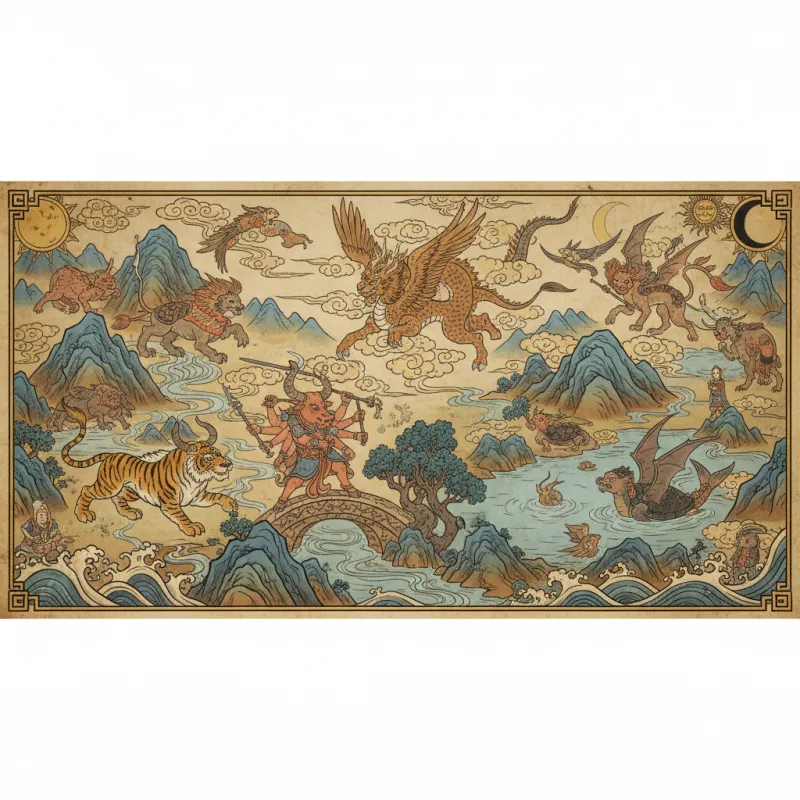
A nine-tailed fox prowls through the pages of the Shanhaijing (山海经 Shānhǎi Jīng, Classic of Mountains and Seas), its multiple tails swaying like flames. Nearby, a bird with a human face sings prophecies. A fish sprouts wings and takes flight. These aren't the fever dreams of an ancient scribe gone mad — they're deliberate constructions, each hybrid form encoding specific meanings about power, danger, and cosmic balance. The Shanhaijing's menagerie of merged beings operates on a logic we've largely forgotten, one where a snake's tail on a bird isn't absurd but inevitable.
The Grammar of Hybridity
The hybrid creatures of the Shanhaijing follow rules as strict as any language. You can't just slap random body parts together and call it a day. Each combination speaks to the creature's essential nature, its role in the cosmic ecosystem, and often its relationship to human affairs.
Take the basic formula: animal A with body part from animal B. The base animal provides the fundamental nature — its habitat, its behavior patterns, its elemental associations. The added parts modify and enhance these qualities, often in predictable ways. A bird gains a snake's tail and suddenly it's associated with transformation and danger. A fish grows human hands and becomes a bridge between aquatic and terrestrial realms, between animal and human consciousness.
The Shanhaijing catalogs over 400 creatures, and roughly half are hybrids. This isn't creative excess — it's systematic classification. The text uses hybridity as a taxonomic tool, a way to position creatures within a complex web of correspondences linking animals, elements, directions, colors, and cosmic forces. When you read that a creature has "the body of a deer, the tail of a snake, and the head of a bird," you're not getting a random description. You're getting coordinates in a multidimensional map of reality.
Tails Tell Tales
Tails are the most common hybrid element in the Shanhaijing, and they're rarely decorative. A snake's tail (蛇尾 shé wěi) appears on dozens of creatures, from birds to mammals to fish. This addition consistently signals danger, transformation, or connection to yin forces. The snake, in Chinese cosmology, embodies change — it sheds its skin, moves without legs, bridges earth and water. Attach a snake's tail to any creature and you're marking it as liminal, dangerous, capable of metamorphosis.
The nine-tailed fox (九尾狐 jiǔwěi hú) takes this logic to its extreme. Multiple tails don't just mean "more dangerous" — they indicate accumulated power, longevity, and the ability to shift between forms. The Shanhaijing describes the nine-tailed fox as an auspicious omen, though later texts would transform it into a seductress and destroyer of dynasties. But even in its earliest appearance, those nine tails mark it as a creature that has transcended normal animal limitations, accumulating centuries of qi (气 qì, vital energy) until it can manipulate reality itself.
Fish with bird tails appear frequently, and the logic is elegant: a fish that can fly, or a bird that can swim. The hybrid form predicts hybrid behavior, hybrid habitat. These aren't mistakes or fantasies — they're thought experiments about what happens when you combine the qualities of different animals, different elements, different cosmic forces.
Heads and Faces: The Seat of Consciousness
When the Shanhaijing gives a creature a human face (人面 rén miàn), it's making a specific claim about that creature's consciousness and its relationship to humanity. The Yingyu (嬴鱼 Yíngyú), a fish with a human face, appears in the text as a creature that can speak and predict droughts. The human face isn't decorative — it marks the creature as possessing human-level intelligence, the ability to communicate, to know things beyond animal instinct.
Birds with human faces populate the text, and they're almost always oracular. The Qinyuan (钦原 Qīnyuán), described as a bird with a human face that appears before great droughts, functions as a living warning system. The human face signals that this creature exists at the intersection of animal and human worlds, capable of understanding and communicating cosmic patterns that affect human affairs.
Multiple heads take this further. The Feiyi (飞翼 Fēiyì), a snake with six heads, doesn't just have enhanced perception — it has multiplied consciousness, the ability to perceive in multiple directions simultaneously, to process information beyond normal animal capacity. In Chinese numerology, six is associated with heaven and cosmic order. Six heads mean this creature operates on a cosmic scale, its consciousness expanded beyond individual animal awareness.
Wings on the Wrong Creatures
The Shanhaijing loves putting wings on things that shouldn't fly. Fish with wings. Snakes with wings. Tigers with wings. This isn't whimsy — it's a systematic exploration of transcendence, of creatures that break the boundaries of their natural limitations.
The Feiyu (飞鱼 Fēiyú), a fish with bird wings, appears in the text as a creature whose appearance predicts great droughts. The logic: a fish that can fly has escaped its aquatic prison, suggesting water's absence or displacement. The hybrid form encodes environmental information, making the creature itself a living omen.
Winged snakes appear throughout the text, and they're consistently associated with transformation and danger. The snake already embodies change through its ability to shed skin and move between realms. Add wings and you've created a creature that can transcend even those boundaries, moving freely through all three realms — earth, water, and air. The winged serpents of the Shanhaijing aren't dragons yet, but they're moving in that direction, accumulating the attributes that will eventually crystallize into the dragon form.
The Tiger-Stripe Code
Tiger stripes (虎纹 hǔ wén) appear on creatures throughout the Shanhaijing, and they function as a kind of cosmic warning label. The tiger in Chinese cosmology is the king of beasts, associated with military power, autumn, the west, and the element of metal. Tiger stripes on any creature mark it as dangerous, powerful, and often connected to military affairs or violent transformation.
The Lushu (驴鼠 Lǘshǔ), described as having the body of a horse with tiger stripes, appears in regions associated with warfare and chaos. The stripes aren't just visual description — they're information about the creature's nature and the nature of the region it inhabits. A horse with tiger stripes is a war horse, a creature of violence and power, marking its territory as a place of conflict.
The Qiongqi (穷奇 Qióngqí), one of the Four Perils, sports tiger stripes along with wings and a hedgehog's spines. Each element adds to its nature: the tiger stripes signal danger and power, the wings indicate transcendence of normal boundaries, the spines suggest defense and aggression. The hybrid form is a complete dossier on the creature's capabilities and cosmic role.
Numbers and Multiplication
The Shanhaijing doesn't just combine different animals — it multiplies body parts. Four horns. Six legs. Nine tails. These numbers aren't random. They're drawn from Chinese numerology, where specific numbers carry cosmic significance.
Four is associated with earth, stability, and the four directions. A creature with four horns, like the Zhuhuai (诸怀 Zhūhuái), is marked as having enhanced connection to earthly forces, to the four corners of the world. Six connects to heaven and cosmic order. Nine is the ultimate yang number, associated with the emperor, with maximum power and transformation.
The Kaiming Beast (开明兽 Kāimíng Shòu), guardian of the Kunlun Mountains, has nine heads and a human face. Nine heads mean maximum awareness, maximum power, the ability to perceive in all directions simultaneously. This isn't a creature — it's a living surveillance system, a cosmic guardian whose multiplied consciousness makes it impossible to approach the sacred mountain undetected.
The Cosmic Filing System
What looks like chaos is actually order. The Shanhaijing uses hybridity as a classification system, a way to encode complex information about creatures' natures, powers, and cosmic roles in their physical forms. Each hybrid combination is a data point, a coordinate in a vast map of correspondences linking animals, elements, directions, colors, seasons, and cosmic forces.
This system influenced Chinese monster design for millennia. The dragon (龙 lóng) itself is the ultimate hybrid — the body of a snake, the scales of a fish, the claws of an eagle, the antlers of a deer, the face of a camel. Each element contributes specific qualities, specific powers, specific cosmic associations. The dragon isn't a random assemblage — it's a carefully constructed synthesis of the most powerful attributes from multiple animals, creating a creature that embodies cosmic power itself.
The divine beasts that guard the four directions — the Azure Dragon, White Tiger, Vermillion Bird, and Black Tortoise — follow this same logic. The Black Tortoise is itself a hybrid, combining tortoise and snake, water and earth, yin and yang. The form encodes the function.
Reading the Hybrids
Modern readers often dismiss the Shanhaijing's hybrids as primitive fantasy, the products of a culture that didn't understand biology. This misses the point entirely. The text's creators understood perfectly well that fish don't have human faces and birds don't have snake tails. They weren't trying to document reality — they were trying to map it, to create a system for understanding the relationships between different aspects of the natural and cosmic order.
Each hybrid creature is a thought experiment: what happens when you combine the qualities of a bird and a snake? What does it mean for a fish to have human consciousness? How does a creature with nine tails differ from one with one tail? The answers encode information about transformation, power, consciousness, and cosmic balance.
The Shanhaijing's hybrid beings aren't mistakes or fantasies. They're a sophisticated classification system, a way of thinking about the world that uses physical form to encode cosmic information. When you learn to read the grammar of hybridity — to understand what snake tails mean, what human faces signal, what tiger stripes indicate — the text transforms from a bizarre bestiary into a coherent cosmological treatise.
The creatures are still strange. But they're no longer random. They're a language, and once you learn to speak it, the Shanhaijing reveals itself as one of the most systematic attempts in human history to map the relationships between all things, using the bodies of impossible creatures as the medium for cosmic knowledge.
Related Reading
- Half-Human Half-Beast: The Strangest Creatures of Shanhaijing
- The Four Guardian Beasts: Azure Dragon, White Tiger, Vermilion Bird, Black Tortoise
- The Nine-Tailed Fox: From Divine Beast to Demonic Seductress
- Human-Animal Hybrids in the Shanhai Jing: Gods with Beast Features
- Exploring the Enigmatic Creatures and Lands of Shanhaijing: A Cultural Journey
- Kuafu Chases the Sun: The Giant's Last Run
- Divine Beasts of the Shanhaijing: The Four Guardians and Beyond