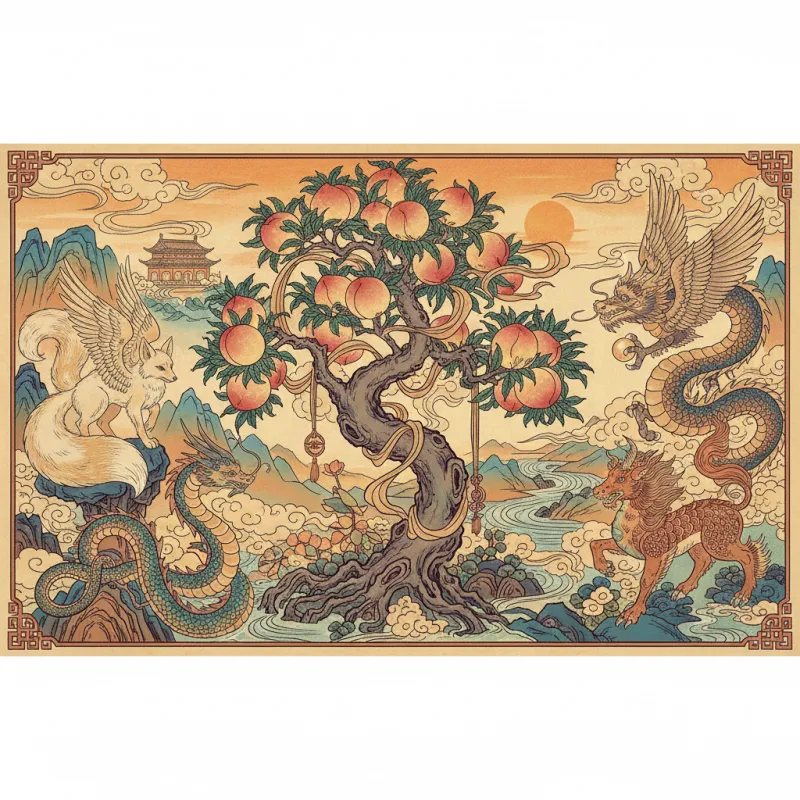
When Sun Wukong, the Monkey King, crashed the Queen Mother's birthday banquet in Heaven, he didn't just steal wine and wreck furniture. He devoured an entire garden of peaches that had taken nine thousand years to ripen. The gods were furious not because of the theft itself, but because those peaches represented something no amount of celestial power could replace: time made edible.
The Peaches of Immortality (蟠桃 pántáo) are the most famous fruits in Chinese mythology, and for good reason. They appear in the Classic of Mountains and Seas, dominate key scenes in Journey to the West, and have become shorthand in Chinese culture for longevity, divine favor, and the kind of cosmic privilege that makes mortals weep. But these aren't just magical MacGuffins. The peach mythology reveals how ancient Chinese thinkers understood time, hierarchy, and the relationship between humans and the divine.
The Garden at the Edge of the World
The Peaches of Immortality grow in the garden of the Queen Mother of the West (西王母 Xīwángmǔ), a deity whose origins predate organized Taoism itself. Her garden sits atop Kunlun Mountain (昆仑山 Kūnlún Shān), the axis mundi of Chinese cosmology — the mountain that connects earth to heaven, the place where geography becomes theology.
The Classic of Mountains and Seas describes Kunlun as a tiered mountain with jade walls and golden towers, surrounded by weak water that cannot support even a feather. The Queen Mother herself appears in these ancient texts not as the benevolent grandmother figure of later folklore, but as a fearsome deity with a leopard's tail and tiger's teeth. Her garden is not a place of gentle cultivation. It is a fortress of immortality, guarded by the geography itself.
The peach trees in this garden operate on a timeline that makes human agriculture look like a nervous tic. They bloom once every three thousand years. They fruit three thousand years after that. And they ripen three thousand years later still. A single harvest cycle takes nine millennia — longer than all of recorded human history.
The Three-Tiered System of Eternal Life
Not all immortality peaches are created equal. According to Journey to the West and elaborated folk traditions, the garden contains three distinct tiers of trees, each offering a different grade of eternity:
The front garden grows 1,200 trees with small fruits that ripen every three thousand years. Eat one of these and you become an immortal, a xian (仙), with enhanced vitality and a lifespan measured in centuries. You're no longer bound by mortal decay, but you're still subject to cosmic hierarchy and heavenly bureaucracy.
The middle garden contains 1,200 trees with medium fruits that ripen every six thousand years. These peaches don't just extend life — they grant you the ability to fly and achieve spiritual transcendence. You become a true celestial being, capable of cloud-riding and transformation. The difference between tier one and tier two is the difference between living forever and living forever with style.
The back garden, the most exclusive section, holds 1,200 trees with large purple-striped fruits that ripen every nine thousand years. Eat one of these and you become as eternal as heaven and earth themselves. Your lifespan becomes coterminous with the universe. You are no longer just immortal — you are cosmically permanent.
This tiered system reveals something crucial about Chinese conceptions of immortality: it's not binary. There are grades of eternal life, hierarchies of transcendence. Even among the deathless, some are more deathless than others.
The Monkey Who Ate Eternity
Sun Wukong's theft of the peaches is the most famous scene involving these fruits, and it's worth examining in detail because it's not just comedy — it's theological rebellion.
In Journey to the West, the Jade Emperor (玉皇大帝 Yùhuáng Dàdì) appoints Sun Wukong as the Guardian of the Peach Garden, thinking this will keep the troublesome monkey occupied. It's the celestial equivalent of making the fox guard the henhouse. Sun Wukong discovers the garden's secret, realizes he's been given access to the ultimate cosmic cheat code, and proceeds to eat his way through thousands of years of carefully cultivated immortality.
He doesn't just eat the ripe ones. He eats peaches from all three tiers. He gorges himself on millennia. When the Queen Mother discovers the theft and organizes her famous Peach Banquet (蟠桃会 Pántáo Huì) — a celebration held once every six thousand years where the peaches are distributed to worthy immortals — Sun Wukong crashes that too, drinks all the wine, eats the pills of immortality from Laozi's furnace, and becomes so thoroughly immortal that he's essentially unkillable.
The story is funny, but it's also radical. Sun Wukong, a stone monkey born outside the system, steals the carefully rationed immortality that the celestial bureaucracy uses to maintain its hierarchy. He democratizes eternal life by eating it all himself. No wonder it took Buddha himself to stop him.
Peaches in the Shanhaijing Tradition
While Journey to the West made the peaches famous, their roots go deeper. The Classic of Mountains and Seas mentions various immortality-granting plants, including trees on distant mountains whose fruits extend life or grant supernatural abilities. The peach specifically appears in connection with the Queen Mother of the West, though the early texts are characteristically cryptic about details.
What's fascinating is how the peach became the fruit of choice for immortality. In Chinese culture, peaches have long been associated with longevity and vitality. The peach wood was believed to ward off evil spirits. Peach blossoms symbolized spring and renewal. The fruit itself, with its soft flesh and hard pit, suggested the relationship between the mortal body and the immortal soul.
The mythological peaches of Kunlun take these associations and amplify them to cosmic proportions. They're not just symbols of long life — they are long life, condensed into edible form. They transform the abstract concept of immortality into something you can taste, something with texture and sweetness, something that takes nine thousand years to ripen but only moments to consume.
The Peach Banquet and Celestial Politics
The Queen Mother's Peach Banquet is more than a party — it's a political institution. Every six thousand years, she invites the worthy immortals, gods, and celestial officials to her garden for a feast. The peaches are distributed according to rank and merit. It's a reminder that even in heaven, immortality is rationed, controlled, and used to maintain hierarchy.
The banquet appears in numerous Chinese novels and operas, always as a scene of celestial splendor and often as a site of conflict. In Journey to the West, Sun Wukong's exclusion from the guest list is what triggers his rampage. In other stories, the banquet becomes a stage for divine politics, romantic intrigue, and cosmic drama.
The banquet also reveals something about how Chinese mythology understands time. For mortals, six thousand years is incomprehensible. For immortals, it's the interval between parties. The peaches create a temporal rhythm for heaven itself, a cosmic calendar marked not by seasons but by the ripening of fruit.
Modern Echoes and Cultural Persistence
Walk into any Chinese home during a birthday celebration, especially for an elderly relative, and you'll likely see peach imagery everywhere. Peach-shaped buns (寿桃 shòutáo), peach decorations, paintings of the Queen Mother holding a peach. The mythological fruit has become the universal symbol of longevity wishes.
The peaches appear in everything from classical paintings to modern video games. They show up in Chinese New Year decorations, in the symbolism of traditional medicine, in the names of longevity-focused products. The nine-thousand-year ripening cycle has been compressed into a cultural shorthand: peaches mean long life.
What's remarkable is how the specific mythology has remained intact even as it's been popularized. People still know about the three tiers, about the Queen Mother's garden, about Sun Wukong's theft. The story hasn't been simplified into vague symbolism — it retains its narrative specificity, its cosmic geography, its theological implications.
The Fruit That Measures Eternity
The Peaches of Immortality work as mythology because they make the abstract concrete. Immortality is a difficult concept — infinite time, endless existence, life without death. But a peach that takes nine thousand years to ripen? That's something you can imagine. That's time made visible, eternity made edible.
They also reveal the fundamental tension in Chinese immortality mythology: the desire for eternal life versus the cosmic order that rations it. The peaches are abundant — 3,600 trees in total — but they're carefully controlled, distributed according to hierarchy, used to maintain celestial bureaucracy. Sun Wukong's theft is revolutionary precisely because he bypasses this system entirely.
In the end, the Peaches of Immortality are more than magical fruits. They're a meditation on time, power, and the relationship between the mortal and the divine. They're the reason the Queen Mother's garden is the most coveted real estate in Chinese mythology. And they're proof that sometimes the most profound theological concepts come wrapped in the sweetness of a single, perfectly ripened fruit.
Just don't let any stone monkeys near them.
Related Reading
- Unearthing the Mythical Flora in Shanhaijing: A Journey Through Legendary Plants
- Lingzhi: The Mushroom of Immortality from Myth to Medicine — Shanhai Perspective
- The Bizarre Plants of the Shanhaijing: Trees That Cure Death and Fruits That Grant Flight — Shanhai Perspective
- Mythical Plants of the Shanhaijing: Trees That Grant Immortality and Flowers That Kill — Shanhai Perspective
- Magical Plants of the Shanhai Jing: Trees That Grant Immortality — Shanhai Perspective
- Shanhaijing Cosmology: How Ancient China Imagined the Universe
- Fenghuang: The Chinese Phoenix and Its True Meaning
- Nuwa Creates Humanity from Clay