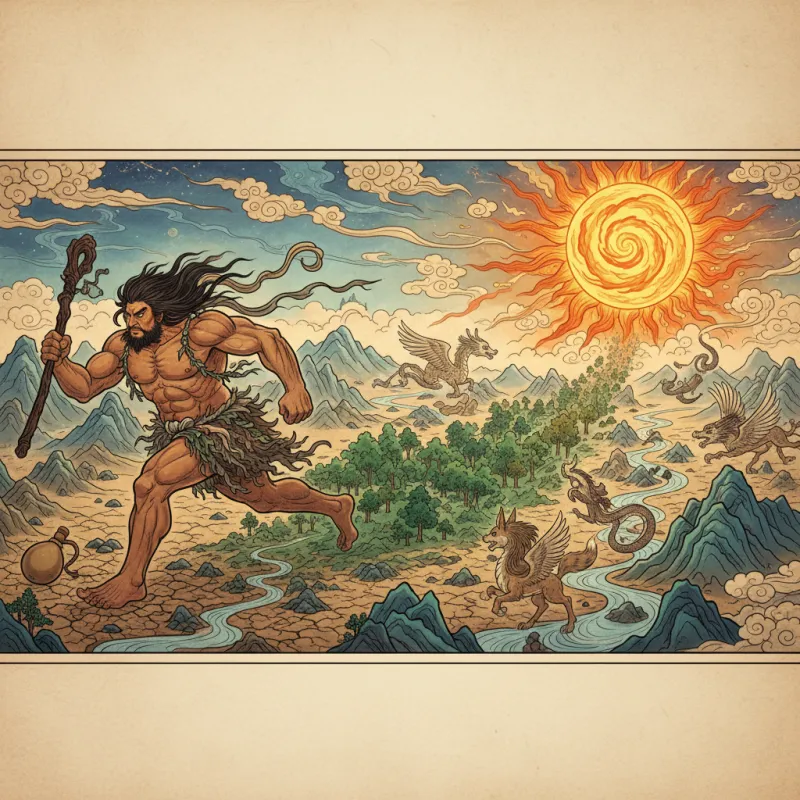
The giant's shadow stretched across mountains as he ran, each footfall shaking the earth like thunder. Kuafu (夸父, Kuāfù) wasn't fleeing—he was chasing the sun itself, driven by a thirst so profound it would reshape the landscape of Chinese mythology forever. This isn't just another tale of hubris punished; it's a story about the terrible beauty of impossible ambition, preserved in the Shanhaijing (山海经, Shānhǎijīng, Classic of Mountains and Seas) as a monument to humanity's most dangerous virtue: the refusal to accept limits.
The Giant Who Wouldn't Stop
Kuafu belonged to a race of titans mentioned in the Shanhaijing's "Overseas North Classic" section, beings who existed in that murky time before the world settled into its current form. The text describes him with startling economy: a giant who decided to race the sun to its setting point. No elaborate motivation, no divine mandate—just a creature who looked at the sun's daily journey and thought, "I can catch that."
What makes Kuafu different from other mythological overreachers is the physicality of his quest. He wasn't trying to steal fire like Prometheus or build a tower to heaven like the Babel builders. He was running, pure and simple, his massive legs eating up distance as the sun rolled across the sky. The Shanhaijing tells us he caught up with it at Yugu (禺谷, Yúgǔ), the Valley of the Setting Sun, somewhere in the mythical far west. For one impossible moment, the giant and the celestial body stood face to face.
The Thirst That Swallowed Rivers
Here's where the story turns from epic to tragic. Having reached the sun, Kuafu discovered what any creature would discover in that position: the heat was unbearable. His body, pushed beyond all limits, demanded water. Not a cup, not a stream—rivers. The text specifies that he drank the Yellow River (黄河, Huáng Hé) dry. Still thirsty, he drained the Wei River (渭河, Wèi Hé).
Think about that image: a giant so parched from his cosmic chase that he empties two of China's major waterways in gulps. The Shanhaijing doesn't waste words on his suffering, but you can feel it in the escalation. One river isn't enough. Two rivers aren't enough. He turns north, heading for the Great Marsh (大泽, Dàzé), but his body finally fails him. Kuafu collapses and dies before reaching that final source of water, his quest incomplete by mere miles.
The Forest That Grew From Failure
Most mythological punishments end with the transgressor suffering eternal torment or being erased from existence. Kuafu's story takes a different turn. When he died, his walking staff—the tool that had supported him through his impossible journey—fell to the ground and transformed into a peach grove called Deng Lin (邓林, Dèng Lín). The Shanhaijing presents this transformation matter-of-factly, but it's one of the most poignant images in Chinese mythology.
The staff becomes a forest of peach trees, offering shade and fruit to future travelers. Kuafu's failure produces sustenance. His death creates life. This isn't divine mercy or cosmic justice—it's transformation, the idea that even doomed quests leave something valuable behind. The peach trees don't memorialize Kuafu's success; they memorialize his attempt, providing comfort to others who might undertake their own impossible journeys.
Reading Kuafu Across Dynasties
Later Chinese scholars couldn't leave Kuafu's story alone. During the Han Dynasty, writers began interpreting the chase as an allegory for drought—Kuafu representing the earth's desperate need for water during dry seasons. By the Tang Dynasty, poets like Li Bai referenced Kuafu as a symbol of noble futility, the kind of magnificent failure that's more admirable than cautious success.
The Qing Dynasty scholar Yuan Mei took a different view in his Zi Bu Yu (子不语, Zǐ Bù Yǔ), suggesting Kuafu represented humanity's scientific impulse, the drive to understand celestial mechanics even when the tools don't exist yet. This reading feels anachronistic but captures something true: Kuafu wasn't being irrational. He saw a phenomenon (the sun's movement) and tried to interact with it directly. That's not madness—it's empiricism taken to its logical extreme.
The Giant in Modern Context
Kuafu's story resonates differently now than it did in the 4th century BC. We've actually sent machines to touch the sun—NASA's Parker Solar Probe passes through the solar corona, enduring temperatures that would have made Kuafu's thirst look quaint. We've mapped the cosmos, split atoms, and decoded genomes. In some ways, we're all Kuafu now, chasing impossible goals with inadequate tools, hoping our failures will at least plant forests for those who come after.
The story also speaks to climate anxiety in ways the original authors couldn't have imagined. A giant draining rivers, dying of thirst, the sun as an adversary rather than a benefactor—these images feel uncomfortably contemporary. Kuafu's chase might have been mythological, but the relationship between human ambition and environmental limits is playing out in real time.
Compare Kuafu to other mythological strivers like Jingwei filling the sea or Gonggong breaking the pillars of heaven, and you see a pattern in Chinese mythology: the celebration of futile persistence. These aren't cautionary tales warning against hubris. They're complicated meditations on what it means to attempt the impossible, knowing you'll fail, and doing it anyway because the attempt itself matters.
The Staff and the Forest
I keep coming back to that peach grove. The Shanhaijing doesn't explain why the staff transforms or what it means. It just happens, the way things happen in the oldest stories—without justification or moral framing. But that transformation suggests something profound about failure and legacy.
Kuafu didn't catch the sun. He didn't even reach the Great Marsh. By any objective measure, he failed completely. But his staff—the thing that supported him through his doomed quest—became something that supports others. The tool of his failure became a gift to future travelers. That's not consolation or compensation. It's transformation, the idea that our most spectacular failures might contain our most valuable contributions.
The peach trees of Deng Lin still appear in Chinese poetry and painting, a forest that exists in imagination if not geography. They represent the strange math of mythology, where one giant's death equals countless fruits, where individual failure produces collective benefit, where the journey matters more than the destination even when the journey kills you.
Why We Still Need Giants
Kuafu's story survives because it captures something essential about human nature: we chase things we can't catch. We always have. We always will. The sun still rises and sets, indifferent to our ambitions, but we keep running anyway, driven by thirst—for knowledge, for achievement, for meaning, for something beyond the ordinary limits of existence.
The Shanhaijing preserves Kuafu not as a warning but as a witness. He testifies to the grandeur of impossible ambition, the dignity of spectacular failure, and the strange alchemy that turns a dead giant's walking stick into a forest of peach trees. In a mythology filled with immortals and sages who transcend human limitations, Kuafu stands out precisely because he doesn't transcend anything. He runs, he thirsts, he dies. And somehow, that's enough to make him immortal.
Related Reading
- The Shanhaijing's Heroes: Mortals Who Challenged Gods and Won (Mostly)
- Gun and Yu: Father and Son Who Tamed the Great Flood
- Houyi Shoots the Suns: The Archer's Sacrifice
- Houyi the Archer: The Hero Who Shot Down Nine Suns
- Kuafu Chases the Sun: The Giant Who Ran After Light
- Kunlun Mountain: The Paradise at the Center of the World — Shanhai Perspective
- Mystical Beasts of the Shanhaijing: A Journey Through Myth and Geography
- Exploring the Myths of Serpents in the Shanhaijing: Creatures of Power and Mystery