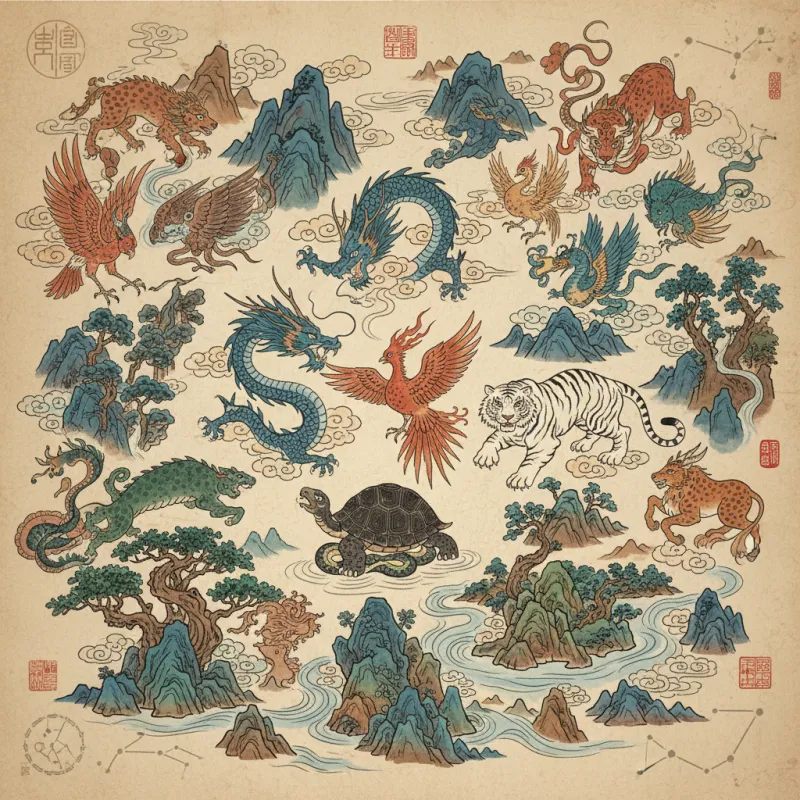
Picture this: You're standing at the center of an ancient Chinese palace, and carved into the four walls around you are creatures so powerful that emperors believed they could command the very forces of nature. A dragon coils to your left, a tiger prowls to your right, a bird spreads crimson wings before you, and behind, a serpent-tortoise hybrid watches with ancient eyes. These aren't just decorative motifs—they're the Four Guardians, divine beasts whose influence shaped everything from battlefield formations to bedroom furniture placement for over two thousand years.
The Celestial Compass: Understanding the Four Symbols
The Four Guardians, known collectively as Sìxiàng (四象, literally "Four Symbols" or "Four Phases"), represent far more than directional markers. They embody the Chinese cosmological view that the universe operates through balanced, cyclical forces. Each guardian corresponds to one of the cardinal directions, but also to a season, an element from Wu Xing theory, a color, and even specific constellations in the night sky.
What makes these creatures particularly fascinating is their origin in actual astronomical observation. During the Warring States period (475-221 BCE), Chinese astronomers divided the celestial sphere into four quadrants, each containing seven lunar mansions (宿, xiù). The twenty-eight mansions formed patterns that, with considerable imagination, resembled these four creatures. The Azure Dragon constellation dominated the eastern sky during spring evenings, while the White Tiger appeared in the west during autumn—a correlation that ancient observers interpreted as cosmic confirmation of these beasts' power.
Azure Dragon: The Awakening Force of Spring
Qīnglóng (青龙), the Azure Dragon, guards the East and embodies the explosive energy of spring. But here's what most simplified accounts miss: this isn't the same dragon that became the imperial symbol of China. The Azure Dragon is specifically associated with the wood element and the color qīng—a term that encompasses blue, green, and even black depending on context. Ancient texts describe it as having the body of a snake, the scales of a fish, the claws of an eagle, and antlers of a deer.
In the Huainanzi (淮南子), a philosophical text from the 2nd century BCE, the Azure Dragon is called Meng Zhang (孟章), meaning "Great Clarity" or "Beginning of Growth." This name captures its essence perfectly—it represents the moment when yang energy begins to dominate yin, when seeds crack open, when life returns after winter's death. In feng shui practice, the left side of any space (when facing outward from the center) is the dragon side, and it should ideally be higher than the right to ensure prosperity and protection. This is why traditional Chinese homes often had a slightly elevated left wing or a tall tree planted on that side.
The Azure Dragon's influence extends into Chinese astrology and divination, where it governs the seven eastern mansions: Horn, Neck, Root, Room, Heart, Tail, and Winnowing Basket. The Heart mansion (心宿, Xīn Xiù), marked by the star Antares, was considered the dragon's vital organ—when it appeared low on the horizon, ancient Chinese believed the dragon was "sick," portending drought or disaster.
White Tiger: Autumn's Fierce Protector
Báihǔ (白虎), the White Tiger, commands the West with an energy that's simultaneously protective and destructive. Associated with autumn, metal, and the color white (which in Chinese culture represents both purity and death), the White Tiger embodies the declining yang energy as the year moves toward winter. But calling it merely a "tiger" undersells its complexity—ancient depictions show it with wings, sometimes breathing wind or frost.
The Shanhaijing itself doesn't extensively detail the White Tiger as a guardian, but references to white tigers appear throughout, often as omens. In the "Classic of the Western Mountains" section, white tigers are mentioned as creatures inhabiting remote peaks, their appearance signaling either great fortune or impending war. By the Han Dynasty (206 BCE - 220 CE), the White Tiger had been fully incorporated into the Four Guardians system, with the name Jian Bing (监兵), meaning "Supervisor of Soldiers."
Here's where it gets interesting: the White Tiger became associated with military might and was painted on shields and banners. However, its fierce energy was considered dangerous if unbalanced. In feng shui, the right side (tiger side) should be lower than the left (dragon side) because an overly strong tiger brings violence and conflict. I've visited traditional courtyard homes in Beijing where the western wing was deliberately built lower, and elderly residents could still explain the reasoning—"You don't want the tiger to overpower the dragon."
The White Tiger governs seven western mansions, including Legs, Bond, Stomach, Hairy Head, Net, Turtle Beak, and Three Stars. When these constellations aligned in certain ways, military campaigns were launched or postponed. The famous general Zhuge Liang reportedly consulted the White Tiger's position before major battles during the Three Kingdoms period.
Vermilion Bird: Not Your Average Phoenix
Zhūquè (朱雀), the Vermilion Bird, guards the South and represents summer, fire, and the color red. Let's clear up the most common misconception immediately: the Vermilion Bird is NOT a phoenix (凤凰, fènghuáng). The phoenix is a separate mythological creature associated with the empress and marital harmony. The Vermilion Bird is a celestial guardian, often depicted with a snake in its beak, representing the peak of yang energy when the sun reaches its highest point.
The character 朱 (zhū) specifically means "vermilion" or "cinnabar red"—the color of fire, blood, and life force. Ancient texts describe the Vermilion Bird as having seven-colored plumage that shimmers like flames, and its cry was said to sound like jade chimes. Its alternative name, Ling Guang (陵光), means "Soaring Light," emphasizing its association with the blazing southern sun.
What fascinates me about the Vermilion Bird is its connection to fire-breathing creatures and solar mythology across Chinese texts. In Daoist alchemy, the Vermilion Bird represents the heart and the fire element within the human body. Practitioners of internal alchemy (内丹, nèidān) would visualize the Vermilion Bird to cultivate their inner fire and transform base energies into spiritual essence.
The seven southern mansions under the Vermilion Bird's domain—Well, Ghost, Willow, Star, Extended Net, Wings, and Chariot—were considered the most auspicious for summer activities. Farmers would plant certain crops when the Ghost mansion (鬼宿, Guǐ Xiù) appeared, believing the Vermilion Bird's energy would ensure abundant growth.
Black Tortoise: The Mysterious Northern Guardian
Xuánwǔ (玄武), the Black Tortoise, is perhaps the most enigmatic of the Four Guardians. Guarding the North, associated with winter, water, and the color black, Xuánwǔ is actually a composite creature—a tortoise entwined with a snake. The name itself is revealing: 玄 (xuán) means "mysterious" or "dark," while 武 (wǔ) means "martial" or "warrior." This isn't a passive, slow-moving tortoise—it's a warrior of the deep, representing the hidden power of winter and the depths.
The origin story of Xuánwǔ is stranger than most realize. According to Daoist mythology, Xuánwǔ was originally a prince who refused to inherit his father's throne, instead retreating to the Wudang Mountains to cultivate the Dao. After achieving enlightenment, he removed his stomach and intestines (representing earthly desires), which transformed into a demon tortoise and snake. He then had to defeat and tame these creatures, which became his servants and eventually merged into the composite form we know today.
By the Song Dynasty (960-1279 CE), Xuánwǔ had become so revered that Emperor Zhenzong declared the creature a deity, building temples in its honor. However, because the character 玄 (xuán) was part of the emperor's personal name, it was considered taboo to use it, so Xuánwǔ was temporarily renamed Zhēnwǔ (真武), meaning "True Warrior." This is why you'll see both names in historical texts.
The Black Tortoise governs the seven northern mansions: Dipper, Ox, Girl, Emptiness, Rooftop, Encampment, and Wall. These constellations were visible during winter evenings, and their appearance marked the time when yang energy was at its weakest, hidden beneath the earth like seeds waiting for spring. In feng shui, the north side of a property should ideally have a hill or mountain (representing the tortoise's shell) to provide protection and stability.
Beyond the Four: The Center and the Cosmic Balance
While the Four Guardians dominate discussions of directional deities, traditional Chinese cosmology actually includes a fifth direction: the center. This is governed by the Yellow Dragon (黄龙, Huánglóng) or sometimes the Qilin (麒麟), representing earth, balance, and the emperor himself. The Yellow Dragon doesn't appear in the Shanhaijing as prominently as the Four Guardians, but its importance grew during the imperial era when yellow became the exclusive color of the emperor.
The Five-Direction system (五方, wǔfāng) reflects the Wu Xing (五行) theory of five elements: wood, fire, earth, metal, and water. Each guardian beast embodies not just a direction but a phase in the eternal cycle of transformation. The Azure Dragon's wood feeds the Vermilion Bird's fire; fire creates earth (ash) for the Yellow Dragon; earth contains metal for the White Tiger; metal enriches water for the Black Tortoise; and water nourishes wood for the Azure Dragon again. This isn't just abstract philosophy—it informed everything from agricultural calendars to medical diagnosis to military strategy.
Living Legacy: The Guardians in Modern China
Walk through any traditional Chinese neighborhood today, and you'll still see the Four Guardians at work. They appear on temple roofs, carved into doorways, painted on walls, and even tattooed on bodies. In Taiwan, I once watched a feng shui master spend three hours determining the optimal placement of furniture in a new office, constantly referring to the positions of the dragon and tiger. When I asked if he truly believed in these ancient creatures, he smiled and said, "Belief isn't the point. These are patterns that have worked for thousands of years. Why would I ignore that wisdom?"
The Four Guardians also appear throughout Chinese popular culture, from video games to television dramas to martial arts novels. In the classic wuxia novel Demi-Gods and Semi-Devils (天龙八部) by Jin Yong, the four main characters correspond to the Four Guardians, each embodying their guardian's characteristics. Modern fantasy novels continue this tradition, often depicting the guardians as summonable spirits or martial arts techniques.
What strikes me most about the Four Guardians is their endurance. These aren't dusty museum pieces—they're living symbols that continue to shape how millions of people understand space, time, and their place in the cosmos. Whether you're arranging furniture, planning a garden, or simply trying to understand the deeper patterns in Chinese mythological creatures, the Four Guardians offer a framework that's both ancient and surprisingly relevant.
The next time you see a dragon and tiger motif, remember: you're not just looking at decoration. You're seeing a cosmological map, a philosophical statement, and a protection spell all rolled into one. The Four Guardians aren't just guarding directions—they're guarding an entire way of understanding the universe.
Related Reading
- The Qilin: China's Sacred Unicorn and Divine Messenger
- The Four Symbols: Azure Dragon, White Tiger, Vermillion Bird & Black Tortoise
- Fenghuang: The Chinese Phoenix and Its True Meaning
- Chinese Dragons: Everything You Need to Know
- The Nine-Tailed Fox: From Divine Messenger to Demonic Seductress
- Hetu and Luoshu: The Cosmic Diagrams
- Mystical Beasts of the Shanhaijing: A Journey Through Myth and Geography
- Exploring the Enigmatic Creatures and Lands of Shanhaijing: A Cultural Journey